Community Corner
A History Lesson in the Spirit of Kwanzaa
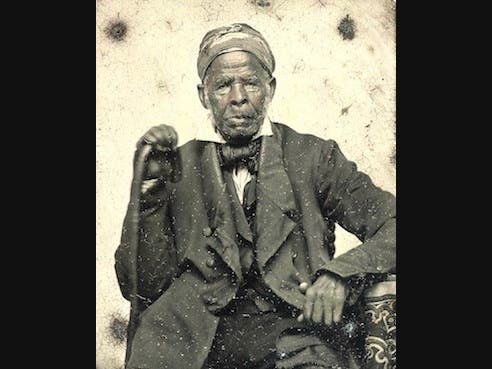
Omar Ibn Said: A Black Enslaved Muslim Scholar Trapped in America

“…O My Lord, advance me in Knowledge!”
(The Holy Qu’ran, 20:114)
“Follow in the footsteps of your ancestors, for the mind is trained through knowledge. Behold, their words endure in books. Open and read them and follow their wise counsel. For one who is taught becomes skilled.”
(The Husia: Sacred Wisdom of Ancient Egypt page 50 Medu Neter’s - the Book of Kheti)
As we approach the celebration of Kwanzaa, it is important we examine an episode of history called slavery in America. For the record, the enslavement of Black people in the U.S. is not the complete history of Black people. People of African descent have a great history before slavery. As we look back at ancient history, we see Black people as the progenitors of humanity and the fathers and mothers of civilization. However, equally important is adequately spending time teaching the facts on the horrific impact and oppressive conditions the American slave experience had on the lives of Black people. The enslavement of Black people in America existed in the United States before the United States won its independence from Great Britain during the American Revolutionary War. Although many Black people fought along side White people to free America from the colonial oppressive tentacles of Great Britain, the majority of White Americans were unwilling to end slavery. As they worked to create a new constitution to govern all of America, White Americans protected slavery with the founding of the U.S. Constitution. The founding fathers, many of them slave owners themselves, argued that the political economy of slavery was completely vital to the survival of America. Therefore, they legally protected slavery with the establishment of the US Constitution in 1789. It took years of moral persuasion activism, slave rebellions, abolitionism, a civil war, and the passing of the 13th Amendment to completely end the physical enslavement of Black people. By 1865, the legal enslavement of Black people was outlawed. However, to really understand the evilness of American slavery, some historians rely on the narratives of enslaved Black people. Overall, slave narratives are really hard to acquire in the halls of scholarship due to America’s stubbornness to acknowledge that early democracy in the U.S. did not apply to Black people and that white supremacy played a significant role in justifying the enslavement of Black people. Over my thirty years of teaching history and Africana Studies (Black Studies) in the Newark, N.J. area, I have been able to get my hands on a few slave narratives. One of them was written by a Black man named Olaudah Equiano. His narrative shows with evidence to my students the horrors of American slavery and the inhumanity of the Middle Passage (the involuntary voyage of Black people from Africa to the U.S. and all over the Americas by White people). However, to find Omar Ibn Said narrative is hauntingly amazing. It’s because he writes his experiences as an enslaved Black man entirely in his native language of Arabic. To make a Black person a slave, White slave owners in America created a policy that prevented people of African descent from knowing their history and culture and speaking in their own languages; or even practicing their own faith traditions (e.g. African spirituality or Al-Islam). Black people in the United States were forced to adopt European names, White American cultural traditions and European English as their language. To find a slave narrative that speaks of the experiences of being an enslaved Black person in America in their own language is an amazing feat. We have that in Omar Ibn Said.
Find out what's happening in Newarkfor free with the latest updates from Patch.
Find out what's happening in Newarkfor free with the latest updates from Patch.
There is no other evidence of enslaved Black people writing about their enslaved experiences in Arabic, or in their own African languages, in the United States. Omar Ibn Said is the first. His memoir shows also the world that this West African was an Islamic scholar trapped in America.
Said wrote his memoir in classical Arabic. Classical Arabic was the indigenous language of his village in West Africa for centuries. Despite American slavery, Said was still able to speak, write, and read in classical Arabic. This is incredible, because when it comes to classical Arabic, most Arabs can not even speak, read, and write in classical Arabic. The Holy Qu’ran is written in classical Arabic. It takes incredible skill to be able to speak, read, write, and comprehend in classical Arabic. Said could perform it all in classical Arabic.
Said was a member of the Fula ethnic group of West Africa who today number over forty million people in the region extending from Senegal to Nigeria. In the interviews he gave during his lifetime he stated that he was born in a place called Futa Toro "between the two rivers" referring to the Senegal and the Gambia rivers that separate those two countries. Said’s father, who was a wealthy man, was killed in an inter-tribal war when he was five, and Said and his family had to move away to another town. In his autobiography, Said writes that as he grew older he sought knowledge in Bundu, an area in Senegal today that had historically been controlled by another ethnic group, the Mande people, until the Muslim Fulas conquered the region in the second half of the 17th century. Said writes that in Bundu he studied under his own brother Sheikh Muhammad Said, as well as two other religious leaders and "continued seeking knowledge for twenty five years." Omar ibn Said then returned to his own town and lived there for another six years, until a "big army" came "that killed many people," captured him and sold him to a man who took him "to the big Ship in the big Sea." After sailing for a month Said arrived in Charleston, South Carolina, where he was bought by a man called Johnson, who apparently was cruel to him. So Said escaped, was captured and landed in jail in Fayetteville, North Carolina, where he spent sixteen days. That is where Said began writing in Arabic on the walls of his jail, and where he was discovered and eventually taken into the household of Jim Owen and his brother John Owen, the Governor of North Carolina (1828-1830) with whom he remained until his death in his late eighties. He converted to Christianity to survive in America.
Said opens his narrative with stinging indictments against the institution of American slavery by quoting the Holy Qur’an’s verse that man can not own another man. Only God owns man.
But based upon the facts of American history, and African / African American history, the White slave owners did not enslave the uneducated and the misinformed. Our students, and the world, must know that the White slave owners enslaved the very best and the brightest of Black people. Unfortunately, white supremacy distorts factual history, especially African / African American history, preventing students the legitimate lens to understand the true picture of the Black experience and the facts of American slavery.
White slave owners enslaved the Black fathers and mothers of human civilization. White supremacy blocks the world from knowing that people of African descent played a major role as contributors to the development of humanity, civilization, and religions.
Another point Said’s memoir makes is the fact that many of the ancestors of Black people in the U.S. and in the Americas were Muslims.
Due to American slavery, we as Black people almost loss a complete knowledge of our own spiritual and cultural traditions. However, thankfully to many Black leaders (i.e. Richard Allen, Paul Cuffe, Sojouner Truth, Denmark Vessey, Nat Turner, Gabrel Prosser, Fredrick Douglass, Harriet Tubman, David Walker, Martin Delaney, Booker T. Washington, Dr. W. E. B. DuBois, H. Sylvester Williams, George Padmore, Dr. Carter G. Woodson, Noble Drew Ali, the Honorable Marcus Mosiah Garvey, the Honorable Elijah Muhammad, Malcolm X, Kwame Nkrumah, the Honorable Minister Louis Farrakhan, Dr Khalid Abdul Muhammad, Father Allah, Huey P. Newton, Bobby Seale, Kathleen Cleaver, Fred Hampton, Dhoruba bin Wahad, Assata Shakur, Kwame Ture’, Imamu Amiri Baraka, Imari Obedele, Queen Mother Moore, Chockwe Lumumba, Arthur A. Schomburg, Dr. Chancellor Williams, Dr. John Henrick Clarke, Dr. Yosef Ben Jochannan, Dr. Jacob Carruthers, Dr. Asa Hilliard, Dr. Leonard Jeffries, Dr. Tony Browder, Dr. Rkhty Amen, Dr. Charshee McIntyre, Dr. George G. M. James, Dr. Edward Scobie, Dr. Molefe Kete Asante, Dr. Cheikh Anta Diop, Theophile Obenga, Dr. Mario Beatty, Dr. Greg Carr, Sista Souljah, etc) that led liberation struggles against White cultural supremacy throughout our sojourn in America. One of those leaders that rose up to continuously wage a cultural war against the White domination of Black people in America is Dr. Maulana Karenga.
He came forward to establish Kwanzaa as a pathway to the rebuilding of the African world community by acquiring the knowledge of self (African / African American history) and the goodness of strong ethical values to create a new revolutionary African culture for Black liberation.
In Los Angeles, California, Dr. Karenga became a respected community freedom fighter in the turbulent 1960s. He was born Ronald McKinley Everett, but later change his name to Maulana Karenga.
This was the era of a national Black Freedom struggle; which consisted of the civil rights and Black power movements. By 1966, the Black Power movement came on the scene capturing the imagination of the masses of Black people. It produced several leading organizations, such as the Original Black Panther Party and the Us organization.
The Original Black Panther Party was founded in Oakland, California on October 15, 1966 by Dr. Huey P. Newton and Bobby Seale. It’s political philosophy was rooted in revolutionary Black nationalism. The Original Black Panther Party organized our people for Black unity against racial and class oppression in the United States. Most importantly, this organization mobilized the African American community against the pervasive problems of police brutality.
But before the establishment of the Original Black Panther Party, a Black nationalist organization had already formed in Los Angeles, California. Dr. Karenga founded the Us Organization on September 7, 1965. It’s political philosophy was based upon cultural Black nationalism. The Us organization unified Black people to fight against the Eurocentric cultural and political hegemony on African American life in America.
Karenga, a voracious reader, was awarded his first PhD in 1976 from United States International University (now known as Alliant International University) for a 170-page dissertation entitled "Afro-American Nationalism: Social Strategy and Struggle for Community". Later in his career, in 1994, he was awarded a second Ph.D., in social ethics, from the University of Southern California (USC), for an 803-page dissertation entitled "Maat, the moral ideal in ancient Egypt: A study in classical African ethics."
As a advocate for pan African self -determination, Dr. Karenga created a Black nationalist political and cultural empowerment philosophy called Kawaida. It is a Kiswahili word meaning "tradition" and "reason," pronounced ka-wa-EE-da. Dr. Karenga defines Kawaida as, "a communitarian African philosophy created in the context of the African American liberation struggle and developed as an ongoing synthesis of the best of African thought and practice in constant exchange with the world." Kawaida became the foundation for Kwanzaa - a non religious pan-African centered holiday celebrated from December 26 to January 1.
According to Dr. Karenga’s book on Kwanzaa called, Kwanzaa: A Celebration of Family, Community and Culture, on page 114 he writes, “the word Kwanzaa comes from the Kiswahili phrase “matunda ya kwanza” which means “first-fruits.” Kwanzaa’s extra “a” evolved as a result of a particular history of the Organization Us. It was done to as an expression of African values in order to inspire the creativity of our children. In the early days of Us, there were seven children who each wanted to represent a letter of Kwanzaa. Since kwanza (first) has only six letters, we added an extra “a” to make it seven, thus creating “Kwanzaa.”
Amy Mckeever of the National Geographic Magazine published a history article on the American racist conditions that created Kwanzaa. Her article was printed on December 22, 2020. She writes, “Kwanzaa was founded in 1966, a year after a historic rebellion rocked the Watts neighborhood of Los Angeles, California. Frustrated by years of abuse at the hands of police and crushed by poverty, the community protested and rioted. The unrest lasted a week and left 34 people dead and 1,000 injured. In the weeks after the Watts rebellion, Maulana Karenga—an activist and leader in the Black Power Movement—founded the Us Organization to rebuild the neighborhood and promote a Black cultural revolution that would inspire pride in Black history and achievements, long dismissed and suppressed by the dominant white culture. From the beginning, the plan was to create a holiday for African Americans to honor their African roots and reaffirm their cultural connections. Kwanzaa was also envisioned as a secular alternative to the holiday juggernaut that is Christmas. To establish the traditions of the new holiday, Karenga drew upon a pan-African set of cultural symbols and practices. In particular, he believed that the annual harvest festivals—in which communities came together to celebrate the fruits of their collective labor—were an apt model for building family, community, and culture.”(https://www.nationalgeographic... ).
Dr. Karenga chose the African continental pan African language of Kiswahili to connect and communicate Kwanzaa’s rituals and principles of the holiday nationalistically to the Black world.
In Kwanzaa, Mishumaa Saba (Kiswahili for seven candles) are used to represent the Nguzu Saba. Seven candles are placed in a Kinara (Kiswahili for candle holder). There must be three red candles, thee green candles, and one Black candle. The kinara is placed on top of the Mkeka (Kiswahili for a woven mat). The colors of the candles represent the colors of the Black liberation flag. Additionally, the Black liberation bandera (Kiswahili for flag) is placed by the Kwanzaa display. The Black liberation colors represents the following: red is for the innocent shedding of African blood, Black is for African people all over the world, and green is for mother Africa. The Black Liberation Flag was created by the Honorable Marcus Mosiah Garvey in 1920. He was a legendary pan-African nationalist. Garvey established a Black nationalist organization called the U.N.I.A. (The Universal Negro Improvement Association). To this day, he orchestrated the largest back to Africa movement in the history of the world. Unfortunately, Garvey’s movement was destroyed by the United States government. However, his legacy and ideology are found in contemporary Black nationalist circles and celebrations.
Also in Kwanzaa, two other symbols are used to complete the holiday ceremony. The mazao (Kiswahili for corn) represents the harvest and Muhindi (Kiswahili for corn) represents children and the future.
On first day of Kwanzaa, the black candle is lit first. Then, the green candle to the left is lit on day two. Next, the red candle is lit on day three. The rest of candles are lit for each principle of that day until all seven are complete.
In Kwanzaa, each day represents a principle of the Nguzu Saba (Kiswahili for seven principles). For example, day 1 of Kwanzaa, one says Habari Gani (Kiswahili for what's the news). The response must be Umoja (Kiswahili) for unity-to strive for and maintain unity in the family, community, nation, and race. But on the first day of Kwanzaa, family and community gather to pay homage to our African ancestors. We pass the kikombe cha umoja (Kiswahili for unity cup) around to everyone. Participates can literally or symbolical drink from the cup. Then, we take the remains of the water to pour libation (water) into a plant or on the earth. As the names of our ancestors are called, the person designated to lead the liberation will say Ibaye (Yoruba for blessings to the ancestors). The response from the audience’s is Ase (Yoruba for so be it).Day 2 of Kwanzaa, one says Harbari Gani. The response must be Kujichagulia (Kiswahili) for self-determination-to define ourselves, name ourselves, create for ourselves and speak for ourselves instead of being, name, created for and spoken for by others. Day 3 of Kwanzaa, one says Harbari Gani. The response must be Ujima (Kiswahili) for collective work and responsibility- to build and maintain our community together and make our sister's and brother's problems our problems and to solve them together. Day 4 of Kwanzaa, one says Habari Gani. The response must be Ujamaa (Kiswahili) for cooperative economics-to build and maintain our own stores, shop and other businesses and to profit from them together. Day 5 of Kwanzaa, one says Habari Gani. The response must be Nia (Kiswahili) for purpose-to make our collective vocation the building and developing our community in order to restore our people to their traditional greatness. Day 6 of Kwanzaa, one says Habari Gani. The response must be Kuumba (Kiswahili) for creativity-to do always as much as we can, in the way we can, in order to leave our community more beautiful and beneficial than we inherited it. Also on the sixth day, the Karamu (Kiswahili for feast) takes place and zawadi (Kiswahili for gifts) are exchanged. Day 7 of Kwanzaa, one says Habari Gani. The response must be Imani (Kiswahili) for faith-to believe with all our heart in our people, our parents, our teachers, our leaders, and the righteousness and victory of our struggle. Additionally, on the last day of Kwanzaa, a farewell address is read. Then, the family and community perform seven harambe (Kiswahili for people pulling together).
Since the first Kwanzaa was celebrated on December 26, 1966 in Los Angeles, California, the holiday has spread to millions of over the globe.
Dr. Karenga is currently the Chair of the Africana Studies (Black Studies) department at the California State University, Long Beach, the founder of a Black cultural nationalist organization called the Us Organization, and the co-founding member of ASCAC (the Study of Classical African civilizations).
In closing, we must study history, especially African / African American history, to understand the present to move forward to make a better future for Black people and humanity.
As Salaamu Alaykum wa Rahmatullahi wa Barakaatuh (Arabic for May the peace, mercy, blessings of God be upon you)!
&
Hotep (an ancient African Kemetic / Egyptian word for Peace)!
-Bashir Muhammad Ptah Akinyele is a community activist, a member of the Muslim community in New Jersey, and a member of ASCAC (the Association for the Study of Classical African Civilizations). He is also a history and Africana Studies (Black Studies ) teacher at Weequahic High School in Newark, NJ.