Neighbor News
Kawaida and Afrikan Centricity : Foundations for Freedom
"The most powerful thing Europeans did to us was the colonization of our minds." -Dr. John Henrick Clarke



Hotep (An Afrikan Word for Peace)!!!
Take notes!!!!!!!!!!
Kawaida and Afrocentricity are two of the most important philosophical foundations for the redevelopment of an Afrikan centered world-view. They both work to help liberate Black people from all forms of White domination.
Find out what's happening in Newarkfor free with the latest updates from Patch.
Dr Maulana Karanga, Professor of Black Studies at California State University at Long Beach. He co-founded the Us Organization-a revolutionary cultural nationalist Black Power movement established on September 7, 1965 in Los Angeles, California. Dr. Karenga is also the creator of Kawaida. It is a Kiswahili word meaning "tradition" and "reason," pronounced ka-wa-EE-da. He defines Kawaida as, "a communitarian African (Afrikan) philosophy created in the context of the African (Afrikan) American liberation struggle and developed as an ongoing synthesis of the best of African (Afrikan) thought and practice in constant exchange with the world." Kawaida is the foundation for Kwanzaa - An Pan Afrikan centered holiday celebrated from December 26 to January 1. Each day represents a principle of the Nguzu Saba (Kiswahili for seven principles) of Kwanzaa. For example, day 1 of Kwanzaa, one says Habari Gani (Kiswahili for what's the news). The response should be Umoja (Kiswahili) for unity-to strive for and maintain unity in the family, community, nation, and race. Day 2 of Kwanzaa, one says Harbari Gani. The response should be Kujichagulia (Kiswahili) for self-determination-to define ourselves, name ourselves, create for ourselves and speak for ourselves instead of being, name, created for and spoken for by others. Day 3 of Kwanzaa, one says Harbari Gani. The response should be Ujima (Kiswahili) for collective work and responsibility- to build and maintain our community together and make our sister's and brother's problems our problems and to solve them together. Day 4 of Kwanzaa, one should say Habari Gani. The response should be Ujamaa (Kiswahili) for cooperative economics-to build and maintain our own stores, shop and other businesses and to profit from them together. Day 5 of Kwanzaa, one should say Habari Gani. The response should be Nia (Kiswahili) for purpose-to make our collective vocation the building and developing our community in order to restore our people to their traditional greatness. Day 6 of Kwanzaa, one should say Habari Gani. The response should be Kuumba (Kiswahili) for creativity-to do always as much as we can, in the way we can, in order to leave our community more beautiful and beneficial than we inherited it. Day 7 of Kwanzaa, one should say Habari Gani. The response should be Imani (Kiswahili) for faith-to believe with all our heart in our people, our parents, our teachers, our leaders, and the righteousness and victory of our struggle.
Dr. Molefe Kete Asante, Professor of Afrikan American Studies at Temple University and the creator of the concept of Afrikan centricity (Afrocentricity). He defines Afrocentricity (Afrikan centricity) as " the centerpiece of human regeneration. To the degree that it is incorporated into the lives of millions of Africans on the continent and in the Diaspora, it will become revolutionary. It is purposeful, giving a true sense of destiny based upon the facts of history and experience. The psychology of the African without Afrocentricity (Afrikan centricity) has become a matter of great concern. Instead of looking out from one's own center, the non-Afrocentric person operates in a manner that is negatively predicable. The person's images, symbols, lifestyles, and manners, are contradictory and thereby destructive to personal and collective growth and development.” These two ideological concepts are necessary pillars for a cultural, religious, and the political liberation of Black people in America, in Afrika, and in the Afrikan world community still in the grips of White supremacy and racism.
Find out what's happening in Newarkfor free with the latest updates from Patch.
In the Black community, we have experienced hundreds of years of oppression in the forms of slavery, colonialism, and segregation. White supremacy, the system of racism, created pseudoscience and scholarship to justify the White racial domination of Black people. Dr. Asa Hilliard, the great Afrikan centered scholar, writes in his book, The Maroon Within Us: Selected Essays on African American Community, says “few Americans have any idea just how intentional systematic, intensive, prolonged and widespread was the defamation process directed toward African people and the descendants of African people all over the world during the slavery, colonial, and racism periods. They are generally unaware of the role that (White) scholarship played.” White supremacists and racists scholars, and intellectuals, such as Benjamin Franklin, Thomas Jefferson, David Hume, George Curvier, Abraham Lincoln, Arnold Toynbee, George Wilhelm Friedrich Hegel, Richard Burton, Samuel Baker, George F. Will, and P. T. Bauer presented to the world that Black people were subhuman beings without a history and a culture.
Although, by the late twentieth century, we were physically free, many us were scared mentally by White oppression. Unfortunately, for many of us, our minds are still enslaved. Many us have internalize our oppression. Some of us have begun to justify our own enslavement. One of the biggest way to escape the realities of White supremacy and racism in the world is through western religions. But as we fully embrace western religions, many of us become Europeanized and Arabized in our quest to become Jews, Christians, and Muslims. To fight this process, some of people embrace western religions, but make it a form of Black liberation theology. Afrikan centrists make western religions relevant to Black people’s fight for empowerment and freedom. Unfortunately, some us have not accepted this Afrikan centered approach to faith traditions. They reject it feverishly. Some even try to discredit it all together just like racist White people do to Black people's religions, philosophy and ideology. This is because, some of our people have not freed their minds of White or Arab oppression. Some of us Black folks are physically free from slavery, but mentally we are Europeanized or Arabized. Therefore, some of us cannot see in own mind Black people creating our own spiritual allegories, myths, and folk tales in Western religions to empower and liberate Black people from White oppression.
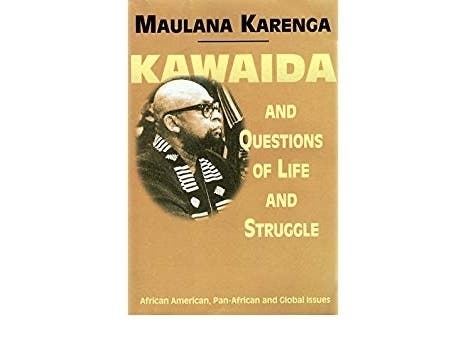
In his book called, Kawaida And Questions of Life And Struggle, Dr. Maulana Karenga writes, “cultural revolution or struggle is key to the preparation and process of any other revolution or struggle. Until we break the monopoly the oppressor has on our minds, liberation is not only impossible, it’s unthinkable. For what you can’t conceive you can’t achieve.” If we do not have an Afrikan centered consciousness, we cannot see the value of Black people, Afrikan culture, Afrikan folk tales, Afrikan allegories, Afrikan perspectives, Afrikan history, Afrikan languages, and our our Afrikan experiences. We without a liberated mind, Black lives will not matter to us.
For a deeper analysis, let me give you an example of a brother who is not looking at faith traditions from Afrikan centered perspective folks. These is a Black Sunni Muslim brother that continuously fights people about the Nation of Islam theology on social media. But before we get into a discussion on Black people and western religions, a brief history of Al- Islam in America must be invoked to understand the growth of Al-Islam within the Black community.
According to the Honorable Minister Louis Farrakhan, a man came to the Western Hemisphere to save a people lost in the world due to slavery. He said, he believes that with the permission of Allah, Master Fard Muhammad, the founder of the Nation of Islam, came from Makkah, Saudi Arabia to North America to liberate oppressed Black people in 1930 with Al-Islam and Black nationalism from White racial domination. He said he stayed until Allah blessed him with his greatest student. The Honorable Louis Farrakhan said that the brother's name was the Most Honorable Elijah Muhammad. He said that Master Fard Muhammad taught the Most Honorable Elijah Muhammad many things, such as Afrikan History, European history, American history, Native American history, racism, White supremacy, Black self -hatred, oppression, agriculture, health, food science, women's history, fatherhood, motherhood, politics, economics, military sciences, politics, government, and theology. But the Honorable Minister Louis Farrakhan said that he required the Most Honorable Elijah Muhammad to read and study 104 books on Al-Islam. The Honorable Minister Louis Farrakhan said that the Honorable Elijah Muhammad said to him that his favorite book was the Holy Qu'ran. But Most Honorable Minister Louis Farrakhan said that the Most Honorable Elijah Muhammad said to him that before I teach Islam to Black people, they must first have a thorough knowledge of their Black selves and Black pride. The Honorable Minister Louis Farrakhan said that when Master Fard Muhammad left North America in 1933, the Honorable Most Elijah Muhammad was made the leader of the Nation of Islam. In turn, he taught his Ministers the lessons Master Fard Muhammad taught him in the early days of the Nation of Islam. But two of the most important lessons the Most Honorable Elijah Muhammad taught his Ministers was that Al-Islam and Black Nationalism. Unfortunately, the White power structure became threatened by the Honorable Elijah Muhammad and the Nation of Islam movement in the Black community. Racist Whites in America, and in the world, worked night and day, to destroy the Nation of Islam and it's Afrikan centered Black consciousness. After the departure of the Most Honorable Elijah Muhammad in 1975, his son Wallace Muhammad, who would later change his name to Imam Warith Deen Mohammed, took over the reign of leadership. The son of the Most Honorable Elijah Muhammad moved the Nation of Islam into Sunni Al-Islam. In 1978, disagreeing with the direction of Imam Warith Deen Mohammed, the Honorable Minister Louis Farrakhan left Sunni Al-Islam to rebuild the teachings of the Honorable Elijah Muhammad and the Nation of Islam. By 1980, the Honorable Minister Louis Farrakhan became the leader of the Nation of Islam. Once again, the Nation of Islam grew to a massive movement in the 1980s, 1990s, and early 2000s for Al-Islam and Black nationalism.
Now back to our discussion on Black people and western religions. I know many people of other faiths fight over theological differences all the time, but this one is a teachable moment for Black people, particularly Black people involved in western religions and Afrikan spirituality. It speaks to why Kawaida and Afrikan centricity are very important to the development Black life in America and in the world. Here is what was said few days ago. The Black Sunni Muslim brother said to me on social media, “These Negroes worship a Caucasian Arab as God in person, so how is that "Building the Black Community"??? NOI (Nation of Islam), ENDED WITH THE BIRTH OF IMAM W. D. MUHAMMAD, AND WAS BURIED IN 1975 AND IS NEVER TO RETURN, NO MATTER HOW HARD PREACHER FARRAKHAN TRIES, TO TALK ABOUT UFO FLYING SAUCERS.” I said back to my brother, “all western religions have created their own allegories, folk tales, and myths, such as Adam and Eve creation story, the Great Flood, Jewish slave labor building the Pyramids, the exodus of Jews out of Kemet (Egypt), Moses parting the Red Sea, Jonah surviving in a belly of a whale, Daniel in the lions’ den, David and Goliath, the immaculate conception of the Biblical Jesus, the resurrection of the Biblical Jesus, and the Angel Jabril visiting Prophet Muhammad (Peace Be Upon Him) in a cave in Saudi Arabia. The Nation of Islam is no different from all western religions and faith traditions. Most of these allegories, folk tales, and myths have their roots in Afrikan spirituality. However, religious allegories, folk tales, and myths have no artifacts to prove that they really existed in human history. We must know the difference between human history and religious history. That’s why our devotion to religious and spiritual faiths traditions are centered on beliefs and not actual scientific and historical facts. However, all religions have their right to create and believe in their allegories, folk tales, and myths. There are great lessons about life, and ideas on the after-life, behind them my brother. We should not totally discard them my brother. However, we must know the that western religions have their root origins in Afrikan spirituality. But just like western religions have their right to create and believe in their allegories, folk tales, and myths, so does the Nation of Islam. If Nation of Islam believes in UFOs and God coming in the person of Master Fard Muhammad to help liberate Black people from White domination, so what family. That is their God, human and Afrikan right to create and believe in their own allegories, folk tales, and myths. Their religious allegories, folk tales and myths are valuable lessons for Black people, and humanity, to learn the Nation of Islam theology Blackman. God coming in human form to save Black people from 400 years from White racist oppression is a great story about hope, change, and freedom. Just like there are lessons to be learned in Afrikan spiritual systems, such as the Nation of Gods and Earths (the 5% Nation of Islam), the Yoruba, and Kemetic faith traditions; these faiths traditions have great lessons for Black people and humanity. Western religions have created great lessons for humanity, and for Black people, but we must continuously challenge these faith traditions to include Black people, Afrikan history, Afrikan culture, Afrikan images, and the Black liberation struggle. Unfortunately, dear brother you, and many of us, have not liberated ourselves from the White domination of Black people. White supremacy, and the system of racism, are still dictating and determining the way we view, worship, believe, and practice our religions and spirituality, particularly Black religions and Black spirituality."
Again without an Afrikan-centered perspective, that is rooted in Kwaida and Afrikan centricity, on western religions; we as Black people will not make these faiths relevant to our experiences and to Black liberation. This is why Dr. Molefe Kete Asante, the author of Afrocentricity, argues that we must approach western religions from an Afrikan centered perspective. If we don't, our identities and values as Afrikan people will be destroyed. He writes, " the most crippling effect of Islam as well as Christianity for us may well be the adoption of non-African (Afrikan) customs and behaviors, some of which are in direct conflict with our traditional values. We out Arab the Arabs as we have out Europeanized the European from time to time. This is not so with Afrocentrist (Afrikan centrist). He or she studies every thought, action, behavior, and value. and if it cannot be found in our culture or in our history, it is dispensed with very quickly. This is not done because we have something against someone's culture; it is just not ours. We do not have too many complaints with the person who decides to accept someone else's culture, religion, or ideology; be it Islam Christianity, or Marxism, if it serves him better than our own. However, for us it is impossible to see how anything from outside ourselves can compare with what is in our history. We have a formidable history, replete with the voice of God, the ancestors, and the prophets. Our manner of dress, behavior, walk, talk, and values are intact and workable when we are Afrocentric (Afrikan centric). Our problems come when we lost sight of ourselves, accept false doctrines, false doctrines, false Gods, mistaken notions of what is truly in our history, and assume an individualistic, anti-humanistic, and autocratic posture."
In closing, I state these things to show the world that White supremacy, and racism, are still dominating Black life in America and in the Afrikan world community. These systems of Whiteness devalues Black lives. Unfortunately, many times we fall victim to these systems of whiteness. Then we, in turn, begin to be used by White supremacy, and racism, to discredit our own Black religious faith traditions like the Nation of Islam, the Nation of Gods and Earhts (the 5% Nation of Islam), or the Yoruba faith, or the Kemetic spiritual system. As a consequence of 400 years of the Maafa (Kiswahili for the force scattering of Black people in Afrika to the world / Enslavement of Black people / the Black Holocaust) years of the Arab Slave Trade, nearly a hundred years of segregation, and nearly a hundred years of European colonialism in Afrika, many of our people have been totally Europeanized or Arabized. Dr. John Henrick Clarke, the great historian of Afrikan descent, says, “the most powerful thing Europeans did to us was the colonization of our minds.” This is why philosophically, Kawaida and Afrikan centricity are absolute necessary in the Black liberation struggle against White domination. Kawaida and Afrikan centricity will help us re-center our minds to a Afrikan world view to re-value, reconstruct, and rescue Black people interpreting the world from a White and non-Afrikan centered perspective in theology, religions, philosophy, ethics, morals, economics, history, education, family life, scholarship, manhood, womanhood, marriages, and politics.
Hotep!!!
-Bashir Muhammad Akinyele is a History Teacher, Black Studies Teacher, Community Activist, Chairperson of Weequahic High School's Black History Month Committee in Newark, NJ, commentary writer, and Co-Producer and Co-Host of the All Politics Are Local, the number #1 political Hip Hip radio show in America.
Note: Spelling Afrika with a k is not a typo. Using the k in Afrika is the Kiswahili way of writing Africa. Kiswahili is a Pan -Afrikan language. It is spoken in many countries in Afrika. Kiswahili is the language used in Kwanzaa. The holiday of Kwanzaa is celebrated from December 26 to January
1.
#Hotep
#afrocentricity
#nationofislam
#kemet
#blackthelogy
#kwanzaa
#blackstudies