Arts & Entertainment
New HYCIDE Magazine Turns Lens on Inner-City Life
Akintola Hanif launches new magazine, focused on the artist's perspective
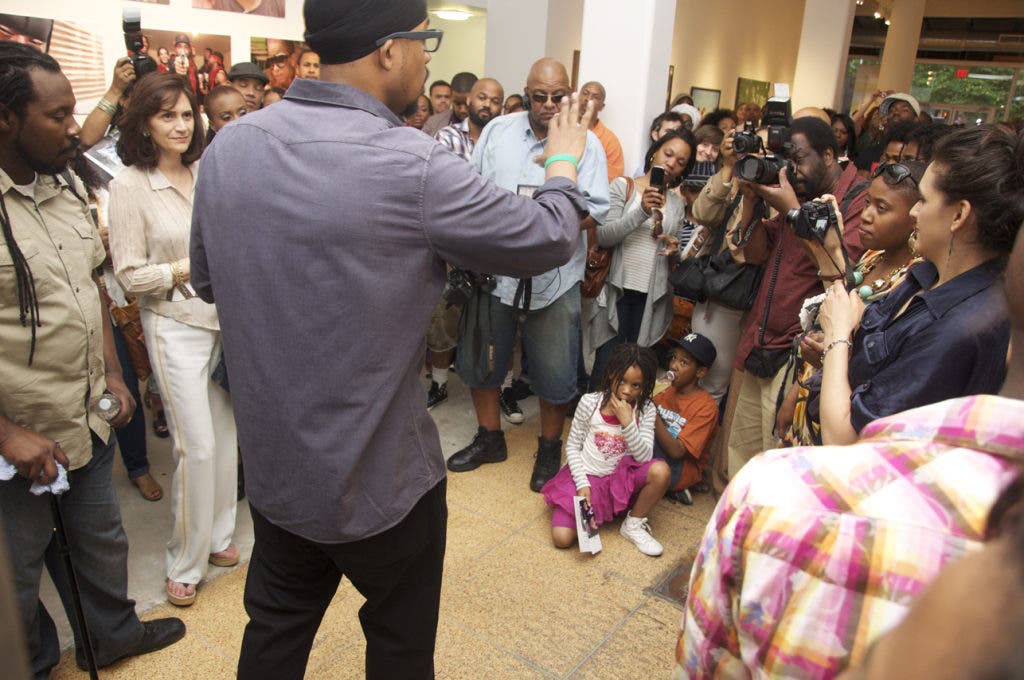


Amiri Baraka, the famed poet and political activist from Newark — and father of South Ward Councilman Ras Baraka — joined members of the local art community who gathered at the Aljira gallery Friday to celebrate the launch of online arts and culture magazine HYCIDE.
Renowned photographers Jamel Shabazz and Ernie Paniccioli were also in attendance, lending their support to a project they see as picture perfect.
"It’s about time there was a magazine for, by, and about an artist perspective," said Paniccioli, who lives in Jersey City.
Find out what's happening in Newarkfor free with the latest updates from Patch.
For Paniccioli, the event called up memories of Newark’s 1980s "Art Without Walls,"a progressive gallery that brought together young graffiti artists and encouraged them to display their work for the community.
"I was here then, it was a beautiful thing," he said. "This magazine is in that same spirit. It’s what’s needed now."
Find out what's happening in Newarkfor free with the latest updates from Patch.
HYCIDE magazine is the brainchild of Akintola Hanif, a photographer and filmmaker who mostly turns his lens on inner-city life. The magazine’s tagline is "Subculture, Art, Conflict." Hanif’s subjects dwell in housing complexes, underground havens, or are otherwise relegated to the shadows of society.
Within the pages of HYCIDE's inaugural issue, former Star-Ledger reporter Carrie Stetler explores the nuanced world of "aggressive" lesbians, who challenge society’s ideas of gender roles; writer Fayemi Shakur spins the Doomsdayer’s end-of-the-world claims into a call to action; and cultural critic Michael Gonzales examines the crack-cocaine era and what is left in its wake.
While there was an artist painting live on location, the exhibit’s photos were ripped from the pages of HYCIDE. There are arresting images of gang members, laughing kids, a shrine dedicated to a boy slain in a drive-by (whose family was in attendance), and other snapshots of life unseen.
"My intention is to show the common thread that exist within us all," said Hanif, a former graffiti artist, who later studied photography. "A lot of people have misunderstood, overlooked or stigmatized and classified (people) through ignorance. So I have taken it upon myself to be a spokesperson for these people. I was with these people before I started taking these pictures. These are more than my subjects these are my people. I feel like I've got to rep for my people. That's what I’m trying to do with my work."
This night, Hanif's message of inclusion and understanding was well received.
"In the 'hood, a lot of times we get myopic, we focus on survival only," said Asen James, who grew on Nye Avenue and met Hanif as a young graffiti artist. "The presence of art and exposure to these type of events helps the people in the 'hood think outside their situation. You never know who would be walking by and see all this and be intrigued."
One such person is David Reeves, an independent music producer who was coming from work at UPS when he decided to take a closer look.
"When I walked by, I asked what was going on. They told me," said Reeves. "I wish I would have known about it, I would have promoted it myself. I support the arts. There are a lot of people I know that would love to be here."
Before the night ended, Amiri Baraka lent his voice to the celebration, reciting the poem "Wise I," a short piece about slavery and the difficulty of breaking free. His finish was met with a rousing round of applause, before more mingling and refreshments. According to Baraka, the night offered a snapshot of what Newark's art scene could once again become.
"I was born in Community Hospital on W. Kinney Street. I was raised everywhere in this city from Douglass Harrison Apartments to the west ward and the south ward. Everywhere," he said. "I saw Charlie Parker play on Clinton Avenue. Like that. Back then, it was all here. Everybody who was in New York was here first."
He looked around at the photos on the wall and the people now milling about. "It's a small impact for now but if people will sustain it, it will be all worthwhile."
Click here to check out HYCIDE magazine.