Community Corner
Newark HS Teacher Reviews ‘Radical’ Book: ‘Revolution Pedagogy’
A Newark educator offers a summary of the book, "Revolutionary Pedagogy," by Dr. Molefi Kete Asante.


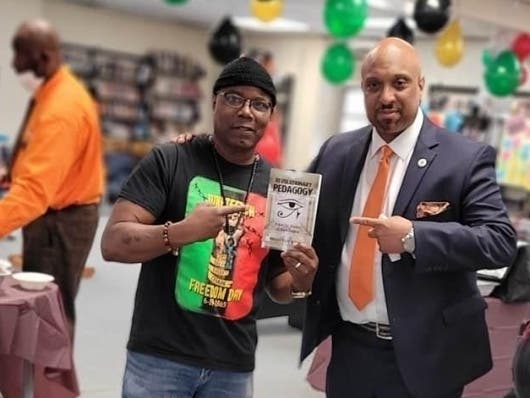


NEWARK, NJ — The following article comes courtesy of Bashir Muhammad Ptah Akinyele, a history and African studies teacher at Weequahic High School. Learn more about posting announcements or events to your local Patch site.
A Summary of Revolution Pedagogy: Primer for Teachers of Black Children, by Bashir Muhammad Ptah Akinyele
(I will use African and Black interchangeably for people of African descent)
Find out what's happening in Newarkfor free with the latest updates from Patch.
I have finished reading Dr. Molefi Kete Asante’s book, “Revolutionary Pedagogy: Primer for Teachers of Black Children.”
Revolutionary Pedagogy was given to educators at Weequachic High School in Newark, NJ as gift for Teacher Appreciation Week by our principal-Mr. Kyle G Khalik Thomas-to read. As an African-centered educator on the teaching and learning of history and Africana Studies for nearly 30 years, the title Revolutionary Pedagogy pricked my interest immediately. I spent several weeks devouring the wisdom of the book. I found Revolutionary Pedagogy to be phenomenal. This book is on the cutting edge of a new radical method of teaching and learning strategies for the 21st century classroom. For educators, you must add Revolutionary Pedagogy to your summer reading list. It teaches you how to make your lesson plans Ma’atic (an African kemetic / Egyptian term for balance) to reflect the actual facts on African people’s contributions to history, English, world languages, science, government, philosophy, religion, theology, the development of nation-states, architecture, medicine, mathematics, as the progenitors of humanity, and as the fathers and mothers of civilization. Let’s be clear, Revolutionary Pedagogy is not perpetuating racism in Black face. The book teaches educators that your lesson plans must also reflect the actual facts on the contributions all human beings made to the development of civilization in their respected points in human history. Unfortunately, white racists did not, and do not, see themselves on equal footing with all human beings, especially Black people. For nearly 300 years, white racists fabricated racial myths about the superiority of Europeans to justify the enslavement, oppression and exploitation of Black people and people of color in America and in the world. In European dominated societies, the classroom became the place for white supremacist indoctrination of the minds of all people, particularly Black people. However, In the millennium, revolutionary educators are in a protracted struggle to correct white supremacy in the classroom by teaching the facts on the history of America and the history of the world. Scholars call this new way of teaching-revolutionary pedagogy. It demands educators to devise lesson plans that will constantly challenge white supremacy in every classroom in America, and in the world, to develop a human mind liberated from a racist and self hatred consciousness left over by centuries of the white domination of African people and people of color on the planet earth.
Find out what's happening in Newarkfor free with the latest updates from Patch.
Here is my summary of the book Revolutionary Pedagogy by Dr. Molefi Kete Asante.
Let’s start with page 17. Dr. Asante defines what the term Revolutionary Pedagogy means. He writes, “Revolutionary Pedagogy is a philosophy of education that seeks to overturn ordinary thinking, methods, and practice of creating and delivering knowledge to children by employing Africological, Kemetological, and rhetorical techniques to reset the instructional focus for children. Africological refers to the study of African and African American history, cultures, and phenomena from the standpoint of Africans as subjects. By kemetological I refer to the origin of the African narrative in classical Egypt, that is, Kemetic society. These ideas are especially centered on changing the way urban schools approach instruction in a radical way.”
What Dr. Asante has said is absolutely necessary to creating lesson plans rooted in equality. The nclusiveness of the history of Black people, Indigenous people, Asians, and Latinos in the human experience sets the stage to challenge white supremacy at its core in the classroom. On page 26, Dr. Asante elaborates on the depth institutionalized racism goes to be biased towards people of color, particularly Black people. He writes, “grounded in the doctrine of European supremacy the educational system promotes a mono-cultural insistence in education that reduces all other cultural expressions to footnotes or pop ups.”
Out of all the cultures in America, and in the world, the African has been the most damage race by white supremacy. Therefore, teachers must include in their lessons plans at every school during each school year the knowledge of self in the classroom.
Inspired by the intellectual greatness of the late Harvard trained historian Dr. Carter G. Woodson (he is known in history as the Father of Black History), Dr. Asante argues that to keep Black people in a constant state of oppression in America, and in the world, the western school system intentionally omits the knowledge of self.
On page 55, Dr Asante, writes, “Carter G. Woodson’s The Mis-Education of the Negro established the principals that influenced both the Afrocentric and revolutionary pedagogy of this era (Woodson, 2013). First published in 1933, Woodson’s classic book revealed the fundamental problems with the education of the African person in America to be the lack of the knowledge of self. Since this is the first knowledge that is required to be sane and stable, the lack of it meant that African Americans were educated against themselves. Indeed as Woodson understood the African American was to love the traditions and ideas of other people and cultures and consequently we were only attached to the fringes of European culture.”
Dr. Asante further writes on 56, “education for Woodson was at the top of the ladder for renewal and revolution. He saw that the elite class of educated blacks had betrayed the community by running after European culture and ideas more than recovering and reconstructing their own. He was disappointed at the African American colleges because they were so deeply entrenched in the European ideology of white superiority that they simply became imitated of what had oppressed Africans.”
Further down the page of Revolutionary Pedagogy, Dr. Asante demands that teachers must not wait for the system to educate Black students, teachers must educate African children right away on the knowledge of self right now. He writes, “a revolutionary pedagogy that would lift others urges Native Americans, Mexican American, Asian Americans, and others who see their cultures underrepresented and misrepresented in the system of education to join the transformation of the system. Yet the African American community cannot and must not wait to begin the immediate implementation of the principles of a revolutionary pedagogy wherever we can. Our children are under severe stress and are psychologically harmed by the education that they are receiving.”
On page 88, Dr. Asante gives teachers our marching orders on how to tear down the walls of white supremacy in the classroom. He writes, “here is what a revolutionary pedagogy must do:
-It must challenge the educational vision perpetuated by the oppressive system of racism;
-It must defend students from the self-hatred that invades their sprits;
-It must play a role in supporting agency for those who have been marginalized by the system of education in terms of concepts, themes, and curricular ideas.
It must demonstrate methods for combatting agency reduction in the academy; and it must counteract and contradict negations of African agency and narratives.”
He further writes, “In this respect revolutionary pedagogy opposes the sexist and racist indoctrination that is often a serious component of the curricula of American education.”
On the last page of Revolutionary Pedagogy, Dr. Asante ends his book by saying to the teacher that creating Afrocentric and cultural responsive lesson plans will establish an environment in the classroom inviting Black students and students of every race to feel conformable learning at the school. He writes, “the revolutionary pedagogist leaps to end all forms of discrimination based on false premises of race, gender, religion, class, and fashion.”
Revolutionary pedagogy sounds nice intellectually, but it will be a struggle for many teachers to implement revolutionary pedagogy. Western and American school systems are overall hostile to anything that will change the educational program. We must approach revolutionary pedagogy with caution. But despite the system fighting against revolutionary teachers, many teachers still worked to establish revolutionary pedagogy in the classroom at the threat of loosing their jobs and tenure. Revolutionary educators must be careful teaching truth to power.
Way back at the beginning of the book on page 13, Dr. Asante gives all revolutionary pedagogists a cautionary warning. He writes, “however let me caution the teachers who are ready to try this revolutionary pedagogy. Administrators tend to lag behind what is going on the classroom; few are revolutionaries themselves because they are too busy socializing to keep their positions that they are afraid to explore what works.”
However, in the same paragraph on page 13, Dr. Asante writes, the best teachers in a building already know what revolutionary pedagogy is because they are doing it! They have taken the attitude that the core of revolutionary pedagogy is content. They are correct in this assessment because in the end the teacher in the classroom is the educator.”
Unfortunately, many teachers have not received any training in work shops that provide support to educators on the infusions of African history into the school’s curricula in social studies, english, science, and math. Therefore Dr. Asante‘s book gives the educator needed resources for classroom revolutionary pedagogy.
My quote on this area of Revolutionary Pedagogy will be extensive. Please bare with me. This part of the book is absolutely necessary to read to becoming a revolutionary pedagogist. He writes on pages 110 through 116, “teachers rarely get the training they need for revolutionary pedagogy; that is why professional development for teachers is essential. Any school district or school that tries to get ahead without some development work teachers will fail. It is impossible to teach in urban schools districts whether Atlanta or Detroit, San Francisco or San Antonio, without some solid culturally relevant training, preferably revolutionary pedagogy. Here are three foundational blocks of revolutionary pedagogy:
1. Human beings originated on the African continent.
2. All human migration to other parts of the world left from Africa.
3. The originators of geometry, sculpture, medicine, philosophy, and astronomy were Africans.
The reader may be thinking, Why is it necessary to state these assumptions?” Mainly it is necessary because there are many people who still believe that these assumptions are false contrary to the reports of scientists.”
Dr. Asante continues to state the actual facts on Africa being the birthplace of humanity by saying, “as far as scientists know homo sapiens originated in East Africa and spread to the rest of the earth. It is fair to say that before 70,000 years ago all humans were black. Leaving Africa, Homo sapiens made it to the ends of the earth in less than 30, 000 years. When civilization takes hold in the Nile Valley numerous people from Uganda to the Mediterranean Sea added to the narrative of society. Writing, medicine, architecture, domestication of animals, naming of the stars, creation of the calendar and mathematics, became formable foundations for all knowledge. The educator who is able to lock in this information will be able to appreciate the lesson plans that will attach the students to contemporary subjects.”
Dr. Asante further writes, “I have chosen to write the names of some Africans that you may not have heard about, yet they are integral to an understanding and appreciation of African culture and history. Teachers should master several of these names in terms of their historical narrative, their work, and their place in the world.
Menes: The African King who untied 42 communities along the Nile River.
Imhotep: African builder of the pyramid and the first physician.
Amenhotep, son of Hapu: Ancient African who was considered the person “who knew all there was to know.”
Rames II: One of the greatest African monarch’s in history and builder of many monuments.
Thutmoses III: The African who was the conquering king in history.
Hatshepsut: The most prominent African female leader in the ancient world.
Queen Tiye: The African woman who influenced many leaders of the 18th dynasty.
Taharka: one of the greatest African leaders who united Kemet with Nubia.
Cheikh Anta Diop: Considered the greatest African intellectual.
W. E. B. Du Bois: The author of 33 books and the most distinguished African American intellectual of the 20th Century.
Nat Turner: Iconic leader of the 1831 revolt against slavery.
Ahmad Baba: Author of 42 books and the last chancellor of the University of Sankore in Timbuktu.
Cheikh Omar Tall: Born in Futa Toro in the late 18th century he became one of the most important generals fighting against the French.
Kwame Nkrumah: The greatest proponent of Pan Africanism and the first president of Ghana.
Amadou Bamba: The spiritual leader of the Mourrides brotherhood in Senegal.
Sundiata: The most noble name in the gallery of West African empire builders
Nzigha: The queen who led her armies against the Portuguese in the Congo and Angola region.
Hintsa Kakhawuta: The 13th king of the amaXhosa nation led the most powerful kingdom in the Eastern Cape.
Shaka KaSenzangakhona: The great Zulu king who created a mighty martial nation in the early 19th century in Southern Africa.
Paul Robeson: African American singer who was a Civil Rights spokesman in the 20th century.
Nanny of the Maroon: A Jamaica national hero, who was a leader of the maroons who fought the English colonialism in the 18th century.
Zumbia: African Brazilian hero associated with the quilombo that claimed independence from the Portuguese colonialism.
Paul Bogle: Jamaican national hero who fought for the legitimate rights of blacks in Jamaica.
Dessalines: Haitian who defeated Napoleon’s army in 1804.
Abubakari: Malian king who sent hundreds of ships toward the Americas in 1311-12.
Abdias do Nascimento: The most important African Brazilian intellectual and social rights leaders of the 20th century.
Booker T. Washington: Founder of Tuskegee Institute.
Mary McLeod Bethune: Founder of Bethune-Cookman College and founder of the National Council of Negro Women.
Nelson Mandela: First democratically elected president of South Africa.
Yanga: African who led a revolt against the Spanish in Mexico.
Manual Zapata Olivella: One of the most important African Colombian writes of the 20th century.
Mansa Musa: The African emperor who has been called “the richest man in the history of the world.”
Vicente Guerrero: First Mexican president who was the first African descendant president of a North American country.
Baraka Obama: First African American president in the United States.
Kwame Ture: One of the most popular leaders of the Student Nonviolent Coordinating Committee.
Marcus Garvey: Heroic leader of the Universal Negro Improvement Association and African Communities League who organized 10 million blacks.
Langston Hughes: One of the greatest poets of the Harlem Renaissance.
Nicolas Guillen: African Cuban poet who was the national poet laureate of Cuba.
Menelik II: The powerful Ethiopian emperor who defeated the Italian army at Adwa.
Hannibal Barca: African king who led Khart-Haddas against Rome during the 3rd century BC.
These are just a few names that teachers who teach black children should know, just a a matter of course.”
If you are interested in studying more books written by the scholarship of Dr Molefi Kete Asante to fill your library for the teaching of revolutionary pedagogy, here is a short biography on his work.
Dr. Asante is Professor and Chair, Department of Africology and African American Studie at Temple University in Philadelphia. He also serves as the International Organizer for Afrocentricity International and is President of the Molefi Kete Asante Institute for Afrocentric Studies. Asante is a Guest Professor, Zhejiang University, Hangzhou, China and Professor Extraordinarius at the University of South Africa. Asante, often called the most prolific African American scholar, has published 85 books, among the most recent are Radical Insurgencies, The History of Africa, 3rd Edition; The African American People: A Global History; Erasing Racism: The Survival of the American Nation; Revolutionary Pedagogy; African American History: A Journey of Liberation (middle and high school textbook); African Pyramids of Knowledge; Facing South to Africa, and, the memoir, As I Run Toward Africa. Asante has published more than 500 articles and is considered one of the most quoted living African authors as well as one of the most distinguished thinkers in the African world. He has been recognized as one of the 10 most widely cited African scholars. Asante has been recognized as one of the most influential leaders in education. In 2019 the National Communication Association named him an NCA Distinguished Scholar, its highest honor, saying that his writings were “spectacular and profound”. He received his Ph.D. from the University of California, Los Angeles, at the age of 26, and was appointed a full professor at the age of 30 at the State University of New York at Buffalo. At Temple University he created the first Ph.D. Program in African American Studies in 1988. He has directed more than 135 Ph.D. dissertations making him the top producer of doctorates among African American scholars. He is the founder of the theory of Afrocentricity.
In summation, Dr. Asante’s book-Revolutionary Pedagogy: Primer for Teachers of Black Children, is a must read. It will give you as an educator a needed teaching and learning framework for revolutionary pedagogy in the classroom. This book will help you holistically educate students of a various cultures at your school, especially the education of Black students.
Peace!
Hotep!
-Bashir Muhammad Ptah Akinyele is a history and African studies teacher at Weequahic High School in Newark, New Jersey. He is also the co-coordinator for ASCAC's (the Association for Study of Classical African Civilizations) Study Group Chapter in Newark (https://ascac.org/).
Don’t forget to visit the Patch Newark Facebook page. Send local news tips and correction requests to eric.kiefer@patch.com.
Get more local news delivered straight to your inbox. Sign up for free Patch newsletters and alerts.