Weather
Newark Issues ‘Code Red,’ Ugly Heat Wave In Weather Forecast
Be a friendly face and check on your vulnerable neighbors this week – it's about to get hot, Newark safety officials say.


NEWARK, NJ — Be a friendly face and check on your vulnerable neighbors this week – it’s about to get hot, Newark public safety officials say.
Mayor Ras Baraka and Department of Health and Community Wellness Director Ketlen Baptiste Alsbrook announced that the city is issuing a “Code Red” for Thursday to Saturday.
Temperatures are expected to rise into the mid-90s, with a temperature as high as 97 and a heat index as high as 105.
Find out what's happening in Newarkfor free with the latest updates from Patch.
Click here to see a list of local cooling centers that will be open to the public in Newark.
Weather experts say 12 New Jersey counties are under a heat advisory from 11 a.m. Thursday through 6 p.m. Friday. Another five counties - Passaic, Hudson, Bergen, Essex and Union - are under an excessive heat watch from Thursday to Friday evening. Read More: 4 Days Of 90+ Temps In NJ Kick Off This Week (See Timeline)
Find out what's happening in Newarkfor free with the latest updates from Patch.
Meanwhile, severe thunderstorms are in the forecast for New Jersey, complete with hail, damaging winds and even hail as the mercury rises to the mid-90s. Read More: Severe Thunderstorms, 70 MPH Winds In NJ Forecast
“The Health Department urges Newark residents to take precautions to prevent serious illness that can result from extreme heat, especially among the most vulnerable populations such as seniors and those with chronic health problems or mental health conditions,” city officials said in a news release.
“Vulnerable Newark residents should use air conditioning to stay cool, drink water at regular intervals, and limit strenuous activity, especially during the hottest parts of the day,” officials added.
The following information comes courtesy of the City of Newark Press Office.
HOMELESS SHELTERS
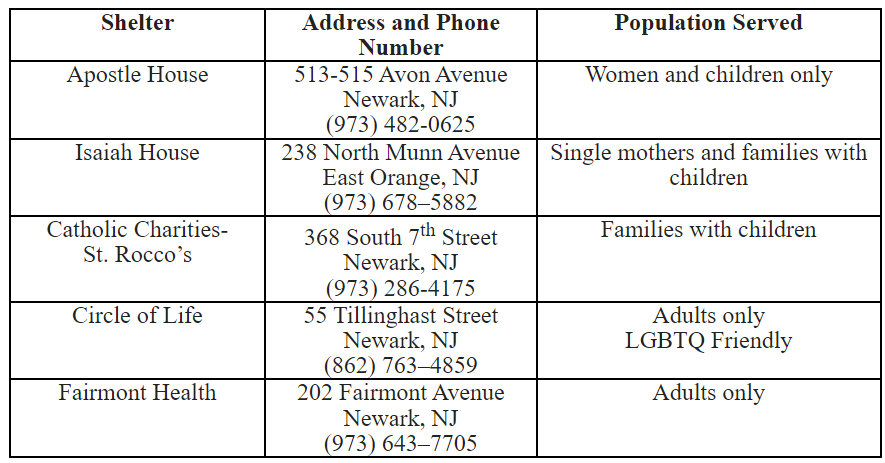
The city is reminding residents that there are emergency shelters operating during extremely hot weather that have collaborated with the city to provide overnight sheltering for residents with no address.
The Office of Homeless Services has contracted with Bridges, Inc. to provide outreach and engagement services to Newark’s homeless population from 3 p.m. to 11 p.m., seven days a week.
Attention is focused on homeless “hot spots” such as Penn Station, city parks, under bridges, and areas off McCarter Highway, etc., especially chronically homeless individuals and those with mental health and substance abuse issues. If you identify homeless individuals in need of services, you can reach Bridges, Inc. at 908-858-7019.
For more information regarding sheltering services, contact the shelters listed below or the Office of Homeless Services at (973) 877- 9481, Monday through Friday, 8:30 a.m. to 4:30 p.m.
CHECK ON THOSE PARTICULARLY VULNERABLE TO THE HEAT
A small, but crucial, gesture can help ensure that we all have a safe and healthy summer. Get to know your neighbors and contact neighbors and relatives—by phone—at least twice a day during heat waves. Pay special attention to the elderly, the very young, and anyone with a pre-existing medical condition. Citizens should also check in on neighbors who may be isolated from friends and family.
HEALTH AND SAFETY TIPS FOR PROTECTION AGAINST THE HEAT
- Air conditioning is the best way to stay cool when it is hot outside. However, some people do not have an air conditioner or do not turn it on when they need it. Newark residents are encouraged to use air conditioning or fans. If air conditioning is unavailable at a residence, please assist those affected to get to a place where it is available.
- Stay out of the sun. This is the quickest way to become overheated. Also, avoid extreme temperature changes.
- Wear lightweight, bright or light-colored clothing to reflect some of the sun’s energy.
- Drink fluids—water is best—even if you do not feel thirsty. Water is also the safest liquid to drink during heat emergencies. This will help your body to maintain a cooler temperature. If you are on a fluid-restricted diet or taking diuretics, please consult your physician first. Avoid beverages containing alcohol and/or caffeine.
- Eat small, frequent, meals.
- Avoid strenuous activity, especially during the sun’s peak hours, which are from 11 a.m. to 4 p.m. If you must perform any strenuous activity, it is advisable to do it during the coolest part of the day, which is in the morning between 4 a.m. and 7 a.m.
- If possible, go to an air-conditioned building for several hours during the hottest parts of the day.
- Cool down with a cool bath or shower.
- Cover all exposed skin with an SPF sunscreen (15 or above).
- Wear a wide-brimmed hat to protect your face and head.
- Use extreme caution in deciding to take an infant outside during extreme heat conditions.
- Be careful not to overdress small children, especially newborns, and infants.
- Never leave children or pets in the car.
The City of Newark will open cooling centers in the five wards when temperatures reach extremely high temperature and humidity levels. You may find the nearest ones by calling (973) 733-4311; go here or follow us on Facebook.
FACTS ABOUT HEAT ILLNESS
Heat illness is serious. Prolonged exposure to the heat can be harmful and potentially fatal. The added stress caused by heat can also irritate heart or lung disease even without symptoms of heat illness. The risk for getting sick during a heat wave is increased for people who:
- Do not have or do not use air conditioning
- Are age 65 or older
- Have chronic medical or mental health conditions
- Take certain medications, which can disrupt the regulation of body temperature
- Are confined to their beds, have trouble with being mobile, or are unable to leave their homes
- Are overweight
- Consume alcohol or illegal drugs
Know the warning signs of heat stress! If you or someone you know feels weak or faint, go to a cool place and drink water. If there is no improvement, call a doctor or 911.
Please call 911 if you or someone you know begins exhibiting two or more of the following symptoms:
- Hot dry skin OR cold clammy skin
- Trouble breathing
- Rapid heartbeat
- Confusion, disorientation, or dizziness
- Nausea and vomiting
KEEPING YOUR PETS SAFE
The summer months can be just as uncomfortable for pets as it is for humans. Pets are affected by humidity as much as the ambient hot temperatures. Follow these tips for keeping them comfortable during the heat advisory.
- Avoid dehydration: Pets can dehydrate quickly, so give them plenty of fresh, clean water.
- Exercise early and late: When the temperature is very high, do not let your dog linger on hot asphalt. Your pet’s body can heat up quickly, and sensitive paw pads can burn.
- Know when your pet is in danger: Symptoms of overheating in pets include excessive panting or difficulty breathing, increased heart and respiratory rate, drooling, mild weakness, stupor, or even collapse. Animals with flat faces like Pugs and Persian cats are more susceptible to heat stroke since they cannot pant as effectively. They should be kept cool in air-conditioned rooms as much as possible.
- Never leave a pet inside of a parked car on a hot day. Even with the open windows, extreme temperatures inside a parked car could quickly lead to a fatal heat stroke for your pet.
- Keep cats safe by installing screens in your windows. Unscreened windows pose a real danger to cats, who fall out of them often during summer months.
- Prepare your pet emergency “go bag:” Pet food, water, medications and supplies should always be included in your emergency preparedness plans and “go bags.”
Send local news tips and correction requests to eric.kiefer@patch.com. Learn more about advertising on Patch here. Find out how to post announcements or events to your local Patch site. Don’t forget to visit the Patch Newark Facebook page.
Get more local news delivered straight to your inbox. Sign up for free Patch newsletters and alerts.