Politics & Government
Newark Public Library Celebrates Improvements to Accessibility
New ramps installed as part of $1.4 million allocated for upgrades


Just trying to get into the Newark Public Librarywas an ordeal for Edward A. Kopelson.
Whenever the Montclair attorney had to attend a meeting for the library's Board of Trustees, which he serves as counsel, Kopelson had to go through the back of the Washington Street building, guide his wheelchair through a steep ramp, and call ahead for library workers to unlock a series of doors.
"Oh God, it was very, very difficult," he said. "It was a very indirect, trying experience to get in and out."
Find out what's happening in Newarkfor free with the latest updates from Patch.
But now, Kopelson can wheel himself in through the front doors via a new granite ramp that has been constructed as part of an ambitious $1.4 million project to make the library and its branches accessible.
"It is an awakening experience when you get through the ramp and get into the awesome rotunda atrium, which creates an atmosphere for book-learning," he said. "It looks beautiful."
Find out what's happening in Newarkfor free with the latest updates from Patch.
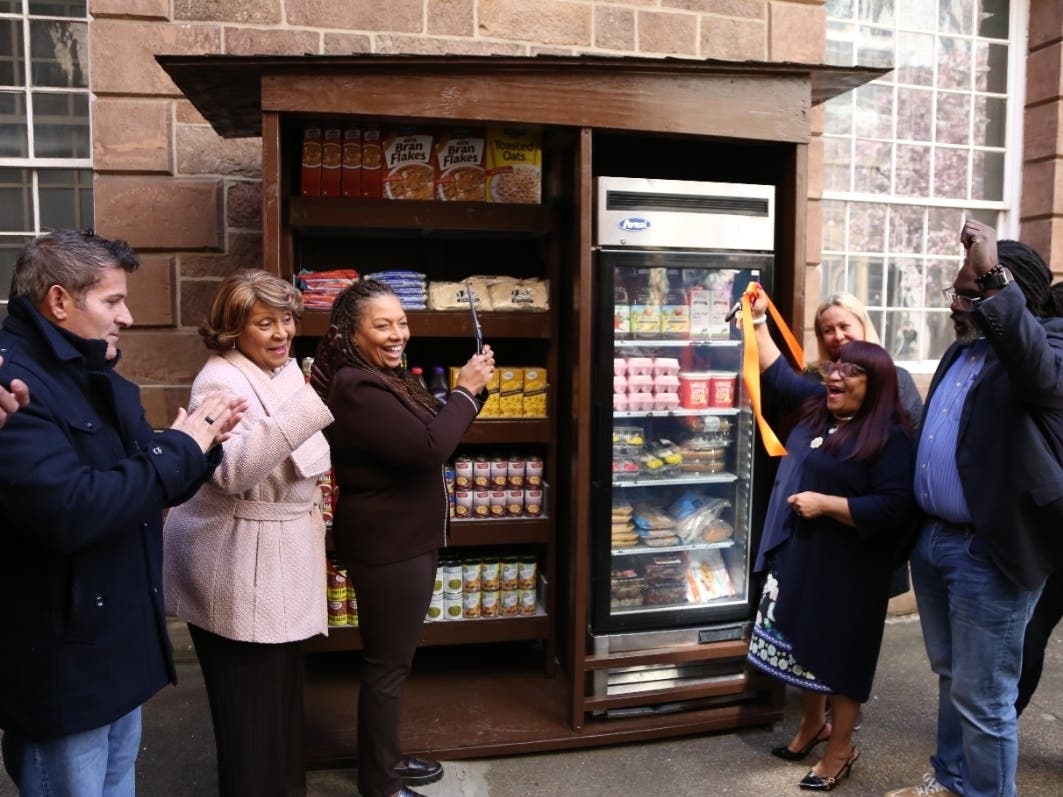
Library and city officials, along with residents, celebrated the project late last month at a reception and ribbon-cutting in front of the main library. Newark Council members Mildred Crump, Carlos Gonzalez, Anibal Ramos Jr., Darrin S. Sharif and Council President Donald Payne, Jr. were on hand for the ceremony. Diane Johnson, director of the Newark HUD office, was also there.
Followed by the Pledge of Allegiance and a violin serenade of the "Star Spangled Banner," officials praised the library, the project, and the council members who supported it.
"This is a civic ritual we have long awaited for" said Clement Price, a professor at Rutgers University and a library trustee member.
Wilma Grey, library director, praised Payne and other council members for their support while touting the institution's mission.
"Our guiding principal is equity of access," she said.
William Elmore, a West Ward resident and an activist for the elderly and disabled, has pushed for the main library's ramp for the last several years. He has also successfully advocated for other city buildings to be handicap accessible.
"Nobody knows your quality of life unless they are in our shoes," said Elmore who uses a wheelchair. "It took over 100 years for this to happen."
The ramp at the main library and other recent improvements throughout the branches were funded by a $1.4 million Community Development Block Grant — part of the stimulus money that the federal government sent to Newark, according to library officials.
The money was used to construct ramps at the main library and three other branches: Roseville, Clinton and Branch Brook, said George Wheatle Williams, assistant library director for planning and government relations and the director for the project. The five other branches are newer and already handicap accessible, he said, while the main library was built in 1901 and the three branches that needed ramps built in the 1920s.
The funds also went to making handicap-accessible lavatories at three branch libraries, library officials said. Rehab projects such as fresh coats of paint and new carpeting were done at all the buildings. Furniture was purchased as well.
Planning for the sprawling project started in January last year, said Heidi Cramer, an assistant library director. About a year ago, the first paint and carpet projects were done followed by the handicap accessible projects this year.
Williams said the library needs more money for phase two of the project, which will make the libraries more accessible such as mechanized doors and special furniture for the handicap.
Payne said the council is committed to finding more funds, such as private sources, for the library., Payne said the council has pledged no more cuts for the library and hopes to return the library's funding back to levels before the crunch.
For the main library, the project to make a ramp started about 10 years ago, said George Jones, architect at Johnson Jones of Newark and Princeton, which had designed the new ramp.
They had originally designed a ramp a decade ago but historical preservation concerns squashed the idea, he said. When federal funds became available, library officials revisited the project.
The new ramp is a compromise, Jones said. It is technically a "sidewalk," which eliminated the need of a hand rail. The sloped sidewalk, which is made of granite, blends seamlessly into the library's granite base.
Diane Robinson, a blind South Ward, resident, praised the ramp.
"I am so glad the ramp is in," she said. "It's easier to get up on a straight ramp."