Community Corner
Newark Will Get $1.2M To Plant Hundreds Of Trees, Remove Dead Ones
Newark will be among the towns and cities that get a big chunk of money to help reduce greenhouse gases in New Jersey, officials said.


NEWARK, NJ — Newark will be among the towns and cities that get a big chunk of money to help restore green space and reduce greenhouse gases in New Jersey, state officials announced Wednesday.
According to the New Jersey Department of Environmental Protection, $24.3 million will be distributed as part of the latest round of Natural Climate Solutions Grants. The program funds projects that “create, restore and enhance New Jersey’s natural carbon sinks,” such as salt marshes, seagrass beds, forests, urban parks/woodlands and street trees.
The city of Newark received $1,228,148 to remove hazardous, dead trees and plant hundreds of new ones in five target neighborhoods throughout the city.
Find out what's happening in Newarkfor free with the latest updates from Patch.
Here are some more details about the “Newark Canopy Initiative,” NJDEP officials said:
“The city of Newark’s Office of Sustainability will work with local contractors and community members on the Newark Tree Canopy initiative. This project will remove hazardous, dead trees and plant 331 new trees in five target neighborhoods in the city. The planting areas – one in each ward – were selected based on community-centered analyses that identified areas of the city that have greater needs to increase urban tree canopy.”
“Newark is committed to creating a greener, healthier, and more sustainable city for its residents and visitors alike, and we are grateful to the state Department of Environmental Protection for its Natural Climate Solutions $1.2 million grant, which will place trees in targeted neighborhoods across the city,” Mayor Ras Baraka said.
Find out what's happening in Newarkfor free with the latest updates from Patch.
“This will reduce heat and sequester carbon emissions in our neighborhoods, which will support the health of our community,” Baraka said. “These trees will also reduce stormwater runoff; provide environmental education through NJIT; community science and development; and jobs and training opportunities for residents.”
According to the NJDEP, the announcement underscores the important role natural resources play in sequestering carbon to meet the Garden State’s greenhouse gas goals.
What is “carbon sequestering?” According to the NJDEP:
“Carbon sequestration refers to the process of capturing carbon dioxide from the air by plants through photosynthesis and storage of that carbon in woody biomass and in plant-derived soil organic carbon. While carbon sequestration is a naturally occurring process on land and in aquatic habitats, there are human actions that can help maintain and enhance carbon sequestration capacity to further help mitigate the effects of climate change. Prime examples of ways to promote carbon sequestration include improved land management practices, such as reforestation (planting trees to support forest regeneration), urban community forestry (street tree planting), afforestation (planting trees on land that has been used for other purposes) and protecting tidal marshes from erosion. Protecting coastal ecosystems is particularly important since tidal marshes and seagrass meadows sequester more carbon per unit area than terrestrial forests.”
“Meeting the state’s 2050 goal of an 80 percent reduction in greenhouse gases below 2006 levels requires an acceleration of the restoration of our shorelines, forests, and urban spaces,” NJDEP administrators said in a news release.
It is estimated that these projects will sequester 32,710 metric tons of carbon dioxide equivalent (MTCO2e) by 2050, officials said.
NJDEP officials noted that the projects announced Wednesday are funded through New Jersey’s participation in the Regional Greenhouse Gas Initiative, a multi-state, market-based program that establishes a regional cap on carbon dioxide emissions from fossil fuel power plants.
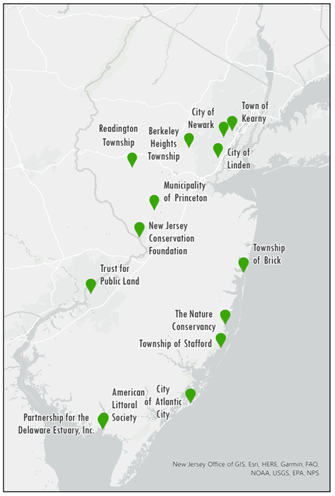
Other municipalities and groups that earned grants include:
Urban Forest Canopy and Water Quality Enhancement
City of Atlantic City, $759,000
Atlantic Avenue Street Tree Initiative - Atlantic City along with a number of local project partners will plant 180 trees along 13 blocks of Atlantic Avenue between Maine and Tennessee avenues. In addition to increasing natural carbon sequestration, the project will provide increased shade and reduce the need for energy produced for air conditioning, reducing the heat island effect in a coastal, overburdened community. Other project benefits include improvements to local air quality and a reduction in stormwater runoff and promotion of groundwater recharge.
Berkeley Heights Township, $721,325
Berkeley Heights Tree Canopy Restoration - The township will work with the Berkeley Heights Environmental Commission (BHEC), Union County Division of Park Environmental Services, Arterial, and other stakeholders to plant 555 trees on township streets and rights-of-way and 120 trees to reforest a blighted area adjacent to Watchung Reservation. These increases to the urban tree canopy in the township will sequester more carbon and will reduce stormwater runoff and the heat island effect.
Town of Kearny, $503,694
Kearny Urban Forest Canopy & Stormwater Mitigation - This project will improve water quality and air quality, increase community green space, and enhance the aesthetic of communal outdoor spaces in Kearny's overburdened communities through the planting of 300 street trees and 28 bioswales.
City of Linden, $355,500
City of Linden Urban Tree Restoration - The City of Linden will plant 540 trees across eight Blue Acres-acquired lots and three city-owned, partially Green Acres-funded parks and lots in the Tremley Point region, including Sgt. A. Wales Memorial Park and Louis Avenue Park. The city will pair this carbon sequestration project with a public outreach effort which includes educational signage at each site and a public tree planting event with the local community.
New Jersey Conservation Foundation, $1,336,125
Throwin’ Shade: Greening the Capital City - The New Jersey Conservation Foundation will work with a coalition that includes the City of Trenton, Isles, the New Jersey Tree Foundation, the Watershed Institute, and the Outdoor Equity Alliance to enhance Trenton’s urban tree canopy. This project will plant a total of 1,000 trees on city streets that have few to no trees and in Cadwalader and Mill Hill parks that have experienced heavy losses of trees due to age and disease. This project will sequester carbon, increase the urban tree canopy, and mitigate the urban heat-island effect, stormwater runoff, and poor water and air quality in Trenton.
Trust for Public Land, $1,035,668
Enhancing Camden’s Canopy for Climate & Community - Camden’s Natural Climate Solutions Collaborative will plant at least 800 trees across three public spaces and at least 215 trees in public housing complexes in the Centerville and Morgan Village neighborhoods in Camden City. Other priority tree planting sites include Gateway Park, Reverend Evers Park, and Stockton Station Park. The Collaborative is led by Trust for Public Land in partnership with Camden Community Partnership, Delaware Riverkeeper Network, New Jersey Conservation Foundation, New Jersey Tree Foundation, Camden City, Housing Authority of Camden City, and Camden County Municipal Utilities Authority.
Living Shorelines
American Littoral Society, $4,999,946
Restoring Marsh at the Mouth of the Maurice River - This restoration project is at a site within the Delaware Bay at the mouth of the Maurice River. The project will restore 19.5 acres of tidal salt marsh using rock revetments at the tip of Basket Flats Marsh. It will also create up to 3,500 feet of hybrid living shoreline breakwaters and oyster reefs that will protect over 4,300 linear feet of shoreline along Basket Flats and Northwest Reach.
Township of Brick, $4,997,124
Forsythe Refuge Marsh Restoration - This project will lead to coastal wetland restoration of the U.S. Fish and Wildlife Service’s Edwin B. Forsythe National Wildlife Refuge in Brick Township. The project will place more than 120,000 cubic yards of suitable dredged sediment into a series of 13 cells to increase tidal salt marsh elevation, protecting the marsh from drowning. The total area of sediment placement is approximately 95 acres of marsh. Added protective measures will be used to contain placed sediment and strengthen shorelines. The elevated marsh will be planted in areas that did not previously contain vegetation to ensure recolonization of vegetation occurs to ultimately restore the health of the marsh.
The Nature Conservancy, $1,846,470 -Restoring Salt Marsh Habitats at Lighthouse Center
This project addresses salt marsh erosion, degradation and loss caused by deficits in elevation and alterations in natural hydrology at the Lighthouse Center in Waretown, NJ. 7.58 acres of salt marsh will be re-established, and carbon sequestration will be increased through erosion control, improved hydrology, and increased elevation suitable to sustain a healthy marsh. The Lighthouse Center in Waretown is owned by the DEP’s Division of Fish and Wildlife as part of the Upper Barnegat Wildlife Management Area.
Partnership for the Delaware Estuary, $766,442
Living Shorelines Salt Marsh Carbon Sequestration at Matt’s Landing - Partnership for the Delaware Estuary, Inc. will lead this project to construct a living shoreline of 1,300 feet along a rapidly eroding salt marsh in the Maurice River at Matt’s Landing. The work will be performed in partnership with Rutgers University Haskins Shellfish Research Laboratory, Ducks Unlimited, Stevens Institute of Technology, the U.S. Fish and Wildlife Service and NJDEP Fish and Wildlife.
Stafford Township, $4,998,109
Stafford Township Popular Point Restoration Project - Stafford Township, in collaboration with the New Jersey Department of Transportation and the U.S. Fish and Wildlife Service, will enhance more than 33 acres of tidal salt marsh wetland as part of a living shoreline project. The township and project partners will utilize approximately 150,000 cubic yards of dredge material to elevate, re-stabilize, and revegetate the shoreline to protect against erosion and increase carbon sequestration in a portion of the Edwin B. Forsythe National Wildlife Refuge.
Forest and Woodland Restoration
Municipality of Princeton, $552,000
Community Park North Forest Restoration - The 45-acre forest restoration project at Community Park North will involve removing invasive species with a combination of contracted labor and volunteers. Thousands of native trees will be planted to replace the non-native species.
Readington Township Environmental Commission, $250,000
Readington Township Meadow Afforestation - The Readington Meadow Afforestation project will plant native species of trees on 11 acres of selected open fields and meadows in Readington Township, returning these areas back to woodlands and reconnecting them with adjacent contiguous forests.
Send local news tips and correction requests to eric.kiefer@patch.com. Learn more about advertising on Patch here. Find out how to post announcements or events to your local Patch site. Don’t forget to visit the Patch Newark Facebook page.
Get more local news delivered straight to your inbox. Sign up for free Patch newsletters and alerts.