Politics & Government
NYC Will Stop Sending Homeless People To Newark (For Now)
New York City pays for thousands of homeless people to move to NJ with its SOTA program. Many are landing in crummy homes, officials say.


NEWARK, NJ — New York City has agreed to temporarily stop sending homeless people to live in Newark, New Jersey, as part of a controversial aid program, officials announced Monday.
Buckling down for a daylong discussion Monday at a federal courthouse in Newark, attorneys reached an agreement that will help protect homeless families caught on the sidelines while a lawsuit between the two cities plays out.
Newark and other cities in New Jersey have criticized New York City’s Special One-Time Assistance program (SOTA), which helps homeless New York residents find new places to live by paying a year’s worth of rent – up front – to their future landlords.
Find out what's happening in Newarkfor free with the latest updates from Patch.
While they have the option to move within New York City or other counties in the state, many people in the SOTA program are choosing to find new homes in New Jersey. Since 2017, New York’s Department of Homeless Services has reportedly relocated 2,226 families across the Hudson River into the Garden State.
That includes about 1,200 who have moved to Newark, according to the city’s mayor, Ras Baraka.
Find out what's happening in Newarkfor free with the latest updates from Patch.
According to Baraka, the problem comes when the year of free rent is up, and the necessary-but-taxing job of aiding the relocated homeless families falls into Newark officials’ laps. To complicate the situation, many SOTA recipients – including those with young children and infants – are reportedly finding themselves living in decrepit, unsafe housing once they get to the Brick City because of unscrupulous landlords, who let the properties' condition lapse once they have their payments in hand.
Sophie Gurley, a mother of three, told CBS New York that the SOTA program seemed like a “dream come true.” But when she and her kids got to their new home in Newark, it was more like a nightmare.
“No hot water, no lights,” she lamented.
At one apartment, the temperature was reportedly so cold that water in a dog bowl froze. In another, raw sewage seeped into the basement, The New York Times reported.
Story continues below
"...participants in the SOTA program are living in subpar conditions. People don't have heat, people don't have lights, people don't have electricity, some people are living in spaces where their kids are in jeopardy or in danger." (2/2) pic.twitter.com/tnLSp33YSG
— City of Newark (@CityofNewarkNJ) December 5, 2019
PROTECTING FAMILIES, INSPECTING HOMES
Last week, Newark officials filed a lawsuit against Mayor Bill de Blasio and Department of Social Services Commissioner Steven Banks, claiming the SOTA program violates interstate commerce regulations.
- See related article: Newark Sues NYC For Shipping Homeless Families To NJ
On Monday, the two cities reached an agreement to help ensure that thousands of families in New Jersey have safe places to live while the lawsuit continues.
Baraka’s office shared the following details about the deal:
“New York agreed to a temporary pause in sending new families and residents to Newark pending the court’s ruling on the injunction requests on this issue. New York also agreed to provide Newark with a confidential list of persons who were moved here and their addresses. Newark and New York will work together to inspect those apartments and homes for housing code violations. Any such violations will be enforced by the City of Newark and landlords will be charged for them in Newark Municipal or Essex County Superior Court, as appropriate.”
Freddi Goldstein, de Blasio’s spokesperson, released the following statement to CBS New York:
“This administration wholeheartedly believes that people have the right to a roof over their heads and to choose where they want to live. In the spirit of productive conversations and with the goal of moving toward an improved program, we will be temporarily pausing placements in Newark. We will be back in court on Thursday and if a satisfactory agreement is not met, we will file a formal challenge to the ordinance the next day.”
But despite the possibility of a future legal battle, Newark’s mayor remains optimistic about the chances of reaching a compromise.
“So far, we’ve gotten much of what we asked for, and we look forward to continue to work collaboratively with New York City,” Baraka said. “For us, this was always about making sure these people were in safe and sanitary housing, and they were handled in a dignified manner, not just jettisoned here with no safety nets.”
According to researchers, 2,235 homeless people were counted in Essex County on Jan. 22 – about 25 percent of the entire state's homeless population. About 87 percent of those residents live in Newark.
- See related article: Essex County Homeless Population Rises For 4th Straight Year
Other New Jersey cities are also drawing lines in the sand when it comes to the SOTA program, with at least one, Elizabeth, reportedly seeking to join Newark’s lawsuit.
According to Elizabeth officials, at least 48 households have been relocated to the city under SOTA.
“The lack of communication and the underhandedness of New York City to relieve some of their homeless problems to our city is despicable,” Mayor Chris Bollwage said.
“Clearly, this homeless relocation program has not been thought through, or seemingly, Mayor de Blasio does not care where these people are being moved to, the impact these programs are having on the cities they are sending them to, or where they will end up after their year in the program is up,” Bollwage added. “I guess once they are out of his city, he really doesn't care what happens to them.”
Last week, Ted Green, the mayor of East Orange, also weighed in on the SOTA program:
“In East Orange, we have been addressing the issue of homelessness by working with a strong network of partners that can help create a plan that transitions people into permanent residency. We welcome any family that needs a home, however, it is our duty as a municipality to make sure these families are living in safe, habitable conditions and have access to the local resources they need. That is where New York falls short. The SOTA program can be successful, but only if New York City reaches out to relocation cities to make it work and abides by the housing laws of that city. As it is now, there is absolutely no process in place that tracks the success or sustainability of this program. They are sending people to our communities, paying landlord’s a full-year’s rent and washing their hands of the situation. What we are finding in East Orange is that after the year is up, many of these families are homeless once again. The negligence of this program must stop, or else New York City will have single-handedly spread their homeless issue all across America.”
A pair of Republican state lawmakers in New Jersey have also expressed concerns about the SOTA program.
On Monday, Sens. Robert Singer of District 30 (county) and Steven Oroho of District 24 (county) issued a joint statement to Gov. Phil Murphy urging him and the New Jersey Office of the Attorney General to step up to the plate for Newark and the rest of the state’s taxpayers.
“Overtaxed communities across the Garden State are already struggling with the fiscal challenges of funding our schools and existing public services for current residents,” Singer said. “We cannot afford to let Mayor de Blasio shift the substantial financial burden of the homeless crisis created by his failed social policies to New Jersey taxpayers.”
IN DEFENSE OF SOTA: ‘DON’T LIMIT FAMILIES’
After Baraka accused New York City of “abandoning” homeless people in New Jersey last February, spokespeople with the NYC Department of Homeless Services (DHS) provided Patch with the following information based on data from January 2019:
- Out of the 3,539 households that utilized SOTA to move out of shelters, only 70 clients (1.9 percent) have returned to shelters.
- More than one-third of the households utilizing SOTA moved to permanent apartments within New York City (see below chart).
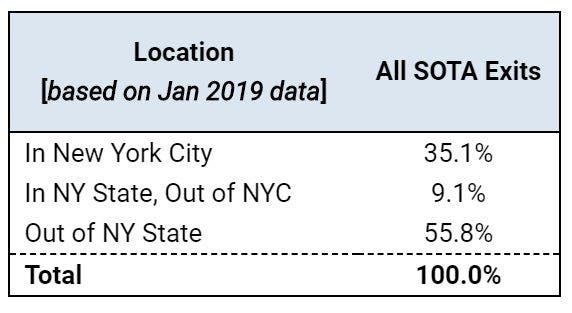
"All units that clients may seek to move into through our rental assistance programs must pass our required reviews, which include a walk-through by trained staff, including DHS and provider staff, and our comprehensive Apartment Review Checklist (ARC)," the NYC spokespeople said.
SOTA-eligible units in neighboring New Jersey counties – including those in Bergen, Essex, Hudson, Middlesex, Passaic and Union – must pass the city's ARC requirements. Housing providers are also required to take photos of the unit and must verify authenticity of the address utilizing Google Street View, the spokespeople said.
Banks authored a resounding statement of support for the SOTA program in a Feb. 6 blog post:
"In our city, we're tackling homelessness head on, leaving no stone unturned in our effort to provide New Yorkers with any and every option to get back on their feet, because we know this crisis can't be addressed with a one-size-fits-all approach. That's why we believe families living paycheck to paycheck shouldn't be arbitrarily limited as they search for housing.
"Today, fully 70 percent of the New Yorkers experiencing homelessness and residing in DHS shelters are families, and more than a third of these families with children we support are headed by an employed adult — the result of rising rents outpacing incomes coupled with policy failures by prior administrations across the city, state, and federal levels. At the same time, today in New York City, households that can only afford housing for under $800 a month must find apartments in a market with a vacancy rate of just 1.15 percent in 2017 — down from the already-razor-thin 1.8 percent vacancy rate in 2014 — which is why we're helping New Yorkers in need find the housing they can afford.”
- See related article: Newark Mayor Claims NYC Is 'Abandoning' Homeless In New Jersey
It’s not like NYC shopped people to Newark against their will. SOTA works with families in shelter to identify apartments in cities -NYC included- where they have history and job prospects. No city is perfect, but none should close their borders to those who enter either
— Alison Hirsh (@AlisonHirsh) December 6, 2019
Send feedback and correction requests to eric.kiefer@patch.com
Don’t forget to visit the Patch Newark Facebook page. Learn more about posting announcements or events to your local Patch site. Sign up for Patch email newsletters.
Get more local news delivered straight to your inbox. Sign up for free Patch newsletters and alerts.