Schools
Scientists Get $1 Million To Study Fish Pelvises (VIDEO)
A team of researchers from three U.S. universities got a $1 million grant to study the pelvis of a strange "walking" fish.


NEWARK, NJ — A team of researchers from three U.S. universities recently earned $1 million to study the pelvis of a strange “walking” fish.
The National Science Foundation has awarded a four-year, $997,510 grant that will fund a new research collaboration between New Jersey Institute of Technology (NJIT), Louisiana State University (LSU) and University of Florida.
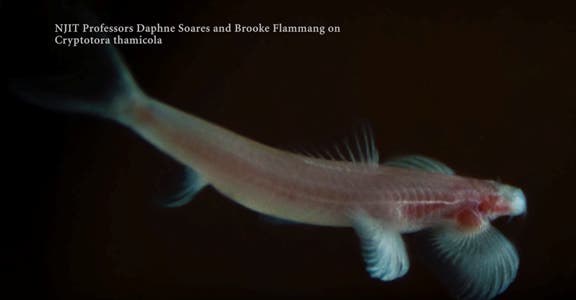
The goal? Probe the secrets of Cryptotora thamicola – the blind cavefish – the only known living species of fish capable of walking on land.
Find out what's happening in Newarkfor free with the latest updates from Patch.
As part of the grant, researchers will study the unique pelvic structure and walking mechanics of the fascinating fish “from an evolutionary perspective,” NJIT announced Thursday.
Researchers said the project’s “unprecedented, comprehensive study” of the cavefish’s “vertebrate–like pelvic girdle” may provide a new window into how the first sea critters eventually made the transition to life on land during the Devonian period, between 350 and 400 million years ago.
Find out what's happening in Newarkfor free with the latest updates from Patch.
“Evolutionarily, there are a number of different ways that other species may have approached the water-to-land transition, but the physics and the fundamental properties of land-walking that the cavefish has had to overcome by developing their pelvic structure have not changed in 350 million years,” explained Brooke Flammang, the project’s lead principal investigator and assistant professor of biological sciences at NJIT.
“This study, for the first time, will provide the opportunity to study and measure a fundamental mechanism that was key to this major evolutionary transition,” Flammang said.
According to NJIT, until recently, all living fish were thought to lack the tetrapodal characteristics necessary for studying the physics of quadrupedal walking by fishes in a terrestrial environment. But in 2016, Flammang and NJIT faculty-researcher Daphne Soares observed that the two-inch-long cavefish shared morphological features associated with terrestrial vertebrates, identifying that the fish utilized a robust pelvic girdle attached to its vertebral column in order to walk and climb waterfalls with a salamander-like gait in its native habitat, the Tham Maelana and Tham Susa karst cave systems in northern Thailand.
- See related article: Weird, Blind Walking Cavefish May Hold Evolutionary Secret
“There have not been many models or preserved fossil records available to help us understand how the pelvis evolved and formed in the first tetrapods that developed appendages from fins to walk on land,” Flammang said. “These cavefish may not necessarily offer a living analog of what ancient tetrapod fish used to look like, but in better understanding the evolution of the pelvis in this cavefish, we may have a window backward into the physics of early tetrapodal weight-bearing limb support necessary to walk on land.”
- See related article: Can Birds Keep Musical Time? This Professor Says Yes
Don’t forget to visit the Patch Newark Facebook page here. Learn more about posting announcements or events to your local Patch site here. Send local news tips and correction requests to eric.kiefer@patch.com
Photos: NJIT
Get more local news delivered straight to your inbox. Sign up for free Patch newsletters and alerts.