Neighbor News
The Fall 2014 New Jersey Film Festival opens this Thursday, September 11 with a George Melies Retrospective!
The Fall 2014 New Jersey Film Festival opens this Thursday, September 11 with a George Méliès Retrospective!

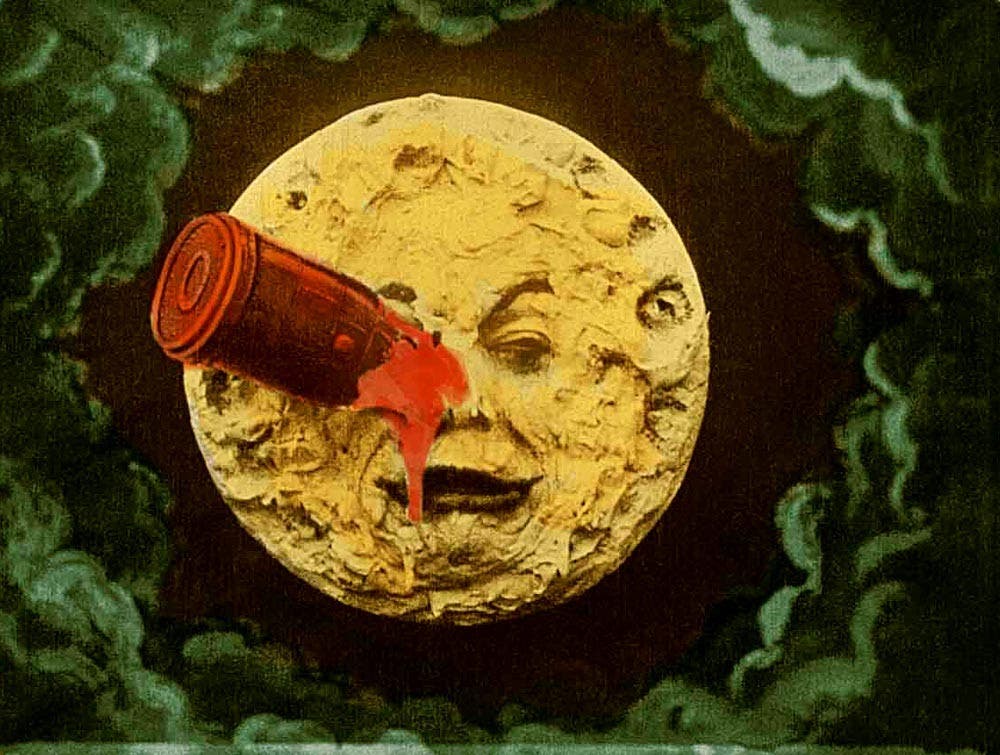
The Fall 2014 New Jersey Film Festival opens with a George Méliès Retrospective!
After having witnessed the first public showing of the Lumière brothers cinematographe on December 28, 1895 at the Grand Café in Paris, George Méliès, master magician and entrepreneur was so taken by the new invention that he tried to buy it outright. This attempt failed, but it did inspire Méliès to pursue, with greater fervor, the acquisition of a motion picture apparatus. In 1896 he attained the rights to a machine developed by his friends the Isola brothers and in March of that year inaugurated his first camera/projector. At first Méliès made films similar to those of the Lumières – one reelers documenting scenes or events from everyday life, but he then began to innovate, manipulating the camera to produce a variety of special visual effects. The most famous trick was discovered by accident. While filming a street near the famous Paris Opera the camera jammed and took a brief time to get back up and running. Upon reviewing the footage Méliès was overjoyed to see that the jam created a mind blowing trick where a horse and buggy was replaced by a hearse. Stop motion animation was born. As a result of this accident the first trick film The Vanishing Lady, inspired by Buatier de Kolta’s magical illusions, was made in 1896. To make a seated lady disappear, Méliès simply stopped the camera, allowed her to leave the scene, and recommenced filming, before taking the trick further. A skeleton then appeared on the seat covered with a large sheet. When the cloth was removed the woman reappeared in its place using this stop-motion effect. Méliès the magician had transferred his prestidigitation act to the motion picture screen. “In conjuring you work under the attentive gaze of the public, who never fail to spot a suspicious movement. You are alone, their eyes never leave you. Failure would not be tolerated… While in the cinema…you can do your confecting quietly, far from those profane eyes, and you can do things thrity-six times if necessary until they are done right. This allows you to travel further in the domain of the marvelous.” (1)
In 1897, to facilitate the primitive shooting/developing process, Méliès built a large glass studio in the garden behind his home in Montreuil (a suburb of Paris). It was not the first film studio, however, Thomas Edison’s Black Maria in West Orange, New Jersey preceded it by four years. Méliès made over 500 films between 1896 and 1912, of which unfortunately only about 100 are extant. His film career reached its apex in 1902 when he unveiled A Trip to the Moon, a 14 minute parody of two stories, one by Jules Verne, From the Earth to the Moon (1865) and another by H.G. Wells, The First men on the Moon (1901). Perhaps the first science fiction film, it was later heralded as a masterpiece by many. Most of Méliès’ films use special stop motion effects to transport the viewer into the realm of the marvelous – a cinematic slight of hand, but trick films were not the only type he realized. L’Affaire Dreyfus (1899) recreates the drama of the Dreyfus Affair. This event, the wrongful conviction for high treason of a Jewish army officer, Alfred Dreyfus, and the ensuing social and political agitation surrounding his retrial, split French public opinion down the middle. Méliès, who was pro-Dreyfus, based some of the eleven sets of his strangely moving film on illustrations in the weekly papers.(2)
“When Méliès attended the premiere of (Alfred) Jarry’s King Ubu on the 10th of Decmeber 1896, he was one of the few in the audience who understood and applauded the play and during a stormy moment in the theater this pleasant and peaceable man stood and shouted at those who were howling and whistling… ‘Ayez au moin la pudeur d’etre idiots en silence.’ (At least have the dignity to act like idiots in silence.) (3)
Find out what's happening in New Brunswickfor free with the latest updates from Patch.
“Marvelous – adj. 1. Causing wonder, surprising, astonishing or extraordinary. 2. So extraordinary as to be improbable, incredible or miraculous. 3. (Colloq.) very good, fine, splendid.” (4)
The marvelous is uniquely merged with a vaudevillian humor in the majority of Méliès’ films. “In The Melomaniac (1903) a singing teacher, played by Méliès himself, followed by his pupils, runs across some telegraph wires strung on poles. These five wires, the professor thinks, would form a very effective musical staff. He carries an enormous key of G, which he throws up on the wires to give the proper pitch for his pupils. He forms a measure by fixing his stick in a perpendicular position among the wores. In order to have musical notes, he tears off his head, and fixes it among the wires. His head magical reappears and then he proceeds to tear his head again several times with them fixed on his musical staff in positions to musically spell out the first part of the tune God Save the King. (5)
Find out what's happening in New Brunswickfor free with the latest updates from Patch.
Méliès did make money from his film sales and rentals but in 1911 he signed a contract with Charles Pathé, head of the the largest production company of the time. Suddenly at the mercy of the film industry’s Leviathan, Méliès found himself bankrupt.
(1) George Méliès, En Marge de l’histoire du Cinematographe, 1920.
(2) Paul Hammond, Marvelous Méliès, 1974.
(3) Sidney Peterson, The Dark of the Screen, 1980.
(4) Webster New World Dictionary, 1982.
(5) Paul Hammond, Marvelous Méliès, 1974.
-------------------------------------------------------------------------------------------------------
George Méliès Retrospective
George Méliès was a French illusionist and filmmaker famous for his technical and narrative achievements in the earliest days of cinema. Méliès, a prolific innovator in the use of special effects, was one of the first filmmakers to use multiple exposures, time-lapse photography, dissolves and hand-painted color in his work. Tonight, we will screen new prints of his classic films A Trip To The Moon (1902), The Impossible Voyage (1904), The Rubber Head (1902), among others. The visionary and ground-breaking films of Méliès received richly-deserved and renewed attention, following the release of Martin Scorsese’s feature film Hugo. 70 min.
Thursday, September 11, 2014
6:00 p.m.
Ruth Adams Building #001/Rutgers University,
131 George Street (near the corner of George and Jones Streets),
New Brunswick, New Jersey
$10=General; $9=Students+Seniors; $8=Rutgers Film Co-op Friends
Information: (848) 932-8482; www.njfilmfest.com