Politics & Government
Rutgers Announces Members of Committee Who Will Study University's Governance Policies
The committee will work closely with the University president and report its initial findings in December.


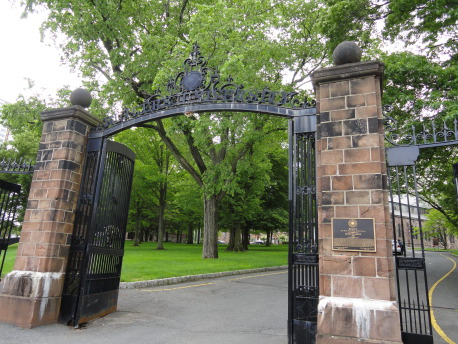
Rutgers University is tackling the recent controversy surrounding its governance policy with the announcement of the individuals who will be involved in identifying areas of improvement associated with the policy.
New Jersey Senate President Steve Sweeney proposed eliminating the Board of Trustees on June 26, via a bill that bypassed Senate and Assembly committees and went directly to second reading.
After showing initial support for the legislation, Assembly Speaker and U.S. Senate candidate Sheila Oliver said she wouldn’t introduce the bill for an Assembly vote.
Find out what's happening in New Brunswickfor free with the latest updates from Patch.
Deputy Speaker John S. Wisniewski introduced a bill establishing a committee to explore the University’s governance policies on June 27.
Rev. M. William Howard Jr., pastor of Bethany Baptist Church in Newark, will chair the committee. Howard is a former chair of the Rutgers Board of Governors and former president of New York Theological Seminary, according to the University. He’s been a member of the Board of Governors since 2004.
Find out what's happening in New Brunswickfor free with the latest updates from Patch.
“Everyone in New Jersey has a stake in the success of Rutgers University,” Howard said in a prepared statement. “We look forward to gathering information and insights from key stakeholders inside and outside the university community.”
Other members of the committee include:
· Vice Chair Sandy J. Stewart, a member of the Board of Trustees since 2006. Stewart is a retired scientist and biotech entrepreneur;
· Marisa A. Dietrich, elected a student member of the Board of Trustees in 2011. Dietrich, a January 2013 graduate of Rutgers- Camden, is a GSLE Specialist for Girl Scouts Central and Southern New Jersey;
· Senator Gordon A. MacInnes, a member of the Board of Governors since 2010. MacInnes, a former N.J. State Senator and former member of the N.J. General Assembly and assistant commissioner with the New Jersey Department of Education, is president of New Jersey Policy Perspective, a nonpartisan, nonprofit organization that researches and analyzes economic issues;
· Iris Martinez-Campbell, a member of the Board of Trustees since 2002. In September, Martinez-Campbell will become a member of the Preschool Intervention and Referral Team for the Perth Amboy Public Schools Early Childhood Program. For the past seven years, she has been a community/parent involvement specialist for that program;
· Kenneth M. Schmidt, a member of the Board of Governors since 2012. Schmidt, a former chair of the Board of Trustees and the Rutgers University Foundation Board of Overseers, is a retired managing director at UBS;
· Heather C. Taylor, a member of the Board of Trustees since 2009. Taylor, a certified public accountant, is an audit director in the commercial and nonprofit services groups at EisnerAmper LLP.
The committee will work closely with Rutgers University President Robert L. Barchi. Its initial report is due at the December meetings of the Board of Trustees and the Board of Governors.
“As we enter this new era we should explore opportunities for Rutgers to become a more efficient and effective institution,” Rutgers Board of Governors Chair Gerald C. Harvey and Rutgers Board of Trustees Chair Dorothy Cantor said in a joint statement.
“This is one of the most significant and challenging periods in Rutgers University’s nearly 250-year history,” Harvey continued. “Our historic integration in July with most of the schools, centers and institutes that made up the University of Medicine and Dentistry of New Jersey has transformed Rutgers into a much larger and more comprehensive university with tremendous potential. To ensure that Rutgers continues to excel, we should critically evaluate all aspects of our university – including our governance.”
The group will consider the following items during its evaluation:
· best practices demonstrated by boards at other institutions;
· best practices and overall effectiveness of Rutgers’ Board of Trustees and Board of Governors;
· recommendations for improving Rutgers’ Board of Trustees and Board of Governors; and
· a plan for implementing those recommendations.
“We have made clear to the members of the task force that they should be thoughtful, thorough and willing to rigorously examine long-held beliefs about Rutgers University’s history and traditions,” Cantor said. “This is an appropriate time for a serious self-examination, with the input of all appropriate stakeholders, of how Rutgers should be governed in the decades to come. No one knows this better than members of our own community.”
Get more local news delivered straight to your inbox. Sign up for free Patch newsletters and alerts.