Politics & Government
Regional Plan Could Save Tax Dollars, Planner Says
The Oakland Borough Council heard a presentation Wednesday night on the effects of signing on to the NJ Highlands Council regional master plan.
Oakland could undertake development more efficiently and save tax dollars by signing on to a regional master plan, the borough planner said in a presentation to the council Wednesday night.
The mayor and council have already adopted two resolutions indicating interest in signing on to the plan, created by the Highlands Council, a state agency formed primarily to protect water resources.
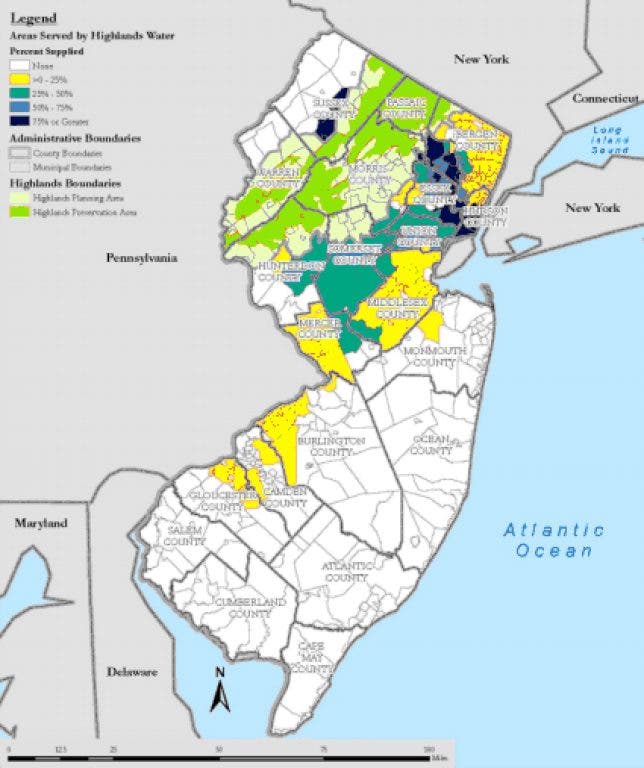
Oakland is among 88 municipalities across seven counties with land in the region, and one of only a few entirely within the zone that provides a majority of the state’s drinking water.
Find out what's happening in Oaklandfor free with the latest updates from Patch.
The plan splits land into preservation and planning areas, concentrating new development into areas that have already seen development and preserving areas with concentrated natural resources. Oakland is roughly evenly split between the two areas.
Planner Steve Lydon said on Wednesday that by concentrating development, municipal resources would be more efficiently distributed, saving tax payer money in the long-term.
Find out what's happening in Oaklandfor free with the latest updates from Patch.
Signing on to the regional plan, which the council could petition to do next month, would require changes in zoning, planning, and land use ordinances to conform to the plan, adding restrictions to development within the borough.
“We are going to need to maintain plans and ordinances that are consistent with the regional master plan,” Lydon said.
The restrictions, however, mainly target large scale developments, and most single family lots and additions to existing buildings would be exempt.
“A large scale development is potentially reviewable by the Highlands Council after local approval, where they can decide either to endorse the local approval, modify it or, potentially, in rare cases, reject it,” Lydon said.
Larger developers would have to access a Transfer of Development Rights (TDR) system, in which they could purchase the right to construct housing units above the limit eventually set by the Highlands Council and the borough. The money, Highlands Council executive director Gene Feyl said, could be used both by the borough for capital improvements and by the council for the acquisition of open space within the preservation area.
If the borough were to sign on to the regional plan, Feyl said, the council would extend planning grants to the borough and that, beyond some development restrictions, Oakland would maintain autonomy in its planning.
“We have no vision for Oakland beyond what your vision is,” Feyl told the borough council. “Your vision tells us how we react from a planning standpoint where you want to take the borough.”
“You tell us what you want to do and we try to work with you to get to that point,” he added.
One of the financial benefits focused on during Wednesday’s presentation was the reduction in the borough’s state mandated affordable housing obligations that would result from conforming to the plan.
According to Lydon, due to an understanding between the Highlands Council and the Council on Affordable Housing, the borough’s obligation for new construction of affordable units could decrease by over 90 percent.
The council, he said, could also help finance planning of and help “remove regulatory roadblocks” to the construction of a downtown sewer system.
Feyl told the borough that the costs in conforming to the plan would be relatively minimal, and that the council would make grants available to plan the process.
“I think you need to look at what the costs are if you don’t do it,” he said.
Public hearings will be held in Oakland as well as with the Highlands Council before adapting to the master plan, a process that Lydon said could begin next month.
“We’ve gotten to the stage where talk needs to end and we need to move forward in concrete ways.”