Arts & Entertainment
Storm of '62 Still Fascinates Ocean City a Half-Century Later
A March 8 presentation by the Ocean City Historical Museum captivates a crowd.
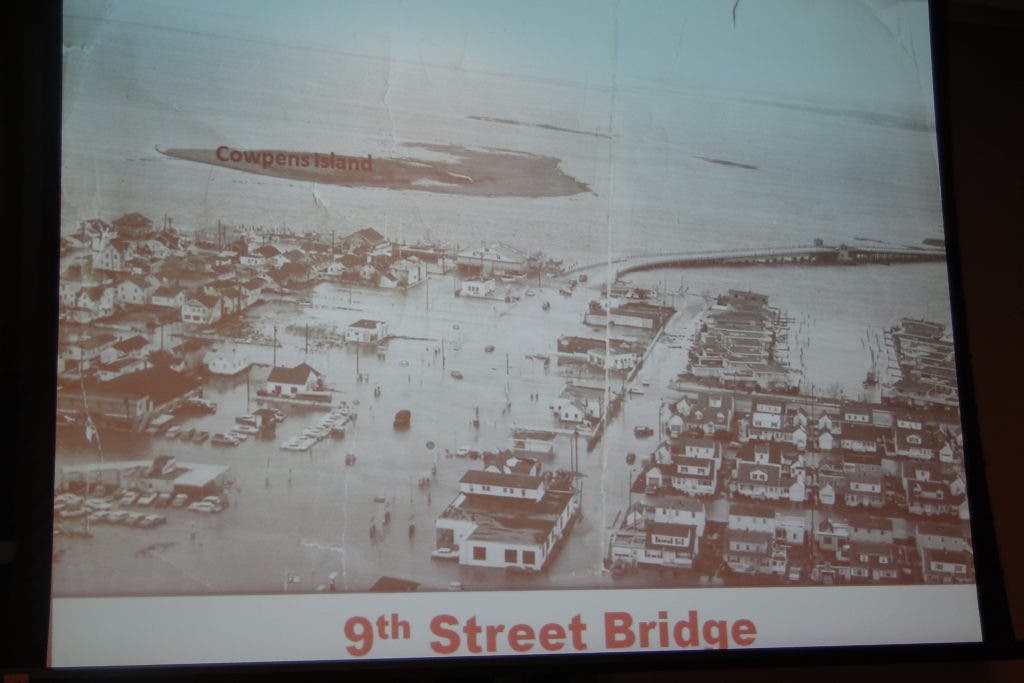


Exactly 50 years after the tides started to recede, an overflow crowd was still eager to share tales of the most destructive storm Ocean City has ever seen.
Ocean City locals, natives, transplants and storm-chasers milled about and told stories about the Ash Wednesday Storm of ’62 at the during a 50th anniversary event on Thursday, March 8.
The massive storm of ’62 was the result of an unusual combination of three pressure areas, and hovered in the Mid-Atlantic states for almost three days on March 6 to 8, 1962, pounding coastal towns with rain, high winds and tidal surges.
Find out what's happening in Ocean Cityfor free with the latest updates from Patch.
The history of Ocean City has fascinated locals for generations. Ken Cooper, president of the Board of Directors of the Ocean City Historical Museum, explained historical maps of Ocean City to locals who thought they already knew everything there was to know about the barrier island.
Robert Gross, museum volunteer, made sure that everyone who was curious would be introduced to someone who had lived through the storm.
Find out what's happening in Ocean Cityfor free with the latest updates from Patch.
“I’m learning so many things I never knew,” one interested browser said.
Lisa Tifft, great-granddaughter of Captain John Mackey Corson, a pivotal U.S. Life Saving Station rescuer at the Sindia sinking, remembers that at the time of the Storm of ’62, she was eight years old, and she had the measles.
Eunice and Jack Kreider, Lisa’s mom and dad, recall the kindness of friends and family, the rising water, and the feeling that they would be safe.
Blanche Roadarmel was 29 years old and lived at 114 West Ave. with a 4-year-old daughter and a 6-year-old son.
“Our house was high, but our heater was low, so our heat went out," Roadarmel said. "My daughter had the measles, because at that time it was going around. We took our son to the doctor, because he was giving the children gamma globulin shots so they wouldn’t get the measles as bad. We stayed on the island until the electricity went, and we had to leave, it was just too cold.”
“My aunt lived at 120 Ocean Ave., and they had no water. She took in three families, and finally it got so crowded, I ended up in Harrisburg with my in-laws. And I always think where we put our car during the storm, that it didn’t get wet, but I can’t remember.”
By 7 p.m. Thursday, crowds moved from the Historical Museum to the adjacent and filled the lecture hall for a slide show presentation. Doors were closed, and the room was filled to capacity.
“This shows how much we love the history of Ocean City,” said Paul Anselm, president of the Ocean City Historical Museum. “And it shows that we want to learn from some of our mistakes about the destruction of a storm.”
Paul went on to one of his memories of the storm.
“I remember bringing my children to the shore a few weeks after the storm, and how amazed they were that we had to drive around a house in the middle of the street,” Anselm said.
“There were refrigerators washed into the meadows at the south end,” he said. “This storm changed the way we build our houses in Ocean City.”
Anselm began the slideshow with a running commentary, and gasps could be heard from the audience at the destruction projected on the screen.
Audience members offered information with an almost uncanny ability to identify houses, children and cars. A slide depicting a row of young children sleeping on blankets and pillows on the floor of the high school gymnasium was projected, and it was noted that all of the children were identified.
After the initial slideshow, people were asked to tell their stories about the storm. Cathy Finnegan told her story of being newly engaged.
“We had just gotten engaged two months before, and we had just had dinner with my parents. My father came downstairs and told Jim he would have to stay the night because all the roads were closed.”
“Jim wasn’t about to be told that he couldn’t do something, so he immediately left and got his car and tried to go over the Longport Bridge, and it was closed. We tried the Margate bridge — it was closed, the toll taker told us no, we couldn’t go over it. Once he showed him his badge he said we could go,” said Cathy Finnegan.
Jim Finnegan added to his wife’s story.
“When I came back into Ocean City, and I came down Route 52 over the causeway, the water was up to the windows. It took me an hour to get to Second Street where my cousin and I shared an apartment for the winter. It was a complete blur for the next month, all we did was work. And I never saw a reporter, never heard a radio broadcast and never saw a television station reporting on what was going on.”
Harry Lord was a police officer at the time of the storm.
“It was 8 a.m., and seemed to just be a normal nor’easter, didn’t appear to be anything out of the ordinary. By noon our cars were gone, and we got out the deuce and a half trucks and the self-propelled Howitzers, and we were driving around and evacuating people. We broke out the boats and were rescuing people that way, too.”
Deuce and a halfs are two-and-a-half ton trucks. A spectator noted that these trucks were so powerful that a furniture store whose windows were taped for safety from the storm were blown out when the gigantic trucks went by.
Harry Lord went on to explain where the most help was needed.
“I ended up in the south end, got to 40th Street, and a house floated past me, right across the street. The island was cut in half at 40th Street. The tanks and deuce and a halfs were the only vehicles running, trying to help people who absolutely refused to leave. It was the most exciting time of my life, but also the most disastrous at the same time. Fortunately at that time of year, there weren’t as many people on the island.”
Jim Finnegan asked Captain Lord how he stopped the looters at the south end.
“We shot at ‘em,” said Harry Lord, to applause and laughter.
The year-round population at the time of the storm was 7,700, and there were no casualties in Ocean City, although casualties from other towns were noted.
The audience seemed to agree that there was never an official order to evacuate given in Ocean City, but they also seemed to agree that there simply wasn’t enough time because the storm progressed so quickly and took everyone by surprise.
A retired fire chief of the Ocean City Fire Department agreed that the water rose so quickly, by the time they realized how powerful the storm was, it was too late.
“I was in my home, and I walked from my living room and saw my car, a ’55 Buick, and the water was up to the middle of the hubcaps. I walked to the back of the house, told my family that the water was really coming up fast, and when I got back to the front door, it was up to the dashboard.”
Edna May Streaker has lived in Ocean City since she was 11 years old.
“At the time of the storm, we had the rain and wind, and we had three children. We stayed on the first floor that night, but we had no heat, it was very cold. Luckily we never lost the gas or the electric.”
As many year-round islanders, Streaker held keys for her neighbors, who lived in Ocean City only in the summer.
“We had keys for several of our neighbors, who were summer folks, so we moved over to one of those cottages on Asbury Avenue. We gave the children crayons to keep them busy, and as I stood on the steps, a National Guard truck went by, telling us we had to get out.”
The National Guard truck took Streaker and her family to the high school.
“If you left town, you couldn’t come back in for a while. If you had friends or family to help you, you could leave the high school. We had friends with a rooming house, so we were allowed to leave.”
One grateful attendee thanked all those who cleaned up after the storm.
“During the storm of ’62, I was a senior at Ocean City High School, and I would like to applaud all those who helped in the cleanup because three months after the storm, we went to the Music Pier and graduated.”
Paul Allegretto mentioned the two fires that occurred as a result of the storm.
“One was at the south end of town, the other was West Avenue and 10th Street. When we got to the fire, no one wanted to get out of the truck because the water was 35 degrees. Then we saw the chief, and we all flew out the back of the truck.”
The meeting ended with another slideshow presentation, pictures compliments of Jerry Speitel, whose company out of Camden at the time was hired to survey the beaches from Ocean City to Cape May; the Lee family; and Mrs. Jeanne Mentzer.
The Ocean City Historical Museum is a non-profit organization. Please visit the www.ocnjmuseum.org for information on hours and events.