Arts & Entertainment
Mount Tabor Artist and 'Unsung American Illustrator' on View at Morris Museum
Illustrator Tony Petruccelli created cover art for The New Yorker, Fortune and other magazines from the 1930s on.
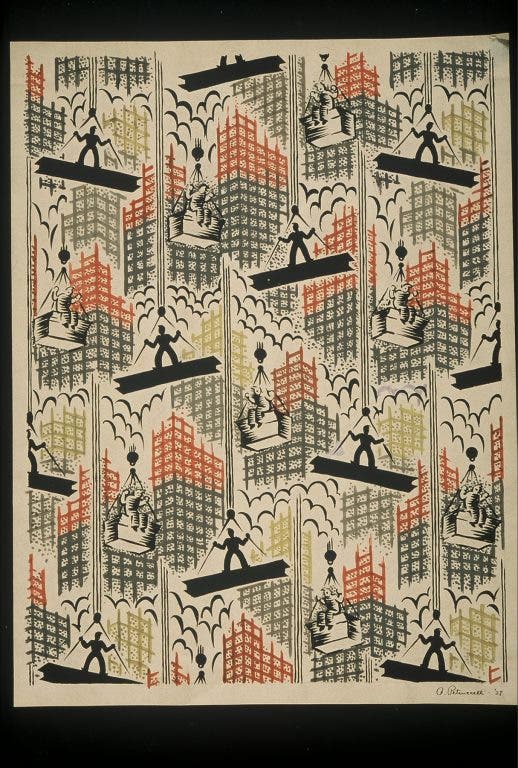


Some artists are born to be stars of the museum gallery. Tony Petruccelli was a standout in a different venue: the humble newsstand.
Petruccelli, a resident of the Mount Tabor section of Parsippany for more than a half-century, was a cover illustrator during the golden age of magazines. His most enduring work was for Fortune, for which he created more than two dozen covers, but he also did illustrations for The New Yorker, Collier’s, Holiday and House Beautiful from the 1930s through the 1950s.
While his artwork was ambitious and visually arresting, with Art Deco, Futurism and Oriental influences, Petruccelli is hardly a household name. Thankfully, the Morris Museum is offering a corrective of sorts with a retrospective of his work, “Antonio Petruccelli: An Unsung American Illustrator.” It runs through March 20.
Find out what's happening in Parsippanyfor free with the latest updates from Patch.
“Although he struggled to gain the appreciation and respect he deserved for his artistic abilities,” the show materials state, “his talent is evident from the detailed, accurate, inventive and vibrant illustrations portrayed throughout this exhibit.”
Born in Fort Lee in 1907, Petruccelli first channeled his artistic skills into textile design. But his career took a turn in 1932 when he entered a House Beautiful cover contest and won first prize. Soon he was churning out illustrations for a number of magazines.
Find out what's happening in Parsippanyfor free with the latest updates from Patch.
From 1933 to 1945, Petruccelli drew 24 Fortune covers, more than anyone else during that period.
“Tony was Mr. Versatility for Fortune,” the magazine’s art director, Francis Brennan, once said. “He could do anything, from charts and diagrams to maps, illustrations, covers and caricatures.”
One of his most successful illustrations was “Board Room,” a sly, fly-on-the-ceiling view of a round conference table packed with nine, identical white-haired executives. A 1941 cover of rows of close-packed army tents was supposed to show the regimentation and boredom of boot camp.
“In the spirit of monotony, I made endless tracings and revisions before the final result,” Petruccelli wrote.
Humor was a constant in his work. In the 1950s, Petruccelli drew an unpublished New Yorker cover of the historic Mount Tabor Fire House. Smoke is pouring out of a second-floor window and volunteers can be seen, in full Keystone Kops mode, hauling out equipment to fight the blaze.
One of his later paintings shows a lawyer’s desk with a set of legal papers resting on the blotter. The party named in the suit? “Phyla Lausute Inc.”
Asked about the best way to develop artistic skills, Petruccelli—who died in 1994—was characteristically self-deprecating. “My own experiencerandom and fumbling—may not be the best guide,” he said.
Several of Petruccelli’s illustrations and paintings in the exhibit are of local subjects. An oil painting of the Morristown train station from the 1950s shows disembarked passengers bent under umbrellas and a foreboding sky.
His beloved Mount Tabor is featured, too. There are two illustrations of Mount Tabor Children’s Day celebrations and a snowy landscape painting that offers a view from his house (with some artistic license taken).
The Mount Tabor Historical Society held it own exhibit of his works that ran until last year.