Neighbor News
Cranbury Girl Scout Daisies "Thinking Day On The Air" event
With help from members of the Delaware Valley Radio Association, the Girl Scout Daisies learned how radio makes modern life possible.
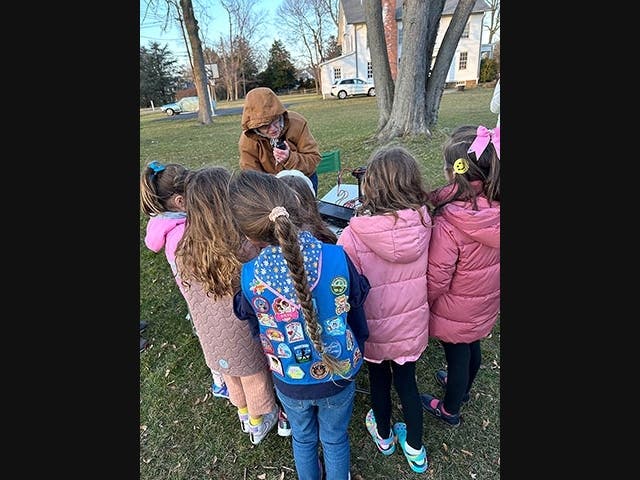
Members of the Delaware Valley Radio Association Tobi Massano AD2CD, Bob Stoker K3EDP and Bob Bowden KB3BB recently participated in a Girl Scout Daisies "Thinking Day on the Air" event at the Cranbury Public Library. The event drew eight Daisies, ages six and seven, several parents and leader Delpha Georges, who initiated, led and organized the event.
Bob Bowden started things off by describing how difficult it was for people to communicate at a distance over many thousands of years, until the invention of the Telegraph in the 1800s. He explained how Morse Code could be sent over long distances using wires, which led ultimately to the telephone.
Then people discovered radio, which is in the same family as light but travels in much longer waves that our eyes cannot see. He explained how the first radio communication was also by Morse Code, but then people figured out a way to send and receive voice and even music using radio.
Television came next, another form of radio that sent sound and pictures over long distances. Now we have things like the Internet on computers and smartphones and streaming TV, but what many don't realize is that radio is still very much a part of all that technology, with cell phones and WiFi in use all around us.
Next, Bowden introduced Amateur "Ham" Radio – a hobby started more than 100 years ago. He also mentioned how it becomes very important during emergencies. Most of all, it's just plain fun for thousands of people around the globe.
Then Bob Stoker talked about some of the exciting places he's reached around the world using Ham radio and told of the hundreds of countries he's contacted. He brought a laminated album
including some of his favorite QSL Cards, colorful postcards Hams send to one another to confirm a contact.
The Daisy Scouts listened very attentively, and were fascinated by the colorful and exotic cards from faraway places.
Afterwards, everyone went outside, where Tobi Massano had set up a portable station using an antenna attached to her car.
Massano had prearranged for a contact with the amazing Rose family of Michigan – seven Ham operators in one family, four of whom participated that day; a 13-year old, 11-year old twins, and the youngest Ham in the family who was fully licensed to operate at age nine.
Contact was made with this family on shortwave 14 MHz, and the Daisies took turns speaking to the four young Hams in Michigan. They did a wonderful job, asking and answering questions over the radio. They didn't seem nervous, and enjoyed it thoroughly.
The group returned to the library to send characters and short messages across the room using Morse Code.