Schools
Princeton Public Schools Tout Results of Dual Language Immersion Program
The first class to register for the program can now conduct an entire class exclusively in Spanish.


The following story was written and provided by the Princeton Public School District:
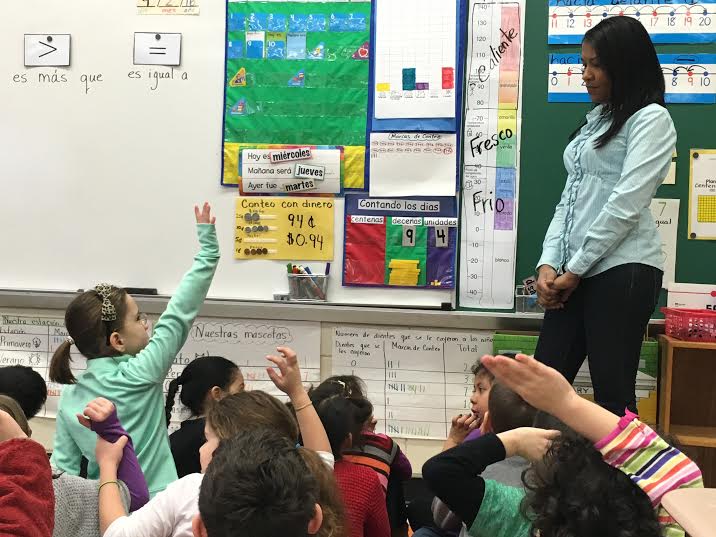
Princeton, NJ -- On a bright chilly morning Damaris Rodriguez’s first grade students were settling in for the school day at Community Park School.
They did a brief activity and began their morning meeting by reporting on the weather, updating their calendar, and doing some quick addition and subtraction of coins.
Find out what's happening in Princetonfor free with the latest updates from Patch.
It was a scene played out in countless other classrooms across the country, but with one significant difference: Everyone in the room was speaking exclusively Spanish.
Almost a year ago to the day, these children were the first to register for the fledgling Dual Language Immersion (DLI) program at Community Park, one of only a handful of such programs in the state of New Jersey.
Find out what's happening in Princetonfor free with the latest updates from Patch.
Using a 50-50 model, which means that at least half of the daily curriculum is taught in the target language (in this case, Spanish) the class includes both children who speak English and those who speak Spanish as their primary language at home.
DLI was limited to Kindergarten and first grade in its inaugural year of 2015-16. This month marks a milestone: On Feb. 23-24, parents of next year’s Kindergarteners at Community Park will meet for a mandatory DLI orientation as year two of the program launches.
In the academic year 2016-17, the program will expand to accommodate the rising second graders.
The idea for the program began some years back, when Priscilla Russel, supervisor of World Languages and ESL for Princeton Public Schools, proposed DLI after studying research on the cognitive benefits of bilingualism.
“We see a higher level of proficiency in the second language; and there is also evidence of enhanced cognitive skills and improved academic performance,” said Russel.
When Dineen Gruchacz, principal of Community Park, heard about the opportunity to launch DLI at her school, she jumped at the chance to provide this rich experience to the students.
The academic benefits as well as the global perspective of such a program dovetailed with her vision of an expansive learning environment in the heart of a tightly-knit, diverse neighborhood of many Spanish-speaking families, as well as speakers of other languages.
“Our entire school culture is being enriched by this new way of thinking about learning,” said Gruchacz. “DLI has made us think more globally -- it is spawning ideas and events to support learning for all of our students, such as our international fashion show.”
As the school helps nurture more Spanish speakers, the children teach and translate for others, even presenting at school-wide morning meetings and delivering the morning announcements in Spanish, as well as in English.
Much planning and more than a little tweaking of schedules went into making DLI a reality. Two teachers in each grade, one Spanish and one English speaking, work in teams, with the students switching between their classroom halfway through each day. The hard work has paid off, for students and teachers.
“This has been a big learning experience,” said Rodriguez, who teaches the Spanish portion of the first grade district curriculum - including math, social studies, science and Spanish language arts - in collaboration with the teacher of the English portion, Mary Gutierrez . “It’s helped me to look at things that I took for granted more closely,” Rodriguez noted.
Learning materials, the physical set-up of the classroom, and, of course, communication in the “Spanish-only” zone have all been transformed.
“Body language and facial expressions are so important in connecting with the students,” Rodriguez said, noting that these were good practices for teaching in general,” Rodriguez said. “On the day I visited the classroom, there was not a hint of puzzlement on the students’ faces as they followed instructions and did their lessons in Spanish, moving seamlessly among activities.”
Rodriguez has also found evidence of the cognitive benefits of a bilingual approach, noting greater growth in mid-year assessments.
The kids have their own criteria for rating the program. They love the songs, learning the sounds of a new alphabet, and especially the fact that they can use the language outside the classroom.
Teddy and Leonie Westrick, two brothers in the Kindergarten and first grade program respectively, have found that their language skills come in handy when they want to share secrets at home.
Maria José Sordo, mother of first grader Ana Rossi, also sees the benefits for her family, whose primary language is Spanish at home.
“It’s helping Ana feel more confident because she can help others,” said Sordo. She is amazed at how much her daughterís classmates have learned, noting that she even speaks Spanish to the children when they come over for to play after school. “They understand everything,” Sordo noted. “Itís like play date plus.”
Photo: Morning Meeting in Damaris Rodgriguez’s first grade class
Get more local news delivered straight to your inbox. Sign up for free Patch newsletters and alerts.