Schools
Princeton Researchers Earn $3 Million For Mapping Early Universe
Thirteen researchers were awarded the Breakthrough Prize in Fundamental Physics for their work on the mapping the early universe.


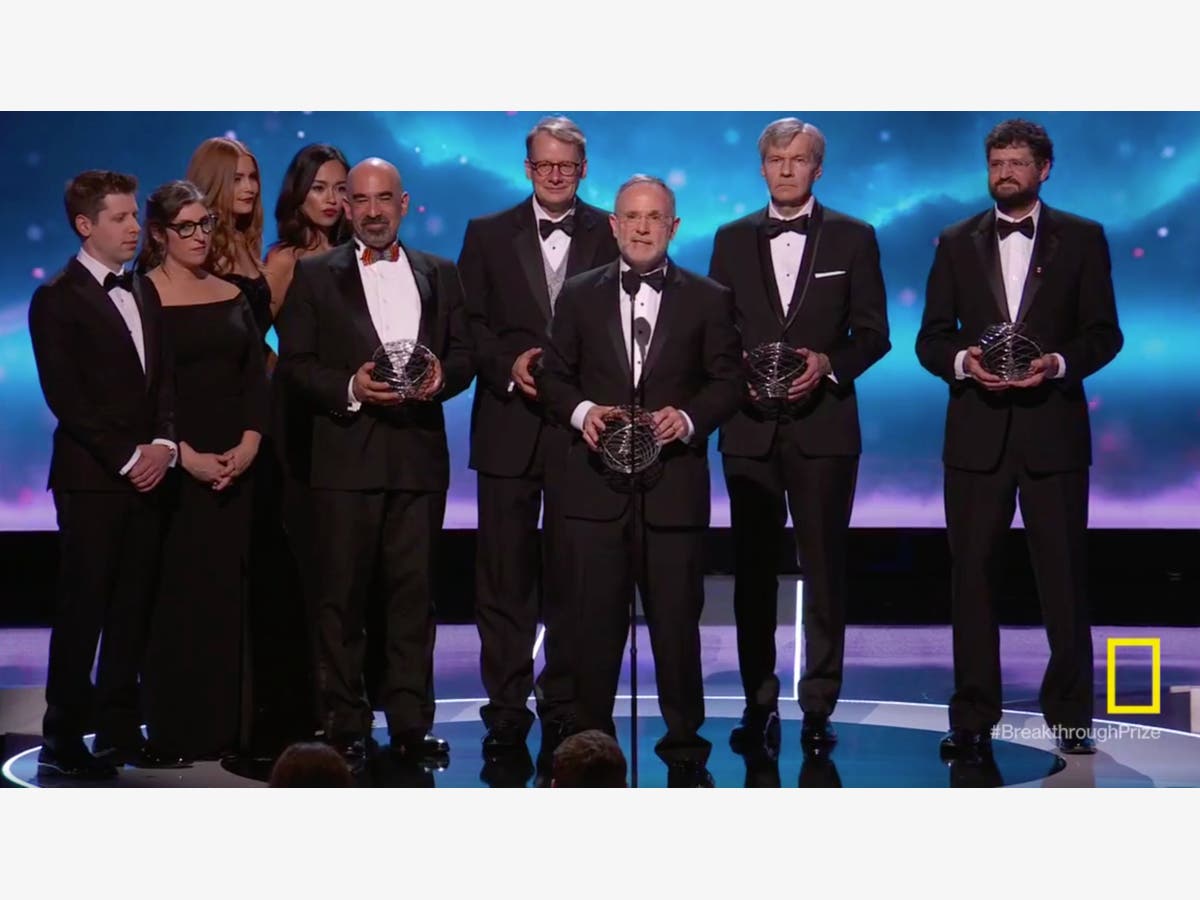
PRINCETON, NJ — Researchers at Princeton University have been recognized for their work mapping how the early universe may have appeared. Thirteen of the university’s researchers were awarded the Breakthrough Prize in Fundamental Physics for their “detailed maps of the early universe that greatly improved our knowledge of the evolution of the cosmos and the fluctuations that seeded galaxies,” the university announced.
Norman Jarosik, Lyman Page Jr. and David Spergel were publicly honored on Dec. 3 for their pioneering work on the Wilkinson Microwave Anisotropy Probe, the NASA satellite known as WMAP. Jarosik is a senior research physicist and lecturer in physics. Page is the James S. McDonnell Distinguished University Professor in Physics. Spergel is the Charles A. Young Professor of Astronomy on the Class of 1897 Foundation.
“Somehow, we seem to have done it,” Spergel said in a video presented during the awards ceremony. “We think we understand the physics that happened in the universe’s first moments.”
Find out what's happening in Princetonfor free with the latest updates from Patch.
Jarosik, Page and Spergel share the $3 million prize with Charles Bennett of Johns Hopkins University, Gary Hinshaw of the University of British Columbia, and the other 22 members of the WMAP team. The team includes Joanna Dunkley, a Princeton professor of physics and astrophysical sciences, and nine former Princeton postdoctoral researchers and graduate students.
The nine members of the WMAP team that participated in the research while graduate students or postdoctoral researchers at Princeton were Chris Barnes. Rachel Bean, Olivier Dore, Eiichiro Komatsu, Michele Limon, Mike Nolta, Hiranya Peiris, Kendrick Smith and Licia Verde.
Find out what's happening in Princetonfor free with the latest updates from Patch.
“Norman Jarosik, Lyman Page Jr. and David Spergel are brilliant physicists whose research has transformed our understanding of the age, shape, and evolution of the universe,” Princeton University President Christopher L. Eisgruber said in a release issued by the university.
The WMAP satellite was originally known as MAP. The W was later added in honor of David Wilkinson, who was an early contributor to the project, which lasted over a decade, according to the university. Wilkinson died in 2002.
The late physicist Robert Dicke was also part of the team of Princeton University contributors that worked on the experiment, which measured the cosmic microwave background radiation. This radiation is the signature of the Big Bang.
NASA launched the WMAP satellite in 2001 toward the second of two spots in space where the Earth and the sun exert equal gravitational pulls on objects. They are known as Lagrange points, and this point is about a million miles away from Earth. Once it reached that point, WMAP scanned the universe, mapping out tiny temperature fluctuations across the sky.
“To my surprise, we saw what we expected to see,” Spergel said in the video. “With WMAP, the tools we had were good enough to explain what the universe looked like 13.8 billion years ago, really for the first time, with high precision.”
Among many other discoveries, scientists interpreting WMAP’s nine years of data have determined that the universe is 13.77 billion years old, and it is composed primarily of dark energy, representing more than 70 percent of all matter.
Eisgruber attended the event with the three physicists.
“Their pioneering work has illuminated some of the most challenging topics in astrophysics, yielding dazzling insights that continue to shape the field today,” Eisgruber said. “I am grateful for their contributions to the Princeton community, and I am thrilled that they have been recognized with this well-deserved honor.”
The physics award was presented by Sam Altman, the president of the startup company seed funder Y Combinator, and Mayim Bialik, a neuroscientist and star of TV’s “Big Bang Theory.”
The Breakthrough Prizes, first awarded in 2013, recognize scientists in the fields of Life Sciences (up to five per year), Fundamental Physics (up to one per year) and Mathematics (up to one per year) with $3 million prizes for each award.
This year, seven Breakthrough Prizes were awarded, with the Princeton scientists sharing the sole prize in the Fundamental Physics category. Additionally, up to three $100,000 New Horizons in Physics and up to three New Horizons in Mathematics prizes are given out to early-career researchers each year.
Princeton biologist David Botstein and physicist Andrei Bernevig received Breakthrough Prizes in 2013 and 2015, respectively.
The Breakthrough Prizes were founded by Sergey Brin, Yuri and Julia Milner, Mark Zuckerberg and Priscilla Chan, and Anne Wojcicki. Selection committees composed of previous Breakthrough Prize laureates choose the winners.
The attached image was provided by Princeton University: Thirteen past and present Princeton University researchers have been awarded the Breakthrough Prize in Fundamental Physics for their “detailed maps of the early universe that greatly improved our knowledge of the evolution of the cosmos and the fluctuations that seeded galaxies.” Norman Jarosik, Lyman Page Jr. and David Spergel were publicly honored on Dec. 3 for their pioneering work on the Wilkinson Microwave Anisotropy Probe, the NASA satellite known as WMAP. Credit: Breakthrough Prize
Get more local news delivered straight to your inbox. Sign up for free Patch newsletters and alerts.