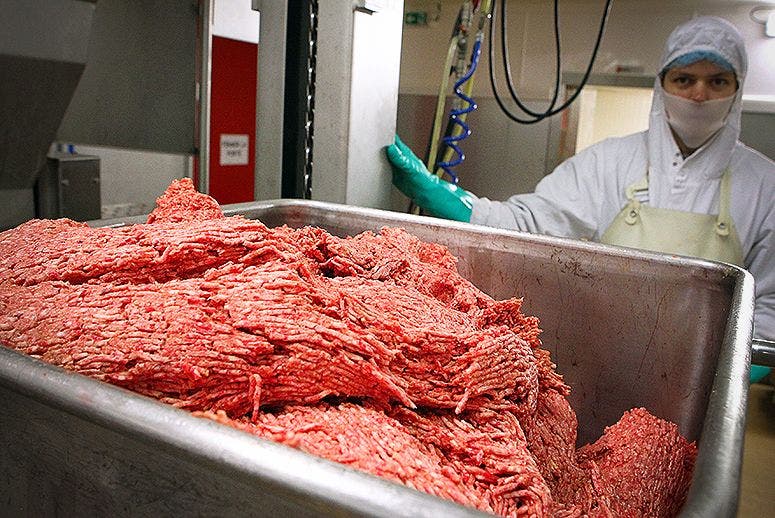
First there was “Pink Slime” and now there are a few more disturbing ingredients that may be lurking within your “mystery meat”.
To the buyer beware!
Grain fed beef can be passed off as grass fed, but the meat industry is not alone!
Find out what's happening in Ramseyfor free with the latest updates from Patch.
A few other examples of deception are:
1. Conventional produce can be passed off as organic.
2. Farmed salmon can be sold as wild caught.
3. Cheaper and less healthy Canola oil can be mixed in with your “extra virgin olive oil”, making it somewhat less than less than “extra virgin”.
Find out what's happening in Ramseyfor free with the latest updates from Patch.
Deception is running rampant throughout the food industry, but DNA testing doesn’t lie. Even if it looks like and tastes like ground beef, it may not be. A pair of studies found that meat purchased in grocery stores and online are not always containing what the labels indicates.
Even if you pay close attention to what is on the label, what isn’t on the label could be what you really want to know.
The bottom line is that you need to trust the honesty and integrity of your food sources.
The finding of two studies produced by Chapman University’s Food Science Program, will be published in the January 2016 Food Control journal.
The researchers conducted DNA testing and other scientific analyses on samples of ground meat (such as turkey, pork, chicken, and beef) found in brick-and-mortar grocery stores and on samples of specialty game meat (including bison, pheasant, and bear) sold online. About 20% of the time, the label on the package didn’t line up with what was inside.
Of the 48 fresh and frozen samples of ground meat found in traditional markets, 10 were mislabeled. Nine of those 10 packages contained a mix of meat species, partially what the label indicated and partially some other animal. The tenth sample was meat from a completely different creature than what the label suggested.
Unintentional contamination at meatpacking plants may account for some of this, according to the study’s authors. If a processor handles pork, beef, and turkey, for example and doesn’t fully clean the equipment, DNA of one animal can, in varying degrees, end up in the packaging for another.
The researchers also speculated that “lower-cost species are being intentionally mixed in with higher-cost species for economic gain.” In particular, that raises a concern about the ethics of the $39 billion specialty game meat market in the U.S.
The second study tested 54 samples from that lucrative online market and found 10 packages were mislabeled. One bundle of black bear burgers was actually beaver, two packages of pricey bison burgers and one package of expensive yak burgers were plain old domestic cattle and a container labeled as pheasant was helmeted guinea fowl. The retailer, of course, pockets the difference.
That’s troubling enough, but the researchers also found that two of the ground meat samples contained horsemeat, which is illegal to sell in the United States.
“Although extensive meat species testing has been carried out in Europe in light of the 2013 horsemeat scandal, there has been limited research carried out on this topic in the United States,” Rosalee Hellberg, an assistant professor at Chapman University and coauthor of both studies, said in a statement.
It is about time that our USDA meat inspectors start protecting Americans against fraud and deception.