Health & Fitness
Talking Turkey
When shopping for your Thanksgiving turkey, try organic, pasture raised and local.

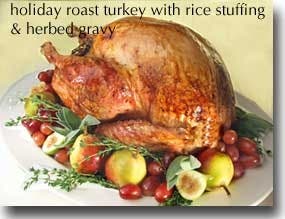
When shopping for your Thanksgiving turkey, try organic, pasture raised and local.
Organic standards help lower risk of contaminated feed and organic turkey usually is of higher nutritional quality. Organic by itself does not guarantee a natural lifestyle for the turkeys.
Go beyond organic by asking for pasture-raised. Don’t get sidetracked by the confusing labeling terms. You are likely to find phrases like “pasture-raised”, “pastured”, “free-range” and “cage-free” on turkey packaging. Labeling laws allow products to display these terms even if the turkeys spend little or no time outdoors in a pasture setting. Talk to your grocer or the turkey farmer and find out how the animals were actually raised.
Find out what's happening in Ramseyfor free with the latest updates from Patch.
Pasture-based diets were found to increase the level of omega-3s in turkey meat. Turkey provides high quality protein. Turkey is also rich in other nutrients. All B vitamins are present in turkey meat, including B1, B2, B3, B5, B6, B12, folate, biotin and choline. In terms of minerals, turkey is richest in selenium and provides over 60% of the DRI in a single 4-ounce serving. Zinc, copper, phosphorus, magnesium, potassium, and iron are also provided by this food in noteworthy amounts. A recent study has shown that consuming 1 to 4 ounces per day or more of skinless turkey, is associated with a decreased risk of pancreatic cancer.
Turkeys are truly native to North and South America - they were not brought to the “New World” by European settlers but were instead discovered to be already present and intimately involved with Native American cultures. Turkeys are relatively large birds that can reach about 30-35 pounds in weight. They can fly short distances at speeds of about 50-55 miles per hour and run at approximately 20-25 miles per hour.
Find out what's happening in Ramseyfor free with the latest updates from Patch.
Pasture-raised turkey eat acorns, beechnuts, pine seeds, grasses, grass seeds, sedges, farbs, tubers, bulbs, crabgrass, wild berries, alfalfa, clovers, beetles, grasshoppers and leafhoppers. This very broad natural diet. Many different breeds of turkey are pasture-raised for food. These breeds include Broad-breasted Whites, Standard Bronze, White Holland, Bourbon Reds, Narragansetts, and Royal Palm.
In the U.S., we consume an average of 16.5 pounds of turkey per person per year. That about is about one-quarter of our chicken consumption. According to the National Turkey Federation, about 20% of all turkey, just over three pounds per person, is consumed on Thanksgiving Day.
First, you should try to purchase of fresh turkey. Additives like sodium erythorbate, MSG and salt are not allowed on fresh turkey and that’s a major health advantage for you.
Second, look for an organic turkey. Federal organic standards require organic turkey to be raised on organic feed, providing you with a food that is far less likely to contain unwanted contaminants.
Third look for true pasture-raised. The terms “free range”, “free roaming” and “cage free” are allowed on labeling by the USDA and do not guarantee that the turkeys actually spent any routine time outdoors in a natural pasture setting. While certified organic turkeys are required to have had “access” to the “outdoors,” the actually amount of time spent outside is not specific in the organic regulations and neither is the quality of the space described as “outdoors.”
Organic, pasture-raised turkeys may be available from local farms. Two websites that are both searchable by zip code and can help you find small local farms in your area are