Business & Tech
A View from the Inside on Thoroughbred Horse Racing
Visitors to the Eastern Branch of the Monmouth Public Library learn the saddle and ropes of horse racing.
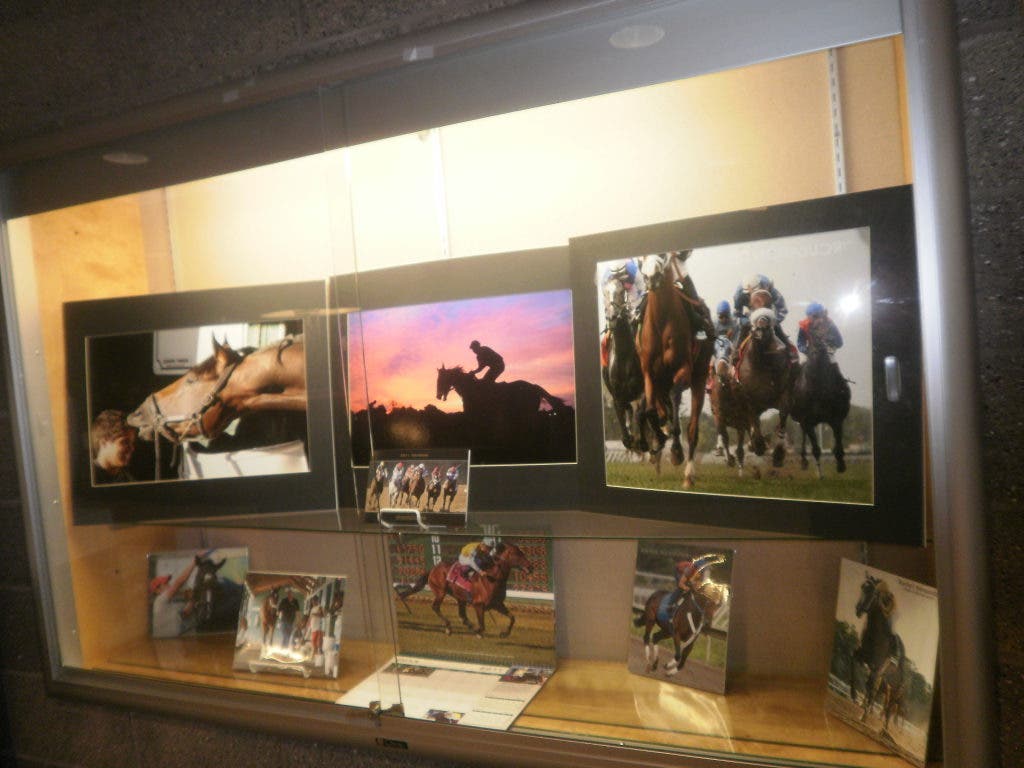

"A horse's natural instinct is to run and run fast," H. Robb Levinsky, chairman of Neptune-based Kenwood Racing said Thursday night, noting that Belmont Stakes winner and Monmouth Park trained Ruler on Ice did just that on June 11.
Ruler on Ice won the Belmont despite challenges by Preakness winner Shackleford and Kentucky Derby winner Animal Kingdom. Levinsky said he didn't expect Shackleford to win because of the length of the race course in Queens, New York.
Approximately 15 people turned out at the Monmouth County Library Eastern Branch in Shrewsbury for the second in a three-part series on the Thoroughbred Horse Industry.
Find out what's happening in Red Bank-Shrewsburyfor free with the latest updates from Patch.
Levinsky told the audience gathered in the library's meeting room how he began his interest in horse racing at the age of 14. He said he "loved being outdoors and animals."
"I wanted to work with horses and one day a man came by my house and said 'stop by the race course on a Monday morning'," Levinsky said.
Find out what's happening in Red Bank-Shrewsburyfor free with the latest updates from Patch.
He did just that and working with horses began a "labor of love."
Levinsky said he is very "passionate about horses" and especially about thoroughbred horse racing.
He noted that horse racing is the oldest sport in the country, and "people started to populate the race courses in the early 1700s."
In the 18th Century transportation to and from a race track was not as advanced as it is today.
"People came to Delaware Park, and it took days to get there," he said.
He explained that horse racing is popular in the history of the United States and is also popular in Australia and Asia.
Levinsky said that there have been mistakes in the racing industry in not getting enough national exposure.
"There have been several mistakes and the industry didn't utilize television as much as it could have," he said.
He explained that horse racing needs to have a "different kind of racing structure."
"We race for two months of the year," he said, noting that casinos for bettintg and gambling operate 365 days a year.
"Casinos offer free drinks (as perks) and a race course does not," he said.
Levinksy noted that Monmouth Park in Oceanport is a "wonderful track." Monmouth Park had previously been operated by the New Jersey Sports and Exposition Authority but on June 1 developer and casino owner Morris Bailey began a five year lease to operate the race track.
He added that at least two other tracks are good for racing thoroughbreds citing Churchill Downs in Lexington, KY and Saratoga in New York State.
During his nearly two hour talk, Levinsky posed a question "Is there dishonesty in horse racing?" He answered by saying "yes" but noted there is dishonesty in politics and even in the stock market (inside trading).
"The vast majority of horse races are honestly done," he said.
Forthose people interested in getting into the horse racing industry by owning a horse, Levinsky said that "almost everyone who does it loves horses."
One of the topics Levinsky covered included the breeding business.
"Breeding horses is a high risk business," he said.
He posed a question to the audience asking who was more important a mare (female) or a stallion (male).
One member of the audience said mare and Levinsky noted that the gentleman was correct.
"A mare has to carry the foal, raise it and nurture it, and a mare is going to teach it to run faster, and a mare is more important in breeding pedigree," he said.
He noted that the gestation period for a mare is 11 months, adding that a mare will usually give birth to one foal.
Levinsky said his own company - Kenwood Racing - is a racing stable. One of the horses in that stable, Hermosillo, won the $100,000 purse at the Charles Hesse Handicap at Monmouth Park in 2009 at odds of 35-1.
Another topic he discussed was how to wager or bet on a horse to win. He explained that most people just pick a name they like or even a jockey they know the name of.
"Wagering is not easy, and there is no house horse to bet on," he said.
He noted that some of the things to look for in wagering include value.
"To be successful over the long term you are looking for value. The horse wiith the best chance of winning is usually not the best bet," he said, adding that a horse with a 40 percent chance to win that is 1-1 (even money) is a losing wager over the long run. He noted that a horse with a 25 percent chance to win in the same race is 5 to 1 will make you money over time.
During a question and answer segment, an audience member asked about a recent 60 Minutes story on injecting horses with two legal enhancers, Lasix now called Salix and Bute.
"I believe Congress should become involved given Salix is a drug," the man said.
Levinsky noted that "medication in most racing internationally is illegal, and there has been great criticism in the US for it."
"Two drugs are legal, Bute and Salix," he said. He noted that giving horses just the minimal amounts of Salix and Bute is fine.
"Giving horses large amounts of the two drugs absoulutely not," he said.
Another person asked about whether the number of female jockeys will increase in the future.
Levinsky noted that the first female jockey was in 1969.
"Women riders should be more common in the future," he said.
"Female jockeys will be gradually increasing as more and more women become successful at racing," he said.