Arts & Entertainment
Love, Hate, Deception and Truth at Two River Theater
TRTC's Much Ado About Nothing is thoroughly William Shakespeare ... which is good and given to great.


To truly appreciate, dissect and glean from the Two River Theater Company's latest offering, Much Ado About Nothing, it is important to cipher it through an understanding of the time of its creation and of its playwright: a prolific, sometimes formulaic, always exquisite English chap named William Shakespeare.
Indeed, despite an updated setting and period dress - Director Sam Buntrock places the Elizabethan romantic comedy in the early 20th century, some 300 years ahead of its original performance period - the text, conformity and opportunity for a confident and skillful actor to step outside of both is pure Bard.
It is important to cipher it in this way, but important to note as well, that it's not essential. TRTC turns in an enjoyable romp of words, of light, of pith for anyone, but for those fans of the tradition, Much Ado, is a perfect example of the clockwork inside the wit of Will Shakespeare.
As likely as humming a Beatles' song would be a musical revelation to anyone, it likewise does not give away the story or betray the production of Much Ado, to foretell that it is ripe with Shakespearean plot devices. Love at first sight, confused identities, plots for love and revenge, a faked death, a necessary moment of hysteria followed by a resolution born from the tongue of the fool - short of a bit about a dog, Much Ado offers audiences the opportunity to enjoy much of the playwright's work in this single play and period it was first staged.
Fortunate for audiences then, that Buntrock directs with a delicate less-is-more style and that his creative team produces a world that represents well, place and mood, and then gets out of the way. The set and scenic design give framework to this glance at the gears of story and character development; apt praise, given the familiar construction of Shakespeare's play, to make full disclosure to his audience, to offer behind-the-scenes views of every motive and plot, giving way to turn of phrase and performance.
Shakespeare acknowledged lovers in his plays, but favored the deliberators and the fools best of all and the performances of those roles in the TRTC production honor that appreciation. In favoring them the playwright focuses his and then therefore the audience's ken upon them. These are the roles that carry the weight and the dialogue and mission of the work.
Michael Cumpsty and Kathryn Meisle (Benedick and Beatrice respectively) act well Shakespeare's intent with their play-long two part harmony about the pitfalls of love and why we overcome them. Rejecting human need and traditional, nay Elizabethan views of love and marriage, the couple debate everyone and prod each other as they fall in love.
While fulfilling the text to the letter, both actors make the language accessible with a clear, visible and contemporary delivery, making the characters their own, despite the age of the work and the multitude of actors who have played their roles before.
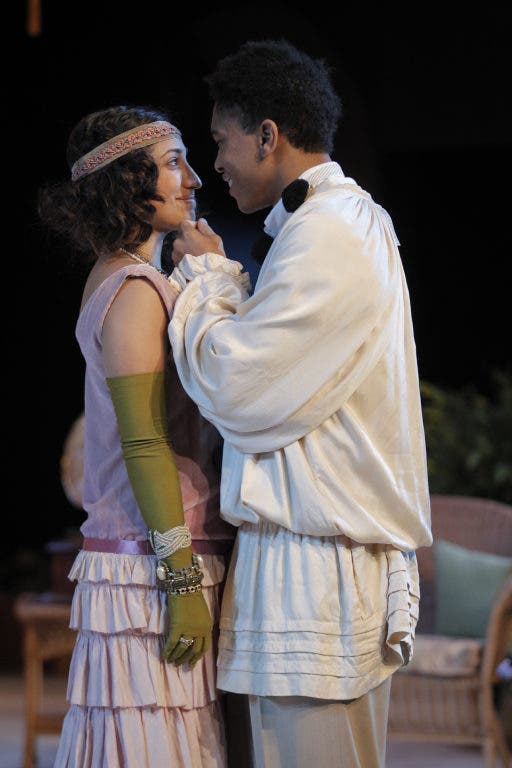
And if Benedick and Beatrice were the writer's challenge to actors, it is the lovers, Claudio and Hero, that were the play's and the period's necessary characters. Immature, irrational and sometimes embarrassing (more so the more we move away from Elizabethan perceptions), the lovers are more stereotype because they were expected to be.
In Much Ado, their isn't much for the lovers to do, or say actually, in the text of the play. Emotion and development of love is more pantomime than anything else and the speed of their affections, wanting to marry only hours after first looking upon each other, is a symbol of their age and their place as the heart of the play.
There is less wiggle room in the work for Claudio (Aaron Cliften Moten) and Hero (Annapurna Sriram) and performances can oft times ring false, contrived, or worse, schmaltzy. Both TRTC actors avoid the latter and are a capable with their charge. Sriram's porcelain doll looks, a beauty to behold, and her gentle and inviting performance both wooed Claudio and the audience.
Despite the fact that the play possess stereotypes and constraints, there are enough moments for every actor to summon true emotion. The Wedding of Claudio and Hero is one of those moments and perhaps the one soft spot in the production. The heartbreak, the visceral rage, the sudden sorrow did not come across, did not feel believable, or apt, nor did the play's emotional resolution. Moten seemed like a tin-soldier or a matinee hero in the action and delivery of his anguish.
And the production in those moments feels a bit - "Shakespearean;" as if too much of what is happening on stage is left to what is written in the text and not felt in the hearts of the actors.
Steven Skybell returns to the TRTC stage (last seen in Candida) to play the role of Don Pedro, a benchmark of the story. His role in Much Ado is strangely similar to his role in Candida, the cerebral, yet tellingly emotional center. Also similar is Skybell's ability. He is confident and convincing.
John Ahlin gives a standout performance as the play's chief fool, Dogberry. It is the role, that Shakespeare clearly most enjoyed creating and crafting. His dialogue, a jumble of malapropisms, is delivered with much enthusiasm and conviction, so as to prove his character's singular belief in what he says and does, giving Ahlin the opportunity to be as ridiculous and hilarious as the role affords and the actor able. His second act performance is reason alone to call the production a success in two acts.
Much Ado About Nothing runs until October 2nd with post-production discussion with the audience on Wednesday, Sept. 28th, following the 1PM matinee. For ticket information visit TRTC on the web at: www.trtc.org.