Health & Fitness
Kimball C. Atwood’s Shingle-Style Chateau
What part did accident insurance, grapefruit and thoroughbred trotters play in the story of one of Bergen County's most recognizable landmarks?

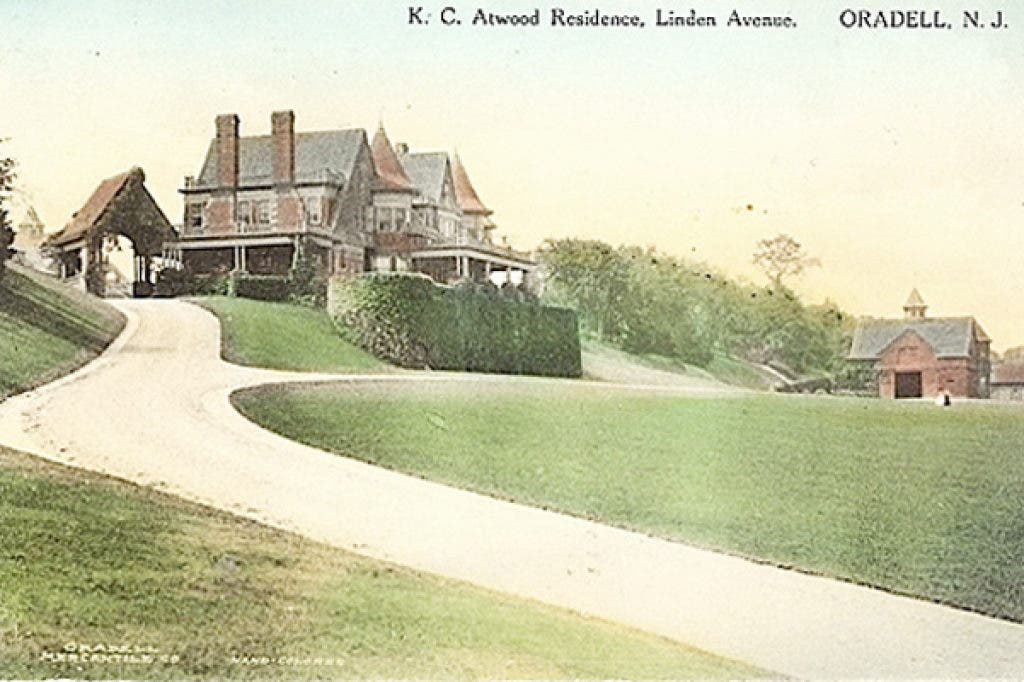


By Kevin Wright©2012
Kimball Chase Atwood’s Shingle-style chateau on Kinderkamack Road in Oradell competes only with the iconic Dutch Colonial Steuben House for the distinction of being the most recognizable residence in Bergen County. This proud but weathered cynosure of the Gilded Age was originally planted on a checkerboard of woodlots and pasture amidst rolling horse country when Oradell marked the suburban frontier. It dominates the eastern slope of Soldier Hill, an eminence with commanding views of the Hackensack Valley, which earned its name from an encampment of Continental troops for several weeks in September 1780. Over the years, cannon wrenches, cannonballs and other military artifacts were plowed from the adjoining stock farms of Kimball C. Atwood and John B. Lozier, as well as portions of the Hackensack Golf Course, providing silent witness to the former presence of Washington’s army in the times that tried men’s souls. While excavating for a road widening, John B. Lozier even unearthed the remains of a Continental soldier—Some claimed these bones belonged to David Hall, who was hanged on September 12, 1780, before the eyes of his comrades-in-arms. James Thatcher, a Surgeon in the Continental Army, described his execution, writing, “A soldier was executed for robbery; he was one of five who broke into a house with their arms, and robbed the inhabitants of a sum of money and many valuable articles. He conducted [himself] with fortitude at the gallows.”
The Dutch farmhouse of John Van Wagoner, built after he acquired the land in 1751, is shown on Revolutionary War maps of the neighborhood—sandstone from its walls are yet to be seen in the parapet wall of Atwood’s sprawling mansion. The property returned to descendants of its original owner in 1922, when Elmer Blauvelt purchased the mansion and its grounds.
Find out what's happening in River Dellfor free with the latest updates from Patch.
Kimball Chase Atwood
Kimball Chase Atwood was born January 3, 1853 in Buckfield, Oxford County, Maine, the second of William Harris Atwood and Helen Mary Atwood’s five children. His father was a Baptist Deacon and merchant. When Kimball was twelve years old, his mother died. His father re-married two years later. After attending the village school, Kimball was educated at Hebron Academy, the oldest endowed boarding school in the United States. During vacations, he clerked in the family general store. According to A History of Buckfield, published in 1915, Kimball Atwood “was passionately fond of hunting and fishing and also of riding and driving. These tastes have clung to him in later life and he is to-day as enthusiastic in any outdoor sport and pastime as when a boy.”
Find out what's happening in River Dellfor free with the latest updates from Patch.
Reaching nineteen years of age in 1872, he sought out his fortune in New York City, with only begrudging acquiescence from his father. Kimball started as a bookkeeper in an established dry-goods commission house, but, after seven years, accepted the position of cashier in a small insurance firm. On July 11, 1881, Kimball C. Atwood married Caroline B. Hutchings of Portland, Maine. A daughter, named Helen Mary, was born in New York City on May 24, 1882.
Kimball Atwood became cashier with the United States Mutual Accident Association, when it was founded in 1883. He was listed in the Jersey City Directory in 1884 as a cashier, residing at 106 Sip Avenue, Jersey City. He founded the Preferred Mutual Accident Insurance Association on October 12, 1885, with successful Connecticut politician and shoe manufacturer, Phineas Chapman Lounsbury, of Ridgefield, Connecticut, who became the agency’s President. Kimball C. Atwood was Secretary, and Allen S. Apgar, Treasurer. Their principal office was located at 257 Broadway in New York City. By 1889, Kimball C. Atwood was living in Clifton, New Jersey, and commuting to work in Manhattan. His son and namesake, Kimball C. Atwood, Jr., was born in Clifton on November 12, 1892.
Though twelve years his senior, partner Phineas Lounsbury’s rags-to-riches story somewhat mirrored Kimball Atwood’s own. Lounsbury was born a farmer’s son in Ridgefield, Connecticut, in 1841. Upon reaching his majority, he started out as a lowly clerk in a shoe store in New York City, where he met his wife, Jennie Wright. Learning every department of the business, he soon successfully engaged as a shoe manufacturer in partnership with his brother. First elected to the Connecticut legislature in 1874, Phineas C. Lounsbury became Governor in 1886. At the end of his term, he retired from politics to serve as President of the Merchants Exchange National Bank of New York.
Marking their great success, Phineas C. Lounsbury and Kimball C. Atwood re-incorporated the Preferred Accident Insurance Company of New York as a stock company on March 3, 1893, with $200,000 in paid-up capital. The company became “the largest in the world, doing exclusively a personal accident business.” Kimball Atwood worked as secretary and general manager of the company he helped to found, eventually becoming its president and largest stockholder. According to contemporary accounts, “he originated the preferred and combination policies and he has probably done more to popularize accident insurance than all others.” Atwood was also principal owner of several shipping vessels plying between New York and foreign ports.
On September 18, 1893, Kimball C. Atwood purchased Lots #36, 37, 43 and 44 in a new suburban subdivision, known as Rutherford Terrace, in Rutherford, New Jersey, for $1,000. On July 10, 1894, Kimball and Carrie B. Atwood, of Rutherford, sold Lots # 43 and 44 in Rutherford Terrace, on the northwest side of Hawthorne Street and bordering St. Clair Avenue, to William S. and May Frye for $3,000. On October 1, 1894, the Atwoods, residents of Clifton, sold Lots # 36 and 37, together with the buildings and improvements thereon, to Daniel Gross, of Rutherford.
Northland
On October 1, 1895, Richard and Euphemia Van Wagoner sold “all that certain tract or parcel of land and premises” in Delford (Oradell), containing 4.04 acres, to Kimball C. Atwood of {Clifton), Acquackanonck Township, Passaic County, New Jersey. This piece of ground encompassed an old Dutch Colonial sandstone dwelling of pre-Revolutionary War vintage. On that same date, Walter and Maria Christie, Alfred and Hannah Van Wagoner, Edward Van Wagoner and David Bogert Van Wagoner, the heirs of John Van Wagoner, Jr., sold that part of the Homestead Farm, belonging to the late John Van Wagoner, Jr., deceased, lying west of Kinderkamack Road, to Kimball Atwood. The Kimball C. Atwood estate in Delford, Bergen County, consisted of about 100 acres, occupying the hillside west of Kinderkamack Road.
Given Atwood’s penchant for horses, it was likely John B. Lozier, owner of the adjacent Oradell Stock Farm, who attracted him to Oradell. In what must have been a coordinated effort, John B. Lozier acquired that portion of the former homestead farm of John Van Wagoner, extending east of Kinderkamack Road, down to the Hackensack River, from the Van Wagoner heirs on August 26, 1893. John B. Lozier resided just north of the Van Wagoner farm, where K. C. Atwood would soon build his residence. Lozier advertized his establishment as “a Horse’s Home,” where fine-blooded animals could be boarded at reasonable rates. He described the location as “one of the beauty spots of New Jersey, 18 miles from the metropolis. The Hackensack River with magnificent shade trees flows almost around the farm.”
Kimball C. Atwood moved from Clifton to Oradell immediately after his purchase of the Van Wagoner farm on October 1, 1895, carrying plans for extensive improvements. According to The Bergen Democrat, “Old buildings were to be torn down and larger structures erected in their stead.” He quickly employed a force of men to grade the lands fronting Kinderkamack Road on a level with the adjoining property of John B. Lozier for the purpose of converting the old place into a modern stock farm. Workmen quickly removed old three-rail fences and demolished antiquated outbuildings.
According to a report in the Passaic Herald, tramps set fire to Atwood’s former Clifton residence on November 20, 1895. His loss on the property was $4,000, but he only carried $2,000 in insurance. He offered $1,000 in reward for arrest of the incendiary. In the first week of December 1895, William Craft, the foreman on Mr. Atwood’s new place, met with what might have been a fatal accident. A horse tried to kick another horse that Craft was leading, but missed and struck Craft in the head and arm, inflicting a painful but dangerous injury.
With ground preparations completed, Atwood hired Oradell contractors, Cooper & Demarest, just before Christmas 1895, to build a barn for $5,000. The Hackensack Republican reported on February 6, 1896, “Activity in building is still observed at the Atwood place, work having been commenced on the big barn.” On March 13, 1896, The Bergen Democrat noted, “Cooper & Demarest are completing a handsome barn, with all modern improvements, on the premises of Mr. Atwood.”
At the same time, John B. Lozier cleared a strip of woodland on his portion of the Van Wagoner farm for pasture, thereby opening “a river frontage of over one mile.” He put his racetrack on the hill in fine working order to exercise “high bred steppers on Mr. Lozier’s property, those of Mr. Hugh J. Grant and of Mr. Atwood.” Locals anticipated some fine racing. The Democrat boasted, “Some of the most noted horses in the country are kept on the Lozier farm. There are 120 horses in the stables and numerous colts, but a few weeks old…Mr. Lozier maintains a drug store and hospital for horses and a blacksmith shop.”
On May 1, 1896, The Bergen Democrat reported on Atwood’s plans to raise “A Big Mansion”:
“Mr. Atwood, who purchased the Van Wagoner farm, which adjoins the handsome property of Mr. John B. Lozier, removed this week to Oradell, where he will reside until the extensive improvements proposed by him are completed. Mr. Atwood has just completed a barn costing $10,000, and stakes have been driven for the foundation of another on the hill. The old Van Wagoner homestead, which has long been a landmark in this vicinity, will be torn down and Mr. Atwood proposes to erect on its site one of the largest and most complete residences in Bergen County. Its length will be 110 feet, and depth 70 feet, the rear portion of the building to be constructed as an art gallery. The surroundings of this property are to be put in first class condition. The entire front along the road to Etna [Emerson] has been graded and in fine order. Residents of Bergen are fast acquiring the reputation of owning many valuable horses and among them Mr. Atwood owns two with records below 2.15.”
On June 18, 1896, another local correspondent noted, “Mr. Atwood is preparing for the erection of a fine new residence on the slope west of his farmhouse. It will be a handsome modern home.” While the great house was rising, a commotion erupted in the Borough of Delford over the introduction of the telephone. It seems the Mayor and Council granted permission for the telephone company to place poles on the streets, provided individual property owners were agreeable. Linemen, however, began putting up poles in September 1896, not only without seeking consent from homeowners, but over numerous objections from them. Oradell’s first telephones were installed in the residences of former New York City Mayor Hugh J. Grant, Kimball C. Atwood, and John B. Lozier, in the drugstore and in Dr. Jones’ office.
Signaling commencement of work on building the mansion, The Hackensack Republican reported on November 12, 1896, “The grading of the Atwood place looks like a big job and when it is completed the grounds and house will present a very attractive appearance from the railroad.” A week later, a steam engine arrived to mix concrete, “of which large quantities are required for the cellar and large plazas of Mr. Atwood’s new mansion, which, by the way, will be one of the grandest homes in northern New Jersey.” The Republican assured its readership, “All the work is of the most substantial character and the architecture is greatly admired.”
At this time, Kimball Atwood and John B. Lozier jointly announced, “a new half mile race track will be built east of the railroad….” It wasn’t known whether the track would be “purely for the private use of those two gentlemen, who own many fine and fast horses, but the fact that the Erie [Railway] Company is going to extend the new double track a considerable distance north of [Veldran’s] mill would seem to indicate that it was for the accommodation of more than ordinary traffic in the sporting season.” The Oradell correspondent for the Republican surmised, “such a track would be sure to draw a large attendance as some of the best animals in the country would be shown.”
On February 18, 1897, the Hackensack Republican noted, “The Kimball Atwood house is now getting near the point of completion, but it is doubtful whether it will be ready for occupancy on April 1.” In March 1897, Kimball Atwood and John B. Lozier began building “a private electric plant to supply light for their residences and grounds.” By the middle of April, a large force of men and carts were grading around the new Atwood residence. On or about June 1, 1897, Kimball Atwood and his family “moved into the upper portion of their big mansion. There is much wood carving to be done on the first floor and that will not be finished before next winter.” Besides the woodwork, establishing the great lawn in front of the house required considerable effort. On July 22, 1897, a local correspondent observed, “Every heavy rain works a large quantity of dirt from K. C. Atwood’s immense new lawn onto the roadway and in some places there is fully three inches of dirt on top of the macadam. The big job of grading this large tract is nearly completed, and when finished will make one of the finest sloping lawns to be found anywhere.”
On July 29, 1897, The Hackensack Republican reported, “A city newspaper prints an illustration of Kimball Atwood’s chateau and has this to say.”
“Mr. Atwood has expended $100,000 and the interior is not yet completed. The house is designed after a French chateau. The stone parapet wall is 23 feet high and 140 feet long. Between the wall and the house is a porch about 15 feet deep, with English terraces at each end.”
“The floors are of inlaid wood. The woodwork in the art gallery is of wine-colored mahogany. The panels in the breakfast room are bird’s-eye maple and the mantles are onyx. The walls in the reception, dining and billiard rooms will be adorned with tapestry and hunting scenes. There is an aisle near the art gallery, with a colored glass skylight. The dining room is a spacious one.”
“Mr. Atwood during his trips around the world secured many curiosities and he thinks he will place them in what he first intended for the billiard room, on the main floor, putting the billiard table on the second floor.”
“Mr. Atwood has built a water system and will soon put in an electric light plant. He also has a perfect sewage system. The lawn in front of the is 1,000 feet in width and runs down to the main road, 500 feet.”
“The property was formerly the Van Wagoner farm, and comprises 100 acres. Mr. Atwood has the original deed for the first Van Wagoner, dated 1751. There is a dense wood of about 30 acres back of the residence, which may be stocked with deer. There are 35 thoroughbreds in the stables. Among the horses are Aubine, 2.13-3/4; Star Lette, 2.21-1/4; and St. Lawrence, 2.23.”
Atwood named his new countryseat, Northland. He and his wife departed for Florida in the middle of January 1898, returning in the middle of March. Other snowbirds included Mrs. James Blauvelt and Mrs. Margaret Van Wagoner.
Atwood’s neighbor, John B. Lozier, “an enthusiastic musician,” added a thoroughly equipped, commodious music room to his own house in September 1897. Even though Lozier already boarded 140 thoroughbred horses on his Oradell Stock Farm, it was fast becoming difficult to accommodate all the applicants who wished to bring their animals there. Consequently he enlarged the facilities “by adding another to his large number of buildings, which form his colony of blooded stock.” Immediately upon completing one new large barn for Mr. Lozier in late January 1898, New Milford contractors Cooper & Demarest started work on yet another.
Kimball C. Atwood, John B. Lozier and Hugh J. Grant incorporated the Delford Electric Company in March 1898, not only to provide for their own needs, but also to supply other individuals who might wish to purchase electricity. The Hackensack Water Company furnished power from their new electric plant, producing enough to supply all comers for some years. The new power company started with $10,000 in capital, divided into 100 shares.
Fred Wesley Wentworth
Apparently while residing in Clifton, New Jersey, Kimball C. Atwood became familiar with the work of Paterson architect Fred Wesley Wentworth, whom he engaged to design his large home and stable on Soldier Hill, where Atwood could breed horses.
Architect Fred W. Wentworth was born in Boxborough, Essex County, Massachusetts, on August 22, 1864, the son of William Trickey Wentworth and Lucinda Phipps McDonald. In 1880, he resided with his parents in Dover, Stratford, New Hampshire. He graduated in 1887 from the Abiel Chandler School of Science and Arts, a department of Dartmouth College. In 1888, Fred Wesley Wentworth was a draftsman, living at 140 Water Street, Paterson, New Jersey. By 1891, the Paterson Directory listed him as an architect. He married Florence A. M. Horlburt in 1893.
In 1901, Fred Wentworth had offices in Rooms 24, 25 and 26 in the Paterson National Bank Building, but he resided at 630 East 27th Street in Manhattan. He became Paterson’s leading architect as the city rebuilt after the Great Fire of February 9, 1902, which destroyed five of the city’s largest churches, eight public buildings, five club houses (including the magnificent Hamilton Club), seven large office buildings, all telegraph offices, one theater, twenty-six or more big business houses, including two of the largest department stores in State, and about 500 homes. Wentworth moved his own studio and offices to the Citizens’ Trust Company Building on Market Street. He died October 3, 1943 at 79 years of age.
The Atwood Grapefruit Company
As their Oradell residence neared completion, Mr. and Mrs. Atwood visited Florida, where they had a new business venture afoot. On May 6, 1897, the Hackensack Republican noted, “Kimball Atwood, of this place, is establishing on the Manatee River, the greatest pomelo (grape fruit) grove in the world. It covers more than 200 acres of virgin soil and has a half-mile of riverfront. Twenty thousand trees have already been planted and the grove is attracting widespread interest from the very thorough and scientific manner in which its foundations have been built. The direct management and supervision of the great enterprise is under Lewis C. Randall, formerly of Passaic.”
Though prospering in the insurance business, Kimball C. Atwood kept a restless eye open for opportunity. As the story was later told, Christian Cole, a business associate in poor health, took a sea voyage on doctor’s orders to restore his health, sailing down the Atlantic seaboard and around the Florida Keys to Tampa. Although he made numerous stops along the way, he spoke most enthusiastically upon his return of Florida and its restorative climate, especially noting his enjoyable stay at the small town of Bradenton on the Manatee River. On Cole’s recommendation, Kimball Atwood embarked on a hunting-and-fishing expedition to Manatee County, Florida, in 1890. According to grandson Charles W. Atwood, he too was “completely enthralled by Bradenton after his first visit” and, in 1892, purchased 265 acres along the Manatee River, about a mile east of Palmetto, which he decided to plant in grapefruit. He employed 500 laborers to clear the land, where he planted tomatoes, earning a respectable $9,300 from his first crop. In 1897, he succeeded in planting 16,000 grapefruit trees in 96 rows, each a mile long. He also built a pier, wide enough for two mule-drawn wagons to pass each other, as well as a packinghouse on the Manatee River to process his harvest. To counter the possibility of a winter freeze, two thousand piles of firewood were dispersed throughout the grove between November and February. Steamships carried the grapefruits to market until 1924, when the Seaboard Railroad completed a spur to Atwood Grove.
Speaking to the New York Herald in 1927, Kimball Atwood claimed, “Of all the business enterprises he had been connected with, none gave him a greater measure of satisfaction than having established this marvelous productive enterprise in what was once a Florida swamp.” (Charles W. Atwood, “The Atwood Grapefruit Company,” Address at Membership Meeting, Manatee County Historical Society, April 19, 1978, Tape MM40, transcribed by Libby Warner) As Diane Ingram, of the Manatee County Agricultural Museum, points out, “Atwood’s savvy advertising popularized the grapefruit throughout the United States.” According to Ingram, “Atwood Grapefruit Company became the largest grapefruit grove in the world, with an annual production of 80,000 boxes of fruit.”
The American Ambassador to England, a regular customer, served Atwood grapefruit to King George V at an embassy dinner. Subsequently, upon particular request, the Atwood Grapefruit Company sent a box of their fruit to Buckingham Palace. Annually thereafter, a box of Atwood grapefruits was sent to the King until his death in 1936. Kimball Atwood “meant it as a sincere goodwill gesture, but he also liked to joke that it was the least a poor boy from Maine could do for the Kind of England, whose ancestors had been roughly treated by the poor boy’s grandfather, who had been a captain in a Maine regiment at the Battle of Yorktown.”
Of lasting note, a field foreman, eating his lunch one day in 1910, unexpectedly peeled the world’s first pink grapefruit. Kimball Atwood initially dismissed the discovery, suggesting, “It would never be popular any more than an egg with a green yolk would be popular.” Subsequently, a local nurseryman, named Egbert Reasoner, successfully propagated pink grapefruit, the first of its kind.
Living the Good Life
In 1900, Kimball Atwood, his wife and son, lived in the great house with their servants, Louisa Ogren, a Swede; Antonio Belleinda, a Filipino; Mary Kane and Amie Rooney, both Irish. A stableman and gardener also lived on the estate. The Federal Census for 1910 lists Kimball C. Atwood, 57, president of an insurance company, as head of the household, residing on Linden Avenue (Kinderkamack Road) in Delford with his wife, Caroline, 45, and son Kimball C. Atwood, Jr., 17. The four female servants comprised a Swedish cook, an English chambermaid, a Finnish laundress, and a Swedish waitress.
Kimball C. Atwood entered the brown mare Princess May in the trotting races at Empire City Park in September 1899. (“Empire City Park Entries,” The New York Times, April 10, 1899) He entered two light-harness trotters, McLaughlin Maid and Neilson, in the Road Drivers’ Matinee at the Empire City track on September 8, 1900. (“Entries for Harness Races, The New York Times, September 7, 1900) On April 16, 1901, The New York Times counted Kimball C. Atwood among “the prominent men among the patrons of the light-harness horse” participating in the first harness meeting of the new Gentlemen’s Driving and Field Club of Monmouth County, held in August 1901 at Elkwood Park in Long Branch, New Jersey.
The decade following Atwood’s establishment of a fine estate and horse farm on Kinderkamack Road saw the decline of horseflesh and the rapid rise of the automobile. On June 8, 1917, Kimball and Caroline Atwood, of New York City, sold their Delford estate to their friend and neighbor, John B. Lozier, when it was proposed to build a golf course on the property. The Atwoods retired to their winter home at 803 Manatee Avenue, Bradenton, Florida. They also maintained a fashionable Manhattan residence.
The Atwood Fire Insurance Company, with offices at 80 Maiden Lane, was incorporated under the laws of the State of New York on December 26, 1919, and was licensed February 9, 1920, with an authorized subscribed and paid-in capital of $300,000 and a surplus of like amount. Kimball C. Atwood was President and P. C. Lounsbury, Vice-President. The officers and directors of this company held similar offices in the Preferred Accident Insurance Company of New York, which company wrote policies for accident, health, auto and teams, property damage, burglary and theft, fidelity, surety and liability insurance.
In 1930, Kimball C. Atwood, aged 77 years, president of an insurance company, and his second wife, Constance, aged 46 years, lived at 355 Riverside Drive in Manhattan, with their Finnish maid. Their son, Kimball C. Atwood, Jr., resided at 316 West 108th Street, with his wife, Adela. Their children were: Kimball C., III, John G. and Charles W. Atwood. Kimball C. Atwood died in 1934 and may be buried in the Cedar Lawn Cemetery in Paterson, where he owned a lot.
Bluefields
On February 10, 1922, John B. and May E. Lozier, of Oradell, sold all that tract of land, partly lying in Oradell and partly in Emerson, being that part of the former homestead farm of John Van Wagoner, deceased, lying west of Kinderkamack Road, to Elmer Blauvelt. The sale also included a tract in Oradell, lying between Kinderkamack Road and the Hackensack River, which Lozier purchased from the heirs of John Van Wagoner, Jr., in 1893. Excluded from the sale, however, was the strip of land occupied by the New Jersey & New York Railroad. Also excluded from the sale was another 19 acres, lying along the Hackensack River, that John B. Lozier conveyed to Hiram Bellis in December 1901, and which the Hackensack Water Company subsequently acquired for excavation of its reservoir. The Kinderkamack Canoe Club was situated along this scenic stretch of the Hackensack River. The club in its heyday boasted many prominent citizens of Hackensack as members. David D. Bellis purchased John J. Van Wagoner’s farm of 42 acres, due south of the Atwood property, on the same brow of the ridge that overlooks the reservoir, in February 1922. Elmer Blauvelt’s wife, Margaret Demarest Bellis, was a sister to David Bellis and to Oradell Mayor, James W. Bellis.
Elmer Blauvelt was heir to a coal and lumber company that his grandfather, Isaac D. Demarest, started when the railroad came to town. Isaac Demarest was born on the Flatts, east of the Hackensack River, on January 20, 1814. He built Oradell’s first store and coal yard, which he operated with his son, Daniel I. Demarest, and later sold to his son-in-law, Hiram Bellis. Isaac D. Demarest married Margaret Van Wagoner on December 19, 1832. She was born on the Van Wagoner farm where Kimball C. Atwood built his residence and stock farm. Acquiring title to the Kimball C. Atwood property in Oradell was therefore a homecoming of sorts. Some original red sandstone from the Van Wagoner homestead was re-used in the battlement of the Atwood mansion, forming part of its foundation. Northlands was re-named Bluefields (the English translation of Blauvelt, a surname describing blooming fields of flax).
In 1920, Elmer Blauvelt, President of the Comfort Coal & Lumber Company, still resided on Grove Street, Oradell, with his wife, Margaret, daughter Anne, aged 28, and son Hiram B. Blauvelt, aged 22. Mr. Blauvelt was born in Macksburg, Washington County, Ohio on November 18, 1866, the son of James C. Blauvelt and Eliza Ann Zabriskie. He married Margaret Demarest Bellis, daughter of Hiram H. Bellis (1842-1910) and Maria Ann Demarest (1844-1920), at Copper Hill, Bergen County, on January 16, 1889. According to the 1930 census, Elmer and Margaret Demarest Blauvelt resided in the shingle mansion on Kinderkamack Road with their daughter Anne, aged 38 years, and son Hiram B. Blauvelt, aged 32 years, who was the Vice-President of the Comfort Coal & Lumber Company. Elmer Blauvelt died April 18, 1938.
Bergen County Panorama, published in 1941, described the Atwood mansion as “the most imposing home in the [Hackensack] valley, a 16-room replica of a Norman castle on the site of a 1700 Dutch colonial homestead torn down in 1892. This structure, now owned and occupied by Mrs. Margaret D. Blauvelt, commands a magnificent view of the Hackensack Valley and the New York skyline, with the 508-acre Oradell Reservoir forming a mirror for the 70-acre slope on which the house stands. The richly furnished interior is in keeping with the impressive façade.” Margaret D. Blauvelt died in 1962.
Hiram Bellis Blauvelt was born October 16, 1897. He graduated Princeton University in 1919. A frequent traveler overseas, he visited Japan, Hawaii, Africa and Europe. Hiram B. Demarest Blauvelt, president of the Comfort Coal & Lumber Company, organized the Demarest Family Association in 1937 and assisted in purchasing the little stone house beside the French Cemetery in New Milford in 1939. To save it from vandalism, the old dwelling was painstakingly disassembled and reconstructed on Main Street, River Edge, directly behind the Steuben House, in 1954-56. Active with the Holland Society of New York (as was his father), the New Jersey Historical Society, and a former President of the Bergen County Historical Society, Hiram B. D. Blauvelt died in October 16, 1957.
————————————————————————————————————
Ask yourself—Just how valuable are the lessons of history? If you enjoyed this article, then please consider joining the Bergen County Historical Society, a non-profit, 501(c)(3) volunteer organization, founded in 1902. We are dedicated to preserving important evidence of the past and promoting historical literacy through interesting programs and publications.
We don't receive public operating support or grants the way other groups do, but rely entirely upon private donations, membership dues and volunteer contributions of time and talent. We are presently trying to raise $350,000 to construct a first-rate historical museum building and library for Bergen County on the Society’s property at Historic New Bridge Landing, 1201 Main Street, River Edge, NJ 07661. For further information or membership application, visit: http://www.bergencountyhistory.org