Health & Fitness
Part Two: A Brush with the Wild, The life and art of Charles Livingston Bull
As a youth in Rochester, NY, Charles Livingston Bull apprenticed in taxidermy, an art form, now fallen from favor, that ironically helped conserve endangered species, especially the American Buffalo.



By Kevin Wright©2012
Part Two: Henry Ward’s Natural Science Establishment
Henry Ward, a geology professor at the University of Rochester, established his Natural Science Establishment at 16-26 College Avenue in Rochester, New York, to mount skeletons and to stuff specimens for scientific lectures and natural history exhibits. Starting with the Centennial International Exhibition of 1876 in Philadelphia, Ward’s taxidermists worked on major exhibits for world fairs and museums. His clientele eventually included the Louis Agassiz Museum of Comparative Zoology at Harvard University, Cambridge, Massachusetts; the Natural History Museum, part of the Smithsonian Institute in Washington, D. C.; the American Museum of Natural History in New York City; the Field Columbian Museum of Natural History in Chicago, Illinois; the Carnegie Museum of Natural History in Pittsburgh, Pennsylvania; and even the British Museum in London. Professor Ward’s wife, Lydia Avery Coonley Ward, was a dedicated suffragist and close friend of Susan B. Anthony.
Find out what's happening in River Dellfor free with the latest updates from Patch.
Professor Ward’s Establishment advanced the craft of American taxidermy from merely stuffing hunting trophies to mounting lifelike displays of natural history specimens for educational purposes. Especially in the days before wildlife photography and film documentaries, taxidermic specimens and printed illustrations brought exotic flora and fauna to the attention of a curious and increasingly urban American audience. And, as odd as it now sounds, such skillfully preserved carcasses actually promoted the conservation of several endangered species, beginning with the American Buffalo.
Recounting developments in taxidermy since the American Centennial, the Annual Report of the Board of Regents of the Smithsonian Institution for the Year ending June 30, 1893, noted how Professor Ward employed “a number of enthusiastic young men … in the various branches of work connected with [his] establishment. It was here that, through the stimulus of association and in connection with the immense work in preparing natural history specimens, which was then in progress, mental forces of another kind came into being; and here, in 1879, and the years following, some very remarkable pieces of work were accomplished, which the originality and strength far surpassed anything hitherto attempted in America. Among these may be seen [William Temple] Hornaday’s groups of orangutans, one of which is now in the museum in New York, and another here in Washington. These, though lacking in the artistic repose which characterizes some of the later productions of himself and his pupils, were extremely spirited and had all the qualities of good workmanship and permanence which could be desired.”[1]
Find out what's happening in River Dellfor free with the latest updates from Patch.
While working for Ward’s Natural Science Establishment, William Temple Hornaday pioneered the use of habitat dioramas to depict interdependent groupings of plants and animals. Most importantly, he led a group of Rochester taxidermists in founding the Society of American Taxidermists on March 24, 1880. According to the Smithsonian’s estimation in 1893, “This Society was the direct outgrowth of the aspirations of the enthusiastic founders of the new American school [of taxidermy], and had for its point, but the elevation and ennobling of the profession of taxidermy and the establishment of loftier ideals for the work.”[2] This new generation of taxidermists combined artistry with artisanship, basing their work increasingly upon the study of live animals—either in zoos or in nature—to achieve more vivid mountings. Consequently, taxidermist increasingly relied on photographers and artists to achieve realism.
William Temple Hornaday was appointed Chief Taxidermist at the Smithsonian’s National Museum of Natural History in 1881. He consequently brought numerous Rochester taxidermists to Washington, D. C., to assist in the preparation of taxidermic mountings of large mammals, which he presented in natural attitudes and ecologically accurate surroundings. Seeking greater authenticity, Hornaday began collecting live animals as models. Public interest in viewing these wild creatures led to creation of the Department of Living Animals in 1888 with Hornaday as its first curator. Around this nucleus, the National Zoological Park was formed in 1890 with Hornaday as its first Superintendent. Policy differences quickly led to his resignation and, at the urging of Theodore Roosevelt and other leading New Yorkers, Hornaday became the Director of the New York Zoological Park in the Bronx, a position he held for the next thirty years.
William Palmer succeeded Hornaday as Chief Taxidermist at the National Museum in 1891, continuing in that position until 1902. In singing Palmer’s praises, the Smithsonian’s Assistant Secretary concluded in 1893, “Many other men have profited by work in our laboratories, and are now scattered through the country, either attached to museums or in private business as taxidermists.” George B. Turner succeeded Palmer as Chief Taxidermist in 1902, serving until 1915.[3]
Schooling in the Fine Arts
Charles Livingston Bull stepped onto the stage at just the right moment. As he later wrote in his introduction to Under the Roof of the Jungle, “I did very little shooting, for I have always found much greater interest in watching the actions of the live creatures than in the study of their dead bodies.” While taxidermy provided a basic schooling in animal anatomy, it was his careful observation of the movements and habits of living creatures, combined with an artistic talent for translating what he saw into competent illustrations, which proved his making.
Charles’ early life consisted of frequent moves and economic uncertainty. His father, Johnson Cornelius Bull, moved his grocery store to 101 Monroe Avenue in Rochester in 1887 and his family to 13 Pearl Street in 1889. The store moved again to 316 Monroe Avenue in 1890 and, a year later, at seventeen years of age, Charles clerked in his father’s store. The Rochester Directory first lists Charles L. Bull as a taxidermist in 1892, working at Ward’s Natural Science Establishment at 16 College Avenue and boarding in his father’s home. By this time, his father had returned to work as a salesman at Theodore Aldrich’s fruit market at 366-368 East Main Street. Charles worked with Ward as a taxidermist for only three years, ending in 1896, when he apparently joined his brother at a bicycle sales-and-repair shop.
Rochester Athenaeum & Mechanics Institute
Most biographers of Charles Livingston Bull borrow uncritically from his friend and memorialist, Beecher Scoville Bowdish, who published Bull’s oft-quoted obituary in The Auk, A Quarterly Journal of Ornithology, in 1932.[4] Their paths intertwined at an early age, for Beecher S. Bowdish was born February 27, 1872, in Phelps, Ontario County, New York, and was therefore about two and a half years older than Bull. Beecher was raised with his older sister, Sophie, and younger brother, Francis E., in the household of their maternal grandparents, Elisha and Adeline Scoville, in Phelps, New York. Bowdish later claimed his “earliest recollection of Mr. Bull was about 1890, when we were young chaps, residents of Rochester and members of the now long defunct Western New York Naturalists' Association.” He goes on to relate, “Bull studied in the art school of Miss Louise Stowell and Harvey Ellis and became a great admirer of Japanese art.”
Organized by Rochester’s leading manufacturers, the Mechanics Institute opened in November 1885 with 400 students, offering free evening classes in the mechanical arts and sciences, freehand drawing and architectural design. Captain Henry Lomb, head of the Bausch & Lomb Optical Company, was its first president. Martin B. Anderson, President of the University of Rochester, heartily endorsed the Institute’s founding, correctly believing, “it would not only develop the talent of our young artisans, but also attract to this city the best talent in the country.” Instruction in fine arts was added in 1886. Building on enthusiasm and demand for its curriculum, the Mechanics Institute re-organized under the dormant charter of the old Rochester Athenaeum, forming the Rochester Athenaeum & Mechanics Institute on June 4, 1891. Its first academic building was built in 1894 at 38 South Washington Street. Styled the Manual Training Building, it housed machine shops, classrooms and a lecture hall. A school of domestic science opened in 1893.
Charles Livingston Bull studied at the Rochester Athenaeum & Mechanics Institute (now the Rochester Institute of Technology) at 13 Exchange Street, with instructors, Miss Louise Stowell, a watercolorist and illustrator, and Harvey Ellis, an architect and painter. Stowell began to teach at the Mechanics Institute in 1890, where she met Ellis, who arrived in 1894. With a shared admiration for traditional Japanese watercolors, Stowell and Ellis developed a unique style of painting over charcoal sketches with watercolors; both became influential figures in the Arts and Crafts movement. During his art-school days in Rochester, Charles Livingston Bull would befriend Walter King Stone, later a noted illustrator and Associate Professor of Fine Arts at Cornell University. Both Charles Livingston Bull and Walter King Stone adopted their mentors’ technique of overlaying a flat watercolor wash on a charcoal drawing.
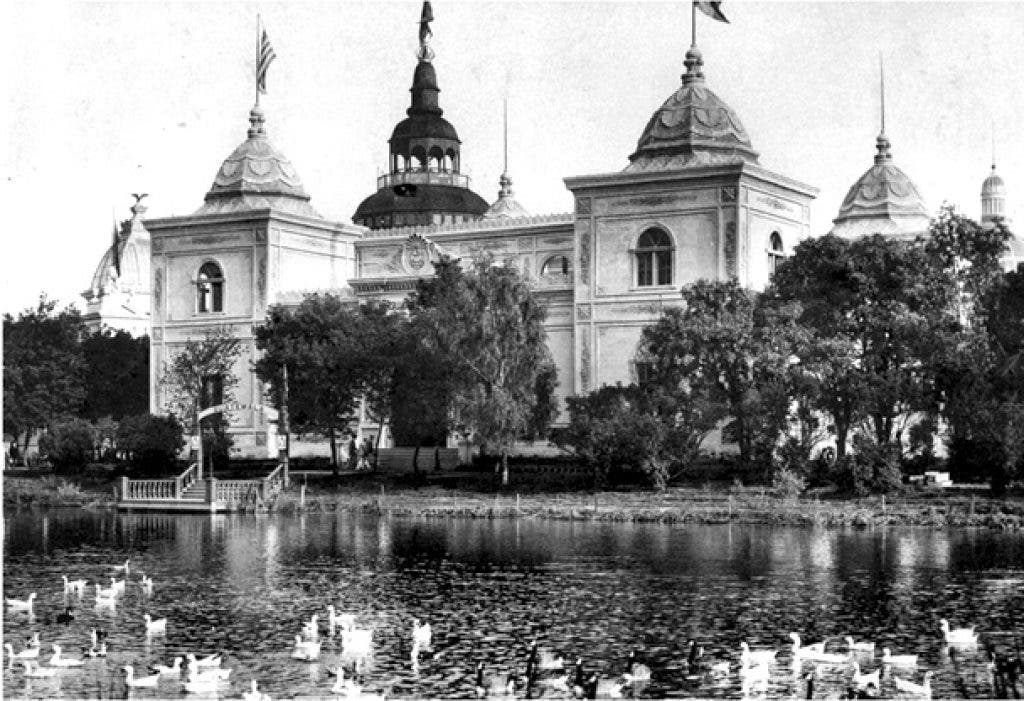
The World’s Columbian Exposition, or Chicago World’s Fair, 1893
The World’s Columbian Exposition of 1893—better known as the Chicago World’s Fair—proved a watershed moment for the new scientific school of taxidermy, which emphasized fidelity to nature in pose and habitat setting. Critics and exhibit judges soundly panned lifeless, unconvincing mounted souvenirs as belonging to “the grotesque and unworkmanlike period of twenty years ago.”[5] For example, in his Report of the Committee on Awards of the World’s Columbian Commission, Professor Robert Ridgeway suggested, “A careful study of the ornithological collections of the World’s Columbian Exposition has clearly developed two conspicuous facts regarding stuffed-bird exhibits of the present time as compared with those of the period of the Centennial Exposition of 1876. One is the very great advance, which has been made in the technique of the taxidermic art and the character of museum installation; the other is the very slight extent to which the improved methods have been utilized. The obvious explanation of this anomaly is to be found in the circumstance that few taxidermists are artists, and it requires the same degree of artistic skill to mount a bird well as it does to paint a picture well….” As far as Professor Ridgeway was concerned, the average “shop” taxidermist was little better than an “ordinary bird stuffer,” heavy-handedly destroying “all resemblance to life” in his specimens or, worse yet, composing “a more or less improbable, often impossible, aggregation of species … crowded together in a case, with gaudily painted and crudely formed artificial leaves and flowers, made especially for ‘the trade, added for embellishment.”
In stark contrast to such hack work, Professor Ridgeway believed, “The position or attitude of every specimen must be carefully studied in order that it may express distinctly a characteristic of the species.” Most importantly, he advocated, “The prerequisite of every [taxidermic] group must be the illustration of some fact, the teaching of some lesson, and, in order that no error may be conveyed, it is important that it shall contain no incongruities, however trifling….” He decried every example of “decorative taxidermy” where “no special lesson is in view; nothing is thought of, in fact, but a massing of bright colors to ‘catch the eye.’ ” Indeed, the truly artistic taxidermist must be more than technically competent in the latest methods of preserving and mounting specimens, “he must be even more than an artist—he must be something of an ornithologist.” In other words, the new scientific breed of taxidermist had to step outside his workshop and “study the subjects of his art in life wherever he has the opportunity. He will make free use of the camera, whenever and wherever the opportunity offers; [he] will make careful memoranda on the colors of parts, which change in hue after death, or, better still, color sketches of them. In short, he will neglect nothing which may add to the excellence of his work.” Professor Ridgeway recognized, “The ideal described above is not impossible, for he does exist, but such are few in number—fewer, certainly, than the fingers on one hand.”[6] Charles Livingston Bull was one of these few.
Documentary evidence shows Charles Livingston Bull working as a taxidermist in Rochester between 1892 and 1896. Bull’s friend and obituarist, Beecher S. Bowdish, later claimed, “he succeeded Dr. William T. Hornaday as taxidermist” at Ward’s Natural Science Establishment (hardly credible since Hornaday left his position as Ward’s taxidermist in 1877). In any event, Henry Ward reportedly assigned Bull to work on an installation of 400 birds for the government of Guatemala at the 1893 Chicago World Exposition.[7] For largely commercial purposes, Guatemala, Columbia, and other Central and South American countries “exhibited collections of their native birds in the form of unlabeled skins, such as find their way into the stocks of dealers in milliners’ supplies, but usually not until such lots have been ‘culled’ by one or more ornithologists.”[8] Reviewers were quick to note, “Two exhibits of this [commercial] character, those of British Guiana and Guatemala, respectively, have, on account of their greater extent and the better quality of the specimens, been referred to the category of scientific exhibits.” But, if Charles Livingston Bull's work in Chicago was responsible for “the better quality of specimens” in these exhibits and thereby brought him to the attention of Chief Taxidermist William Palmer at the National Museum in Washington, D.C., his career did not immediately soar skyward. If anything, the historical record shows a more patient pursuit of his artistic ambitions. In point of fact, he seems to have set aside his fulltime occupation as a taxidermist to chase the bicycle craze then sweeping the nation, which perhaps allowed him to take night classes in drawing.
In 1896, Charles Livingston Bull was enigmatically listed in the Rochester Directory as an “instructor” in the Liberty Building at 293 East Main Street, where his older brother, Schuyler, also worked as a machinist. This address was the location of Robert Thomson’s new bicycle sales-and-repair shop. Charles’ brother, Schuyler, launched his own business as a bicycle repairman in 1897. In that same year, the family moved to 236 Averill Avenue in Rochester. Charles continued as an instructor in the Liberty Building through 1899, albeit in a storefront around the corner at 11 East Avenue, also identified as Robert Thomson’s bicycle shop. In 1900, however, Charles became a salesman at the new bicycle shop of L. C. Tower & S. W. Bull, 40 Exchange Boulevard, owned by his older brother Schuyler and their neighbor, Lewis C. Tower. The new firm offered the “Bull Standard Hub Cone.” The Federal census for 1900 lists both Schuyler and Charles Bull as “machinists.”
Coming Soon: Part Three, Launching a Career in Wildlife Art and Illustration
————————————————————————————————————
Ask yourself—Just how valuable are the lessons of history? If you enjoyed this article, then please consider joining the Bergen County Historical Society, a non-profit, 501(c)(3) volunteer organization, founded in 1902. We are dedicated to preserving important evidence of the past and promoting historical literacy through interesting programs and publications.
We don't receive public operating support or grants the way other groups do, but rely entirely upon private donations, membership dues and volunteer contributions of time and talent. We are presently trying to raise $350,000 to construct a first-rate historical museum building and library for Bergen County on the Society’s property at Historic New Bridge Landing, 1201 Main Street, River Edge, NJ 07661. For further information or membership application, visit: http://www.bergencountyhistory.org
[1] Annual Report of the Board of Regents of the Smithsonian Institution for the Year ending June 30, 1893, Report of the U. S. National Museum, (Washington, D.C.: Government Printing Office, 1895), 42.
[2] Annual Report of the Board of Regents of the Smithsonian Institution for the Year ending June 30, 1893, Report of the U. S. National Museum, (Washington, D.C.: Government Printing Office, 1895), 43-44
[3] Charles Livingston Bull’s obituary would claim, “He succeeded Dr. Hornaday as the taxidermist at the National Museum in Washington, where he mounted many of the well-known groups now on display there, including some of the collection of Theodore Roosevelt. Akeley sought his advice in the arrangement and completion of his elephant groups and some of the other work for the American Museum.” However, there is no evidence to support the first claim since William Palmer succeeded Hornaday as Chief Taxidermist at the National Museum in 1891, holding the office until G. B. Turner took over in 1915.
[4] Witmer Stone (editor), The Auk, A Quarterly Journal of Ornithology, Continuation of the Bulletin of the Nuttall Ornithological Club, Old Series, Vol. LVII, New Series Vol. XLIX, (Lancaster, PA: The American Ornithologists’ Union, 1932), B. S. B. “Obituaries, Vol. XLIX, 1932, 392-393.
[5] “Report of the U. S. National Museum,” Annual Report of the Board of Regents of the Smithsonian Institution, Showing the Operations, Expenditures, and Condition of the Institution for the Year ending June 30, 1893, Washington, D. C.: Government Printing Office, 1895, 47.
[6] Professor Robert Ridgeway, “Ornithology,” Report of the Committee on Awards of the World’s Columbian Commission. Special Reports upon Special Subjects or Groups, Vol. II (Washington, D. C.: Government Printing Office, 1901), 1339-40.
[7] Costa Rica displayed 268 mounted specimens of native birds.
[8] Professor Robert Ridgeway, “Ornithology,” Report of the Committee on Awards of the World’s Columbian Commission. Special Reports upon Special Subjects or Groups, Vol. II (Washington, D. C.: Government Printing Office, 1901), 1313-1340.