Health & Fitness
The Story of Our Valley, Chapter Four – A Ton of Bricks (Part III, 1873-1890)
Sound familiar? Financial markets collapse, real estate depreciates and the American economy makes a slow recovery! Bricks tell the story of the Long Depression, 1873-1880.



By Kevin Wright©2011
Brickmakers on the Hudson and Hackensack Rivers found steady work, filling a prodigious demand for building materials along Manhattan’s rising skyline. With government contracts fueling an agricultural, industrial and financial boom, the Civil War accelerated the shift in manufacturing from country waterpowers to smokestack cities, which grew rapidly as transportation hubs and population centers after introduction of the modern factory system. Economic exuberance swelled as government printing presses spewed forth “rag money.” With veterans flooding home after Southern surrender at Appomattox, mines and furnaces worked to capacity, rolling out iron for thousands of miles of wildcat railroads. In the fall campaign of 1872, workmen “carried pockets full of greenbacks, lived luxuriously and shouted for [President] Grant [‘s reelection]; young men without means purchased farms at exorbitant prices; incompetent and unprincipled favorites were placed in positions of trust and Credit Mobilier, Emma Mine, Crooked Whiskey and District of Columbia Rings were run direct from the National Capital, if not from the White House itself.” The bubble burst when Jay Cooke & Company, the government’s preferred bankers, failed on September 18, 1873, bringing general ruin in their wake. Widespread economic stagnation caused an unprecedented shrinkage of values and bankruptcy to manufacturers, financiers, farmers and shopkeepers. While previous financial panics lasted a few months, hard times now lengthened into the Long Depression. Within a short span of months, factories stopped, laborers went “tramping” about begging for bread, and real estate, depreciating 30% to 50% in value, was fast sold under the Sheriff’s hammer.
Westward expansion now brought the Midwestern Plains, a vast expanse of cheap flat land, well suited to large-scale mechanized agriculture, into fatal competition with old farms in the immediate hinterland of the Atlantic seaboard. Observers hereabouts watched with dismay as “farms in the surrounding country are cheaper now than for many years past, and when sales are made it is often at prices far below the assessed value.” Before the economy staggered back to its feet in the spring of 1880, the Long Depression winnowed outmoded industries and drained many old channels of commerce.
Find out what's happening in River Dellfor free with the latest updates from Patch.
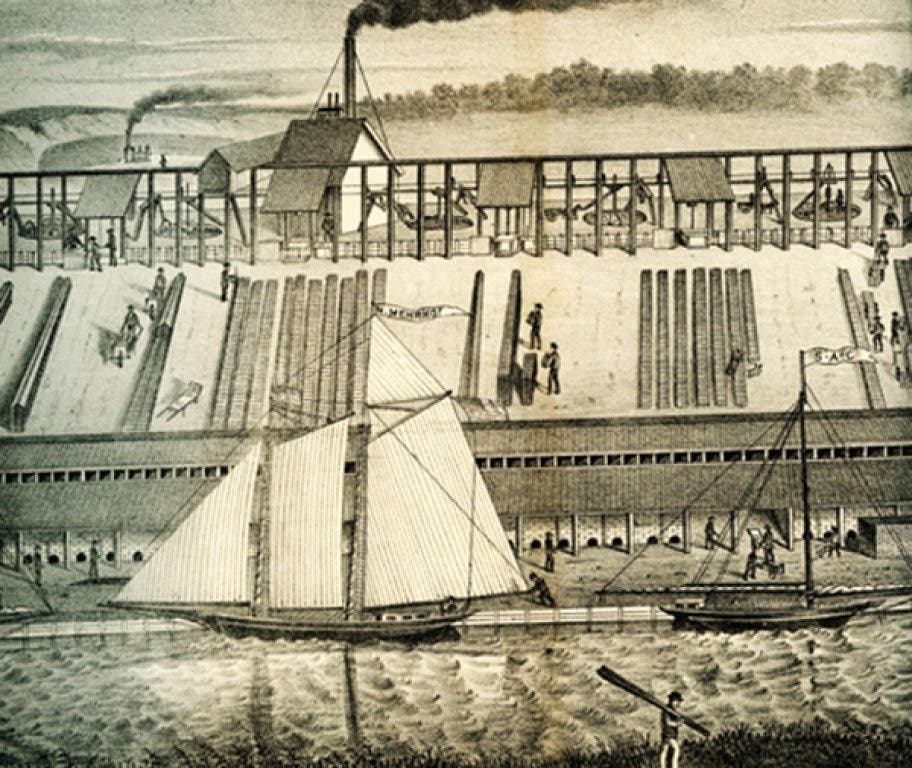
Despite the downturn, the Mehrhofs paid $1,018 to Ann Paulison for four-and-three-quarters acres on the south side of the road leading from Moonachie to Little Ferry in 1875. On October 24, 1877, Bergen County Sheriff Garret R. Hering sold seven acres, belonging to the Manhattan Brick & Land Company, to John H. Winant for non-payment of mortgage and interest. On December 22, 1877, Nicholas, Philip and Peter Mehrhof acquired this valuable clay land on the Hackensack River, adjoining their brickyard, for $367. Despite continuing hard times, the Mehrhofs shipped "large quantities of the best quality potters’ clay and fire-brick” to market. By 1882, they were employing about 70 men for six months out of the year in the daily manufacture of 70,000 bricks and an annual output of 1,500,000. Within five years, they operated the second largest brick manufactory in the United States. Their lower yard, operating under the business style of Mehrhof Brothers, comprised six tempering pits, each with a capacity for 35,000 bricks. The upper yard, worked by Nicholas Mehrhof & Company, employed 35 men in the daily output of 35,000 bricks for an annual capacity of 850,000. According to contemporary description of their operations, a slow wood fire first heated the scove-kiln for 36 hours, completing the drying process, before a sufficiently hot fire baked the brick over five days and nights; the process consumed a cord of wood for every 8,000 bricks. The Mehrhofs used four schooners to carry their output to market in Paterson, Newark, New York and Providence, Rhode Island.
Haverstraw brickmaker Isaiah M. Gardner first appeared in Hackensack in 1879, seeking fertile fields for opportunity. Seeing signs of a general business revival, Mehrhof Brothers employed blacksmith Henry Kirschgassner in March 1880 to make ironwork for another schooner to transport brick. John Schmults engaged Nathaniel Alberts to build another dock just south of his brickyard, near his new clay pit. The Bergen Democrat announced in April 1880 that business at the riverside brickyards and docks of John Schmults, Benjamin L. W. Hanfield and Nicholas Mehrhof showed “something of old time activity.”
Find out what's happening in River Dellfor free with the latest updates from Patch.
Failing under heavy mortgages, the remaining properties of the Manhattan Brick & Land Company were sold under the Sheriff’s hammer. On September 14, 1881, Sheriff David A. Pell sold a lot of land on the Hackensack River, bounded south by De Peyster Creek, west by lands of John A. Parsons and others, and north by the Little Ferry Tavern Farm, to John De Peyster Stagg. On March 31, 1884 Sheriff Isaac A. Hopper sold 20.73 acres on the river, bordering lands of David M. Winant, Gerard De Peyster and the Moonachie Road, to complainant Nevin W. Butler, a Brooklyn accountant, for $10,269 in unpaid principal and interest on the mortgage.
On April 20, 1882, brick schooners began passing New Bridge, carrying 600,000 bricks from the Mehrhof yards in Little Ferry to the Hackensack Water Company’s property at New Milford, supplying Italian bricklayers working on the new reservoir and pumping station at the head of tides. Brickyards along the Hackensack River manufactured 25,000,000 bricks in 1882 and 31,500,000 bricks in 1883, providing steady employment to river boatmen. Besides Mehrhof Brothers’ four schooners, John Schmults owned two, while Isaiah M. Gardner hired Captain John Christie’s schooner. Mr. Gardner, a Haverstraw brickmaker, purchased the 97-acre Brunjes’ farm in February 1884 with intentions of starting another brickyard to be run by his eldest son, Murat. This property was located opposite Ridgefield Park, but without a bridge to facilitate passage over the river.
On April 1, 1885, Charles E. Walsh, son of a New Windsor brick maker, and his partner, Lewis K. Brower, paid $15,000 to John W. Gillies, another Haverstraw brick manufacturer, and to Isaiah M. and Elmira Gardner, of Hackensack, for 18 acres, encompassing the brickyard near the foot of the Hackensack Plank Road (otherwise known as the Bergen Turnpike) in Little Ferry, bordering the Hackensack River and the Moonachie Road. Born in Scotland in 1817, Gillies fled economic and political upheaval in Europe in 1848. Brothers Irving and Warren Felter, also of Haverstraw, New York, purchased part of the Strohmeyer property in Little Ferry in April 1886 to open yet another brickyard. Intending to increase production by a third over the previous season, Mehrhof Brothers’ Brick Manufacturing Company built a large new building, 300 feet long, in December 1886, to house improved machinery. Gardner & Gillies likewise enlarged capacity.
Owing to a construction boom, brick sold for $8.50 per thousand in June 1887. On September 23, 1887, the tug Wesley Stoney, pulling a scow load of brick, passed the open draw in one of the railroad bridges over the Hackensack River. Unfortunately, the bridge tender did not notice the approaching schooner W. H. Lowe, loaded with brick belonging to Benjamin L. W. Hanfield and John Schmults. Consequently, he prematurely closed the draw, breaking both masts as the Lowe’s four crewmen jumped overboard. Hiram H. Walsh’s brickyard, located between Bogota and Ridgefield Park, was the last along the river to cease operations for the season, closing October 22, 1887. A hundred curious brickmakers from the Hackensack Valley joined others from as far west as Chicago for a practical demonstration of burning brick with kerosene oil in an experimental kiln at one of the Diamond Brick Company’s brickyards in Haverstraw, New York, on November 16, 1887. Proponents of the new fuel claimed savings of 50% over wood burning in scove-kilns.
On February 12, 1888, Murat and I. Elwood Gardner acquired a tract of land on the west side of Hudson Street, bounded west and north by Moonachie Road and south by the New York Cemetery (Maple Grove Cemetery), whereon they built their home. The Mehrhof Brickyard resumed work in April 1888 with 180 employees, increasing their payroll to 500 only a month later. Over one hundred employees labored at Gardner’s brickyard. In July 1888, Henry Strohmeyer had two perpetrators arrested when they tore down a fence he erected to prevent Mehrhof Brothers’ employees and teams from crossing his lot. When trespassers removed the replaced fence on July 24th, Strohmeyer swore out a warrant against Nicholas Mehrhof, Jr. Brickmaker John Schmults died at his residence on July 20, 1888, leaving his son Edwin to continue the family business. Upon his passing, the Hackensack Republican noted, “Mr. Schmults at one time kept a hotel near Washington Market, he was also a brick manufacturer at Cornwall [New York]. He first came to Hackensack in 1856 and settled here permanently in 1870. His death removes a good citizen and a genial gentleman.”
By the start of August 1888, oversupply and slackening demand forced a halt in production until the stock of brick on hand was exhausted. Lewis K. Brower, of Hackensack, sold his equal undivided half-interest in 18 acres at Little Ferry, with its improvements and machinery, to partner Charles E. Walsh for $7,500 on November 22, 1888. On April 1, 1889, Milburn B. & Lycurgus B. Gardner succeeded their father, Isaiah M. Gardner, as managers of the family brickyard. Mehrhof Brothers employed 300 men in June 1889 to fill an order for 3.5 million bricks to the Standard Oil Company at $6.50 per thousand delivered. By the close of the season in October 1889, the Mehrhof Brickyards were shipping 100,000 bricks daily to Paterson.
The heaviest snowstorm of the winter arrived on March 19, 1890. But, by the middle of April, brick schooners made frequent trips to supply a booming construction industry. When a large, three-masted schooner named the Annie R. Lewis—the first of its kind seen upon the Hackensack River—discharged its cargo of spruce timber at Westervelt Brothers’ dock in Hackensack on May 12, 1890, Captain D. Anderson Zobriskie, operator of the tugboat Wesley Stoney, said he must hereafter “have more river or smaller boats!” In June 1890, Captain Henry Lozier sold the Wesley Stoney to the Verow Towing Company, signifying the end of its days on the Hackensack River.
On October 31, 1890, The Bergen Democrat noted, “five or six years ago, the four-masted schooner was a rarity, if indeed there were any in existence then.” Recently, however, shipping interests began experimenting with this type of vessels for “coasters.” A four-masted schooner named the William Neely was launched at Bridgeport, Connecticut, in the fall of 1890. Its dimensions measured: length of hull, 170 feet; breadth of beam 39.5 feet; depth of hold, 18 feet; masts, 91, 92 and 93 feet tall. It registered at 850 tons and cost $48,000 to build. Veteran sail-maker William Blair, of River Edge, made its sails at his workshop on Barclay Street, New York. The fore and aft sails of three or four-masted schooners were so very heavy that steam power was needed to hoist them.
————————————————————————————————————————————————
Ask yourself—Just how valuable are the lessons of history? If you enjoyed this article, then please consider joining the Bergen County Historical Society, a non-profit, 501(c)(3) volunteer organization, founded in 1902. We are dedicated to preserving important evidence of the past and promoting historical literacy through interesting programs and publications.
We don't receive public operating support or grants the way other groups do, but rely entirely upon private donations, membership dues and volunteer contributions of time and talent. We are presently trying to raise $350,000 to construct a first-rate historical museum building and library for Bergen County on the Society’s property at Historic New Bridge Landing, 1201 Main Street, River Edge, NJ 07661. For further information or membership application, visit: http://www.bergencountyhistory.org