Health & Fitness
The Story of Our Valley, Chapter Four – A Ton of Bricks (Part I)
Architectural brickwork may earn an admiring glance, but the price per thousand paid for Hackensack Valley brick records the unsteady rise and near collapse of the American economy from 1860 to 1935.



By Kevin Wright©2011
Plucking, scraping and grinding, glaciation gathers rocky debris ranging in size from sand grains to humongous boulders. Melting distributes this stony residue in various landforms, filling voids and making the rough places plain. In the waning of the last ice sheets to cover our valley, a fine rock flour clouded summer meltwaters, settling in layers, called varves, at the bottom of Proglacial Lakes Bayonne and Hackensack for 2,532 years. Consequently, a thick body of Late Pleistocene clay underlies the Hackensack Meadowlands, extending west to Newark and north to New Bridge. Just imagine—if lacustrine clays of Pleistocene age were removed from our valley, then an oceanic inlet, 200 feet deep, would open from Newark Bay north to Rockland County, New York, with Teaneck Ridge forming an island between present-day Haworth and Ridgefield Park. This embayment would also reach up the Passaic Valley to Paterson and westward from Newark to Springfield.
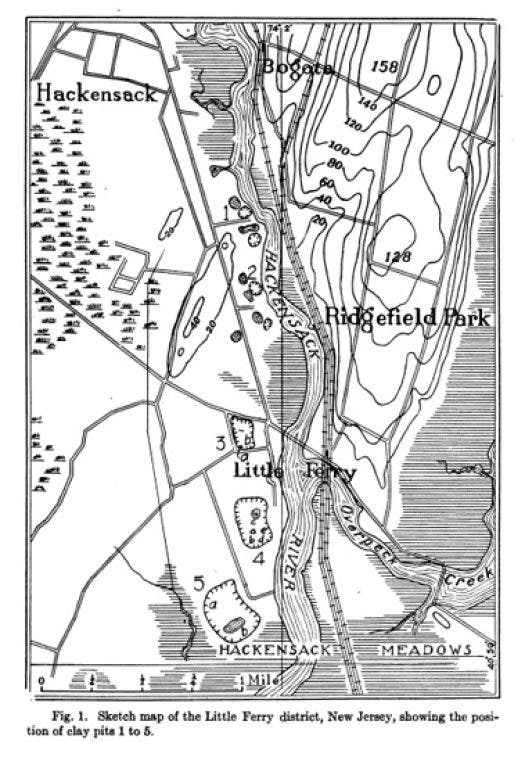
In July 1909, Tenafly well-driller R. F. Harold bored down through 212 feet of solid glacial clay in the rear of the new Consolidated Market Company building at 153 Main Street, Hackensack, without reaching bedrock. While soil covers the clay to a depth of 200 feet at Newark, only two feet of soil cover it at Hackensack. This red-burning clay is easily molded and hardens at a moderate temperature (1800° Fahrenheit). Workable clay beds along the Hackensack River vary in depth from 20 feet at Hackensack to 98 feet at Little Ferry. Being well adapted for the manufacture of common brick of uniform color and strength, it was extensively mined at ten different brickyards in this locality.
Find out what's happening in River Dellfor free with the latest updates from Patch.
Brick has been widely praised for its genteel solidity, stately appearance and fireproof reputation. Humankind has been laying small baked clay patties in mortar to build walls for 9,000 years. In our valley, the earliest manufacture of brick coincides with construction of the first substantial houses for European settlers, who brought the craft with them from the Old World. In most primitive circumstances, workers simply hand patted clay into rectangular blocks of roughly standard dimensions, sometimes leaving the impression of their fingers in their handiwork. Since it required considerable labor and much wood to make large numbers, these “patties” were generally restricted to the construction of chimneys, although a few status-conscious families could afford to build complete houses of brick. When the so-called Redstone Tavern (also known as the old Blair House) was razed in November 1896 to make way for the First Congregational Church of River Edge, a quantity of brick from a large hearth in its south room was sold to benefit the Building Fund. These measured 8" in length, 3-1/2" wide and 1-1/2" thick. Known today only from a single photograph, this early stone house stood on the west side of Kinderkamack Road, partly in what is now Tenney Avenue, directly in front of the River Edge Borough Hall. According to a date stone set in the façade, it (or possibly an antecedent structure) was built in 1719 for Albert Romeyn and his wife Jannetie Roelofse Westervelt.
Was this old brick imported from Holland as ship’s ballast? Despite folkloric claims, this is most unlikely since the skills and raw resources to manufacture bricks were so close at hand. For comparison, a thin brick of yellowish color (attributed to the presence of lime), uncovered in recent years on lower Manhattan, measures 7-1/2" by 3-1/2". Obviously craftsmen trained in the ways of the old country would be inclined to replicate the standard dimensions of Holland brick (6 to 8-1/2" in length, 3 to 3-3/4" wide and 1-3/8ths to 1-3/4" thick), but would also quickly appreciate the greater economy and insulation qualities of larger bricks of English standard.
Find out what's happening in River Dellfor free with the latest updates from Patch.
Increasing population and wealth stimulated demand for snug masonry dwellings. Consequently, enterprising farmers or merchants established small brickyards as a seasonal sideline, wherever a suitable clay bed and ample firewood were cheaply available. Andrew Zobriskie operated the first commercial brickyard in the Hackensack Valley between 1813 and 1829, located near the Zabriskie-Steuben House at New Bridge, on or about the present site of the Steuben Arms apartments on Main Street, River Edge. Following ancient practice, he mixed straw into the wet clay as a binder. Perhaps brick for the 1819 Bergen County Courthouse was made here. A ledger now belonging to the Bergen County Historical Society preserves the record of his industry for the year 1827. Shallow depressions behind the present Campbell-Christie House and Westervelt-Thomas Barn at Historic New Bridge Landing identify the site of his clay pits.
For many centuries, brickmakers tempered fresh clay with sand, water and straw in open ring-pits, almost ten feet deep and as much as thirty feet in diameter. Until the introduction of steam engines, horses powered a vertical iron wheel, which revolved eccentrically between the pit’s center and circumference, blending (pugging) enough ingredients into a creamy paste to mold 25 to 30 thousand bricks. Following brickmaker James Wood’s successful experimentation at Haverstraw in 1828, about a bushel of coal dust was added to the mix for every thousand bricks, promoting an even burn throughout the kiln while reducing baking time from two weeks to one at a great cost saving in fuel. “Soft mud” from the ring-pit was hand-shaped in sanded molds, made of wood or metal, slightly larger than a standard-sized brick to allow for shrinkage while drying and firing. Pug mills with interacting fixed and rotating blades were introduced at some large commercial yards in the latter half of the nineteenth century, speeding tempering and feeding brick machines that mechanically pressed the wet paste into molds. By hand, a molder could form 2,500 bricks in a ten-hour workday. A horse-driven pug mill yielded 8,000 to 12,000 bricks daily. Once Richard Vervalen introduced the first steam-molding machine to his Haverstraw brickyard in 1852, four men could easily mold 40,000 bricks in the same period of time.
Since wet clay exploded in the kiln, wheelers first carted green bricks to a drying yard, where they were turned on their edges after several hours’ exposure and “hacked” up. These stacks remained under battens for several sunny days until dry enough to hold their shape. To build a scove kiln, or clamp, raw dry bricks were stacked three-on-three in alternating directions in parallel walls, connected by corbelled arches, thereby creating tunnels for ovens. Brick burners daubed a thick coat of wet clay on the exterior of the kiln to contain heat. Many New Jersey brickmakers took to burning coal on grates in the arches, rather than increasingly scarce and expensive cordwood. Once fires were lit, the tunnel heads were closed. The "Dutch" scove kiln employed a wooden shed to shelter the kiln from rain.
Dependent upon weather, it took three to four days to bake a kiln of 15,000 to 125,000 bricks. Inevitably, arch-bricks over-burnt, averaging 20% of a kiln load. The under-baked outermost bricks, called pale-bricks, averaged 12%. City builders favored Hackensacks for their uniform dark red color and fine appearance, accepting some loss due to brittleness. Operating their yards for only six months out of the year at best, brickmakers along the Hackensack River were generally reluctant to invest in mechanization unless high overhead compelled them. Finding employment from April through September, nineteenth-century laborers typically earned between 50¢ and 75¢ for a day’s work at a local brickyard.
————————————————————————————————————————————————
Ask yourself—Just how valuable are the lessons of history? If you enjoyed this article, then please consider joining the Bergen County Historical Society, a non-profit, 501(c)(3) volunteer organization, founded in 1902. We are dedicated to preserving important evidence of the past and promoting historical literacy through interesting programs and publications.
We don't receive public operating support or grants the way other groups do, but rely entirely upon private donations, membership dues and volunteer contributions of time and talent. We are presently trying to raise $350,000 to construct a first-rate historical museum building and library for Bergen County on the Society’s property at Historic New Bridge Landing, 1201 Main Street, River Edge, NJ 07661. For further information or membership application, visit: http://www.bergencountyhistory.org