It was the ultimate labor of love for a proud veteran and former postal service employee, but Fanwood resident Jim O’Connor’s effort to paint all of the town’s mail relay boxes red, white and blue ultimately fell victim to a United States Postal Service cost-cutting initiative.
Relay boxes, or “cans,” as mail carriers call them, look like traditional public mailboxes, but without a mail flap and accessible only by key. Traditionally, they are painted green, not blue. Six days a week, for nearly 50 years, a USPS delivery truck dropped off a pile of letters at the 60 relay boxes that dotted Fanwood. Seven to nine mail carriers, walking their routes, would retrieve the letters and deliver them, pausing at other relay boxes along the way to replenish their mail bags.
Relay boxes remain common in cities, where the homes are squeezed together. In suburban areas, with houses spread farther apart, postal workers typically drive instead of walk – delivery trucks allow them to move more quickly between houses and carry more mail at a time. Fanwood, measuring one-square-mile, was an exception, according to spokeswoman Amy Edge.
Find out what's happening in Scotch Plains-Fanwoodfor free with the latest updates from Patch.
In September 2010, the USPS began replacing its system of mail relay-boxes with delivery trucks, removing all but a handful of the boxes.
“The mail carrier can deliver much more mail on their route. When it is stored on a truck, they are driving rather than stopping at the relay boxes," Edge said. “Local management evaluated cost savings and efficiencies and realized that, for Fanwood, relay boxes were an inefficient way of storing mail."
Find out what's happening in Scotch Plains-Fanwoodfor free with the latest updates from Patch.
The number of routes, which is determined and adjusted every couple of years by the Washington office, has not changed. But the overall cost-savings strategy appears to have worked: The trucks have allowed post office administrators to avoid filling two vacancies created by retirements and to decrease the use of part-time workers, Edge said. And when the USPS, about $40 million in debt, released a list in July of 3,700 post offices it may close, including 50 in New Jersey, Fanwood was not one of them.
But shortly after the Fanwood Post Office implemented the new fleet of delivery trucks, O'Connor's impromptu works of public art began to disappear.
O’Connor, who retired from the USPS in July 2009, said he had heard rumors that the post office would stop using the relay boxes. But when workers started to pull them from the ground, he said it came as a surprise. “Nobody told me about what was going on,” O’Connor said. “But all of a sudden I saw trucks arriving to remove the boxes.”
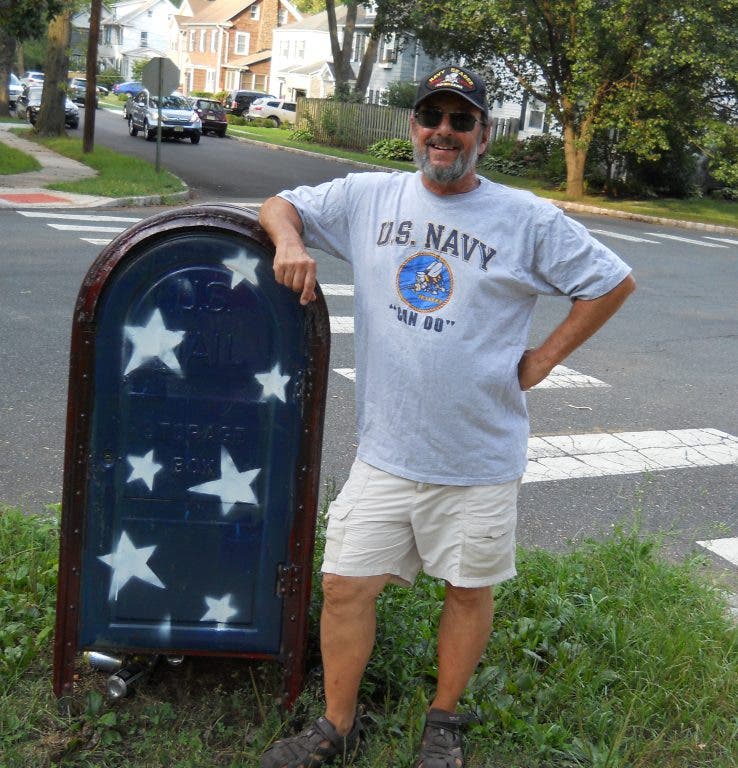
O’Connor painted his first relay box in the fall of 2009. A Vietnam War veteran with post-traumatic stress disorder – he was wounded in his second tour in Vietnam during the Tet Offensive, when a landmine exploded under him – he said he has found a therapeutic outlet through art. He first started painting on canvas, brightly colored abstracts he keeps in his home on Marian Avenue. Then, one spring morning, he decided to repaint the relay box that was then outside his house. He replaced the can’s flaking olive drab with a blue background, red trim, and white five-pointed stars.
“This looks so much better than the green box that had graffiti on it,” O’Connor said one August afternoon as he stood next to a relay box on Second Street, one of his last pieces of public art. “They could also use the beaten-up mail boxes to be repainted. They are all rusted and badly in need of repair.”
Fanwood Mayor Colleen Mahr acknowledged that the Fanwood Post Office, like so many other agencies and businesses, needed to make changes and cuts where possible to remain solvent during the economic downturn. Nevertheless, she praised O’Connor’s volunteerism. In fact, after discovering the newly-painted relay boxes, she invited him to paint the relay box across the street from her home on North Avenue.
“He joins the ranks of many of Fanwood's quiet unsung heroes who, through their time and effort and personal resources, make our community a better place,” Mahr said. “I am proud to call him a friend and thank him for this one act that has made a big difference along several of our residential streets.”
O’Connor said he was hurt that Post Office administrators did not inform him that the relay boxes would be removed. “I thought somebody could have explained it to me, because I painted them on my own time and expense and did it because people asked me to.”
Edge stated, “This decision came from Washington, and I don’t think Mr. O’Connor needed to be notified.”
Regardless, O’Connor’s efforts attracted the attention of his neighbors. Young’s Paint on South Avenue in Fanwood, for example, donated two cans of paint to the relay box project.
"Every time I see a green postal storage box, like in the background of a news story on T.V, or just driving through any town in any state, I look at the box and think how nice it would look in red, white and blue. And I would paint that box myself for free," O'Connor said. "I tried to bring attention to a drab, rusty green box that could look real American, and make the Post Office look good, it needs all the help it could get in these hard times. And there are thousands of boxes all over the U.S. that should get a makeover."