Schools
Rutgers Scientists Join in Celebration of Nobel Prize for Discovery of Higgs Boson
Two physicists received the Nobel Prize for their 1964 theory on Tuesday.


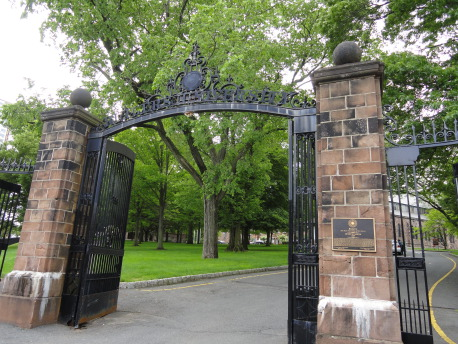
About a dozen researchers from Rutgers University participated in the process that led to the discovery of the Higgs boson.
So when two physicists were awarded the Nobel Prize for Physics for the discovery of the elusive particle sometimes referred to as the God particle, it was natural that a Rutgers assistant would watch the ceremony from the spot of the discovery.
Rutgers Assistant Professor John Paul Chou watched from the European Organization for Nuclear Research in Geneva, Switzerland, where the particle was discovered on March 14 of this year, according to the University.
Find out what's happening in South Brunswickfor free with the latest updates from Patch.
The Higgs boson is a key part of the Higgs field, which confers mass upon elementary subatomic particles, and by extension, all the matter in the universe, according to the University.
The Higgs boson was needed to explain the “standard model” of physics, which describes elementary particles and how they interact, according to the University.
Find out what's happening in South Brunswickfor free with the latest updates from Patch.
The discovery affirmed the existence of a particle first theorized in 1964 and sought after for many decades by numerous researchers, including those from Rutgers. A total of 2,000 physicists from 89 American institutions and seven national laboratories were involved in the search.
Rutgers’ contribution included instruments for an LHC detector known as CMS, or Compact Muon Solenoid, which measures particle fragments that result from collisions between protons traveling at light speed.
This included electronic chips for a 60 megapixel digital camera. The camera captured images of particles scattering, according to the University.
Another contribution is a device called a calorimeter that measures the energy of the photons produced in the collisions, according to the University. The University also developed analysis routines that searched for the decay of the particles.
Get more local news delivered straight to your inbox. Sign up for free Patch newsletters and alerts.