Schools
A Full Day, And A New Approach For Toms River's Kindergartners
Kindergarten Expo gives teachers tools to move from traditional model to a centers-based model that helps students learn at their own pace.




On the kind of day where most people are talking about the beach, Mallory Kennedy was talking about teaching the scientific method.
“Have them go down the slide without being pushed, and time it,” she said, explaining a science experiment. “Then have them go down but self-push, and do it again with someone pushing them,” she said, adding a reminder to record the times on a clipboard.
Having the children compare the times and reason for themselves which works faster and why ”introduces the scientific method,” she said.
Find out what's happening in Toms Riverfor free with the latest updates from Patch.
This isn’t an experiment aimed at high schoolers, however; Kennedy’s audience was a group of kindergarten teachers.
“Most of these teachers haven’t thought about the scientific method since college,” said Kennedy, supervisor of instruction at Hooper Avenue Elementary School.
Find out what's happening in Toms Riverfor free with the latest updates from Patch.
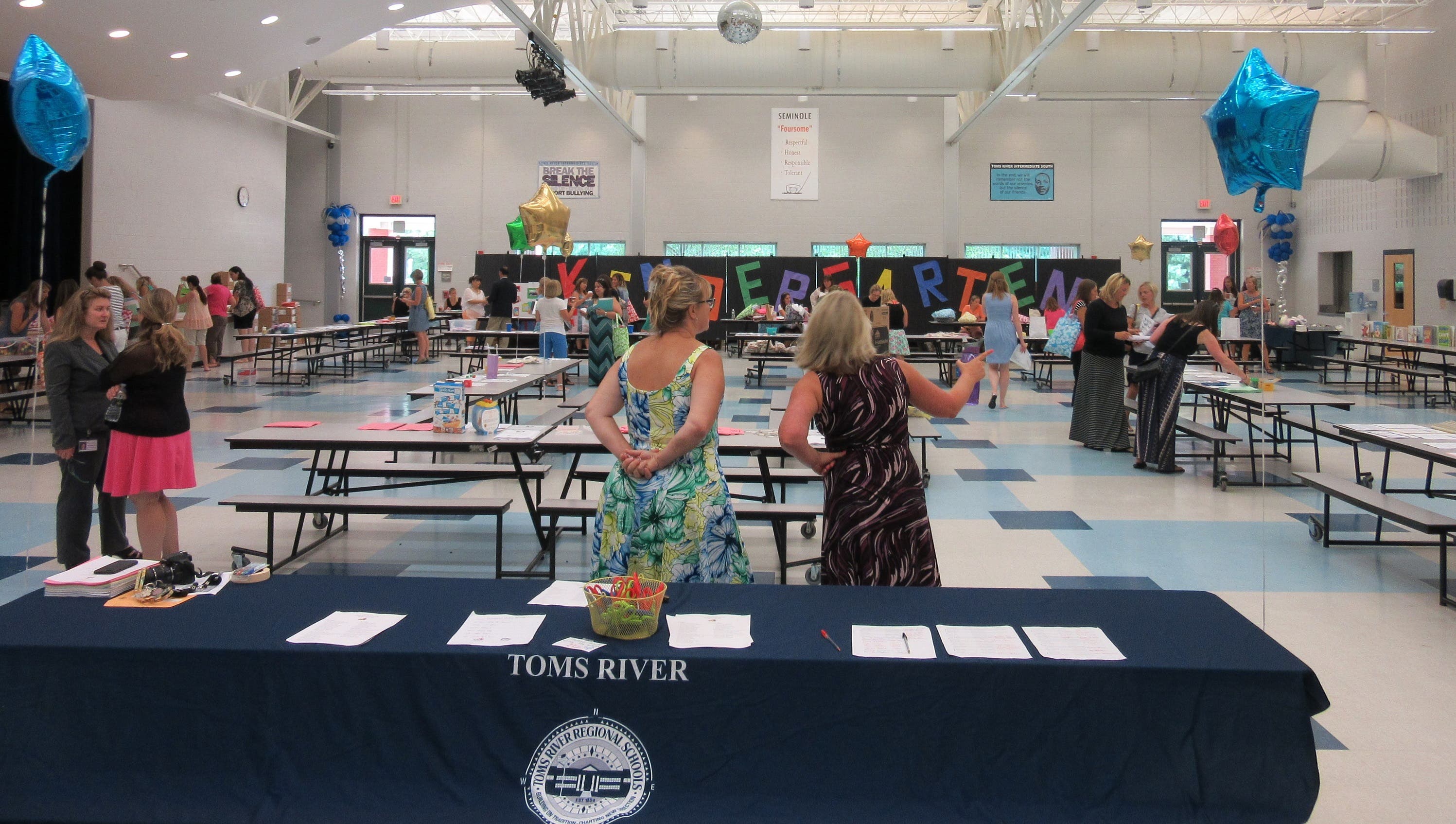
With the Toms River Regional School District’s move to full-day kindergarten -- and changes coming from the state --finding ways to teach science to those youngest pupils is a priority. But it isn’t the only one, officials said Thursday at a Kindergarten Expo for the district’s kindergarten teachers, held at Toms River Intermediate South.
The district will have 54 kindergarten classes, each with a maximum of 20 students, Superintendent David Healy said, and six special education kindergarten classes.
Nearly all of the district’s kindergarten teachers were in attendance at the expo, Assistant Superintendent Debra McKenna said.
“It shows how committed they are to making this fly,” McKenna said.
Healy said the additional 23 kindergarten classes -- there were 31 last year -- are being staffed through a reallocation of teachers based on lower enrollment. Twenty-one teachers were moved from other teaching positions to kindergarten classrooms, he said, and while the district hired two kindergarten teachers from outside the district, their positions were not new ones, but also were existing positions moved from other schools. Class sizes in the other grades will remain at a maximum of 24 pupils, he said.
“We promised the taxpayers this would have a minimal impact on the tax rate,” Healy said.
The expanded day also brings with it the opportunity for a complete change in the approach to teaching these youngest students, and as such the district is implementing what’s called ”center-based” learning, which puts an emphasis on children learning through play, said Cara DiMeo, the district’s elementary curriculum coordinator.
“That is how young children learn, through play,” she said. The center-based model “allows students to learn at their own pace.”
It is a signifcant change from the traditional model, of the teacher giving out workbooks and worksheets and talking at the children, and instead allows teachers to be more hands-on, said Tracey Fournier, who teaches a mixed kindergarten-first grade language learning disabled class at East Dover Elementary.
“Now you teach a small lesson and have activities for all levels (of students) at all the centers,” she said, allowing the teacher to move from group to group as needed.
It requires a lot more work on the part of the teachers who have to prepare activities for all levels of learners, she said. But it results greater success for the students.
“Center-based learning allows you to run your room for everyone all day long,” she said. “It gives the kids a tremendous amount of ownership of what they’re learning. I love that we’re doing this across the board.”
Heather Lauria, a kindergarten teacher in a regular classroom at West Dover Elementary School, said the move to full-day kindergarten will be a big improvement. The students will have math, language arts, and science lessons but also special subjects such as music, art and time in the library.
“It’s a lot to fit into a 2-1/2-hour day,” said Lauria, who taught kindergarten in both the Newark schools and in the Asbury Park School District before she was hired in Toms River. Both of those districts had full-day kindergarten, she said, adding that she welcomes the change in Toms River. Now, ”we won’t feel like we’re on roller skates just trying to get everything into the day.”
The full-day schedule won’t be just packed with instruction, however; Lauria said the daily schedule includes naptime, and “free center play,” that will retain an instructional element but where the focus will be having the children learn social skills -- how to play together, how to solve problems together.
“Those (social skills) are where we see the biggest deficit,” she said, because kids are spending so much time on electronic devices.
The district isn’t simply giving the teachers orders and telling them to figure it out, however, said Fournier. In addition to the Kindergarten Expo, where the teachers came in to swap ideas and get items to help them carry out the new format -- Play-Doh and foam blocks and packet upon packet of ideas -- the district also has held several workshops.
“It’s so nice to have the support,” she said.
“I know this program will be something incredible for the whole community,” Healy said as he thanked the teachers who had come out to the expo.
Board of Education member Bob Onofrietti said the change is an exciting time for the district.
“I’m a little jealous,” he said, noting that the change is coming after his four children all have passed through kindergarten. “The kids coming in (now) will be much better prepared.”
Healy said the most gratifying part of the change has been seeing how the teachers have embraced it.
“Here they are, on their own time, collaborating and sharing ideas,” Healy said. ”They are committed to it and to each other. It’s an amazing way to set the tone going forward.”
(1. A room full of ideas for the Toms River Schools’ kindergarten teachers. 2. Mallory Kennedy, supervisor of instruction at Hooper Avenue Elementary, explains how a pair of yardsticks taped together can be used to demonstrate a scientific concept to kindergartners. 3 and 4. A dice game made from foam blocks to help teach words. 5. Superintendent David Healy addresses the group. Credits: Karen Wall)
Get more local news delivered straight to your inbox. Sign up for free Patch newsletters and alerts.