Health & Fitness
Half Of NJ's Drinking Water Population Came From Systems That Had Problems, New Analysis Says
Only three states had more people drinking from water systems that violated federal safety rules than New Jersey. Is your community safe?


Only three states have more people drinking water that violated federal rules protecting consumers from cancer-causing chemicals and illness-inducing viruses than New Jersey, according to a new report by the Natural Resources Defense Council.
About 4.5 million people in New Jersey drank water in 2015 from suppliers that violated the Safe Drinking Water Act, according to the NRDC report. (See map below.)
That was the same year that a drinking water crisis in Flint, Michigan, prompted a national outcry because of the predominance of lead that made thousands of people sick. And Michigan wasn't even in the top five of states with drinking water systems violating the SDWA, according to the new analysis.
Find out what's happening in Toms Riverfor free with the latest updates from Patch.
Read more: These N.J. Towns Have Bigger Lead Poisoning Risk Than Flint, MI: Watchdogs
The NRDC, a nonprofit group of 500 scientists, lawyers and policy advocates charged with protecting the environment, said the report shows how federal enforcement of water safety rules are "short."
Find out what's happening in Toms Riverfor free with the latest updates from Patch.
"These requirements are meant to protect us from serious health impacts—cholera outbreaks, lead poisoning, and even cancer," the report said. "But the EPA and the states have been falling short."
The state Department of Environmental Protection said report shows the number of health-based violations discovered in New Jersey were "minimal."
Lawrence Hajna, a DEP spokesman, said the report missed the fact that many of the potential problems were corrected, and that many of the problems were "paperwork violations." He disputed the credibility of the report.
"This doesn't pass the smell test," Hajna said, who then criticized other publications for exaggerating the findings.
The report cites some New Jersey systems that allegedly had problems, such as New Jersey American Water's Coastal North system, which reportedly had three violations in 2015, according to the report. But the company disputes the findings and said the DEP says the system is in compliance
Denise Venuti Free, director of communications and external affairs for New Jersey American Water, said at least one rule violation came about because of a miscommunication, and the DEP has since corrected the problem.
"New Jersey American Water is proud of our outstanding compliance with state and federal safe drinking water standards," she said in a statement. "We work closely with the U.S. EPA and NJDEP to ensure that the water we provide customers meets, and in many cases surpasses, federal and state safety standards. We also support our customers’ right-to-know and post our water quality information on our website."
By population served, the top five SDWA rules violated by community water systems in 2015 were those addressing:
- disinfectants and disinfection byproducts
- lead and copper
- total coliform
- surface water and ground water quality (i.e., pathogens)
- the “consumer confidence” rule, which seeks to ensure the public’s right to know about possible violations by requiring annual water quality reports to be provided to consumers.
In 2015, violations were reported in all 50 states, the District of Columbia, Puerto Rico, and other territories covered by the SDWA (including Guam, American Samoa, the U.S. Virgin Islands and the Northern Mariana Islands).
When ranked by population served by systems with SDWA violations, the top five states were:
- Texas (12,066,920 people served)
- Florida (7,540,465 people served)
- Pennsylvania (5,645,903 people served)
- New Jersey (4,487,703 people served)
- Georgia (3,846,734 people served)
Here is a map of New Jersey and Pennsylvania, which shows the counties that have had the highest number of people served by drinking water systems violating federal safety rules:
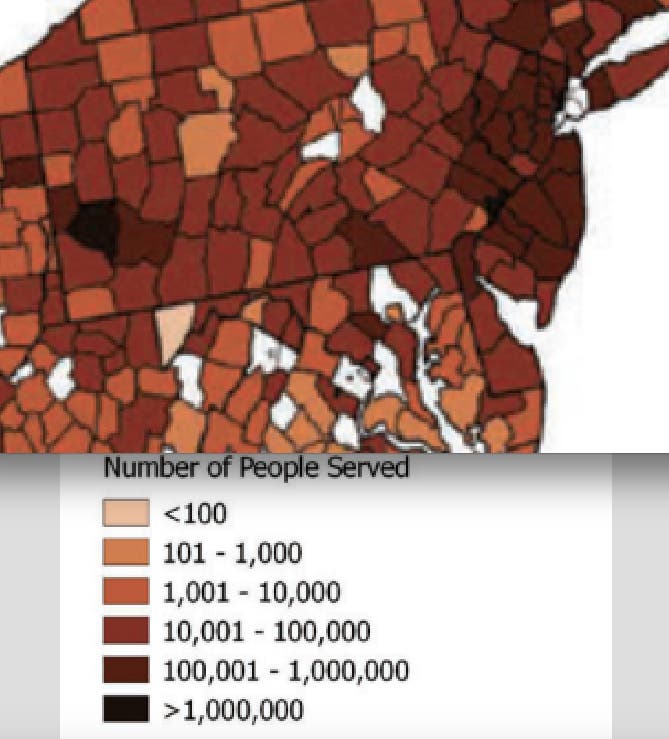
SDWA violations generally fall into two categories: health-based violations and monitoring and reporting violations. Those violations don't necessarily mean the water is unsafe; it means that testing or monitoring wasn't conducted sufficiently, according to the report.
However, the report notes these violations "can mask serious underlying issues such as contamination."
"Without proper monitoring and reporting, it is impossible to determine whether health-based standards have been met," the report said.
Get more local news delivered straight to your inbox. Sign up for free Patch newsletters and alerts.