Community Corner
Northern Ocean Habitat For Humanity Home Repairs Uplift Residents
They're known for building homes, but the Toms River-based group completed its 250th home repair, giving residents safer access.


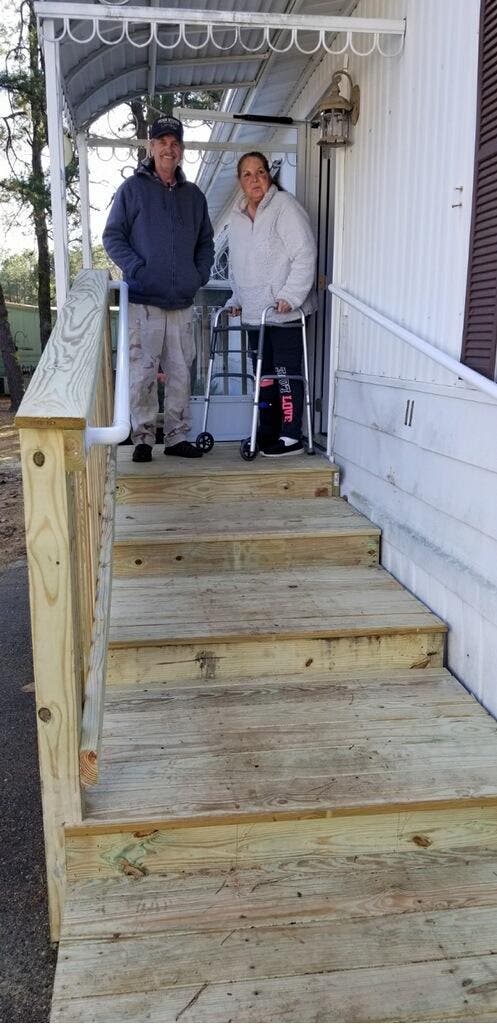
TOMS RIVER, NJ — For Ellen and Bob, getting in and out of their home had become a tremendous challenge. Ellen's walker made using the old, narrow steps to the front door difficult.
"We couldn't get in the door together," Ellen said recently, while volunteers worked outside, rebuilding the steps into her Manchester home. "The steps were so steep. I had to hug the wooden rail," while Bob tried to help her. "If we had groceries, forget it."
By the end of a beautiful spring-like Saturday in January, however, she had wide steps that can accommodate her walker, giving her the freedom to be able to leave her home more comfortably.
Find out what's happening in Toms Riverfor free with the latest updates from Patch.
The new steps were put in place by volunteers working with Northern Ocean Habitat for Humanity. The organization, whose motto is "a hand up, not a handout," is better known for its projects building homes for low-income families.
But the Northern Ocean group also has a home repair program that aims to assist low-income residents who own their homes with repairs they otherwise might not be able to perform themselves or be able to hire someone to do. The work at Ellen and Bob's home was the group's 250th repair project. (Patch was asked to withhold the couple's last name.)
Find out what's happening in Toms Riverfor free with the latest updates from Patch.
Bob Conway, the construction director for Northern Ocean Habitat for Humanity, said the home repairs program includes an application process along with an on-site review of the work that needs to be done. Then, the application is reviewed by the Homeowner Services Committee, which chooses projects based on need, with projects tied to health and safety issues getting the top priority.
They do about four to five repairs each month, Conway said. The program is something that not all Habitat for Humanity affiliates do. It's funded by a combination of grants, donations, and revenue from the Habitat for Humanity ReStore on Route 37.
Similarly to the home building projects that Habitat for Humanity does, recipients of repair services are asked to contribute to the organization in some way, whether it's a small donation or through volunteer hours with Habitat for Humanity.
"It's tailored to what they are capable of," Conway said.
The volunteer hours — "we call it sweat equity," Conway said — are an integral part of what the organization does, because especially for the new homeowners, it gives them a sense of pride in having helped themselves. They are expected to contribute 300 volunteer hours, often helping to build homes for others.
The homes Habitat for Humanity builds are not given away free; the new homeowners have mortgages, but they are interest free and spread over 30 years, making them more affordable.
The repair jobs run the gamut. They have widened doorways to accommodate wheelchairs into bathrooms, repaired roofs that were leaking so badly there were buckets all over the home.
Todd Reinhardt, who does construction work and volunteers his time as a project foreman, said the first time he volunteered with the homeowner repair program, "they had me go under a house where the pipes were broken."
"There was water everywhere, and they had me in a hazmat-type suit," he said. It was a complete mess under the home. It was a difficult situation, but what Reinhardt found, and what keeps him coming back to help, is how much the people receiving the repairs appreciate the time.
"They're the forgotten people," he said. "Sometimes they have no one to check in on them."
The work becomes secondary to letting them know they matter, Reinhardt said.
For Ellen, 67, and Bob, 71, the replacement of their front steps with much wider stairs that can accomodate her walker is a huge change. Ellen has a form of multiple sclerosis, she said, and a couple of other illnesses that have caused mobility problems, including multiple falls. She was diagnosed with MS at age 42, but said the doctors suspect she'd been dealing with it for far longer.
Her husband has health issues that make the kind of work involved with building the wider stairs a challenge. The work on their home was performed in part by members of the Central Ocean Rotary Club of Toms River.
"There are no words for what this means to us." Ellen said. "The other steps were really steep." The new ones will make it safer to go in and out of the home, and will make it easier on Bob as well, because he won't have to stand behind her or beside her in a tight space to keep her from falling.
"I really appreciate everything they're doing," she said. "I don't know how I can ever thank them enough."
Note: This article has been updated to correct the name of the Central Ocean Rotary Club of Toms River. Patch regrets the error.
Have a news tip? Email karen.wall@patch.com Follow Toms River Patch on Facebook.
Get more local news delivered straight to your inbox. Sign up for free Patch newsletters and alerts.