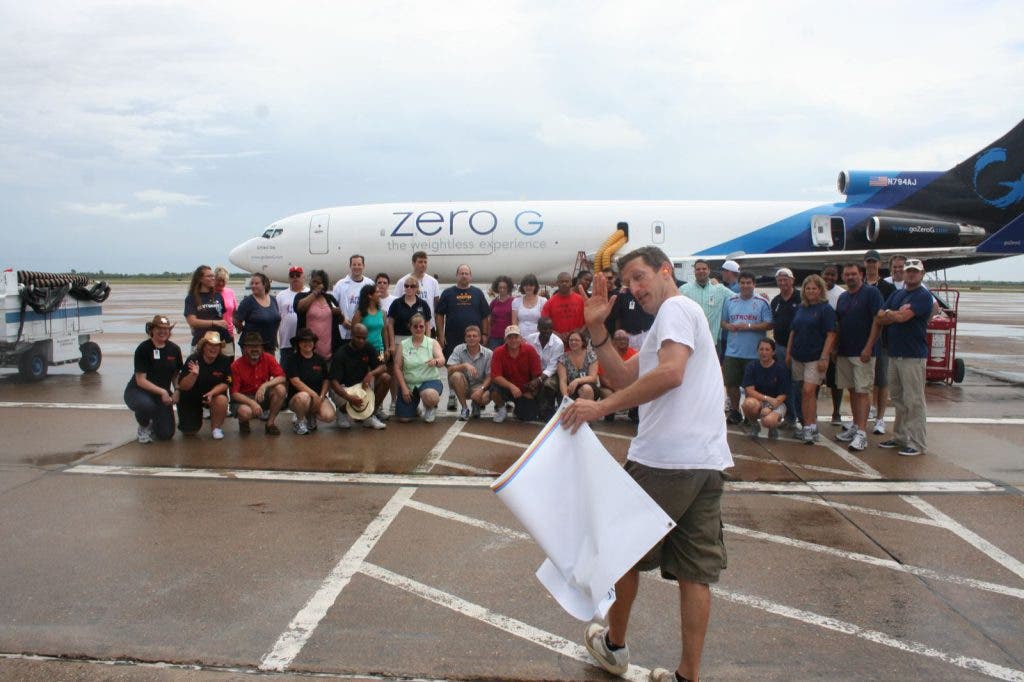
A team of four teachers, Matt Dellibovi, Christine Erickson, Michael Kutch from WHRHS and Caitlin Rozman from Warren Middle School have been chosen to form a Zero-Gravity Education professional development team under the mentorship of WHRHS physics teacher Sophia Gershman.
The team is a part of an exciting and intensive teacher development program called “Clouds,” co-sponsored by NASA, the Department of Energy and the Princeton Plasma Physics Laboratory (PPPL). Dr. Gershman has been involved in the Princeton Plasma Lab’s Science Education program since 1998 and mentored a teacher team from Princeton High School last summer in Houston, where she experienced her first zero-gravity flight. Although the part of the program that gets the most publicity is indeed the teachers’ chance to train for a Zero-G “weightless” experience with NASA, the program is much more than that. Gershman helps teachers design experiments with their students, starting during the school year and following through the 10-day experience in Houston. Teachers report this to be a life-changing experience that leads to exciting improvements in their teaching. An example of such change is a middle school science teacher who started a classroom project with her students to design green, ecologically-sound and technically sophisticated shoe-box houses.
Dr. Gershman assists teachers all the way through the post-experiment data analysis, the preparation of presentations for the public, and the eventual integration of the experience into school curriculum. Indeed, Gershman says that this is what makes this professional development program so special compared to the typical workshops that teachers attend. The teachers involved in Zero-G work from January onwards, typically participating in weekly meetings, as well as doing extensive outside research. As summer draws nearer, the intensive phase of the project has teachers working long hours on the project in addition to their regular teaching. Even after teachers get back from Houston, they continue to work up their data, to present it to others and then, perhaps most importantly, to change school curriculum to reflect knowledge gained in order to benefit future generations of students. Another strong point of the program is its cross-discipline orientation. Although the majority of teachers who have participated thus far are science teachers, there has also been interest from disciplines as varied as history and English. Dr. Gershman explains that a history teacher who participates in the rigorous scientific process called for in the Zero-G program could learn valuable lessons and gain insight to better teach the integral connections between the scientific and the industrial revolutions for example.
Find out what's happening in Warrenfor free with the latest updates from Patch.
For more information on the Zero-G education initiative visit the website: http://science-education.pppl.gov/CLOuDS/About_CLODS.html