Schools
Students' Bones Project Highlights Genocide
School joins larger effort with contribution to installation in Washington, DC.

Bones can tell the story of lives taken on a large scale and in disparate locations around the globe, infamous sites such as Armenia, Auschwitz, the Congo, Cambodia, Rwanda, Darfur, the Sudan, Burma.
Some bones are not the bones placed reverently in cemeteries, but are hidden in deep pits in dark forests, bleaching on open plains or moldering in caves...some never to be discovered, while others are blatantly displayed.
These are the bones of lives taken in events known as holocausts.
Find out what's happening in Watchung-Green Brookfor free with the latest updates from Patch.
So significant, so urgent, is the area of Holocaust studies that the State of New Jersey has mandated its inclusion in the school curriculum. At Watchung Hills Regional High School this year, genocide education is being pursued in a unique way, a collaborative effort between art teacher Michelle Truskowski’s Ceramics class and social studies teacher Ryan Murray’s Holocaust and Genocide Honors class.
Their cooperative efforts are connected to a wider project, called One Million Bones, whose mission it is to “increase global awareness of the ongoing devastation of genocide, raise funds to protect and aid displaced victims and educate students about tolerance through art and social activism.” The two classes have been collaborating throughout the semester to learn how art can bring awareness of an issue, or to memorialize it.
Find out what's happening in Watchung-Green Brookfor free with the latest updates from Patch.
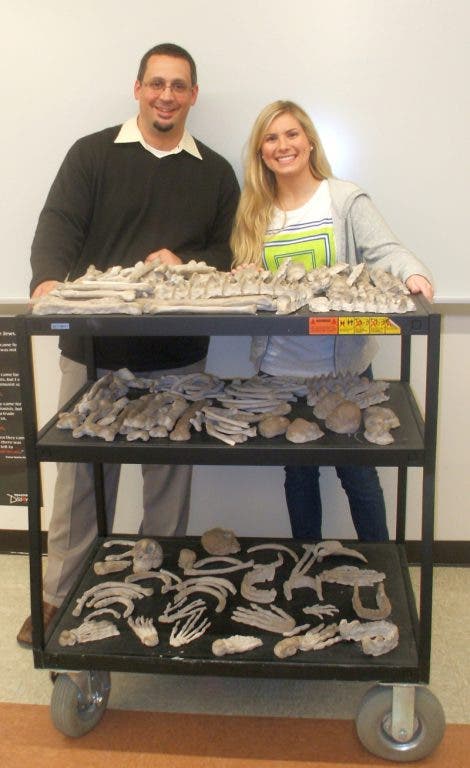
Truskowki’s ceramics students have crafted authentic-looking human bones of all shapes and sizes, from fingers to a complete backbone, out of self-hardening white clay.
Sophomore art student Amanda Carroll said the project brought awareness, a whole new spin, to something they’d discussed in social studies.
The finished “bones” are even now in the process of making their way to the National Mall in Washington, D.C., where they will join similarly-crafted bones from around the nation in an outdoor, symbolic mass grave in front of the Capitol Building from June 8-10. The initiators of the One Million Bones project expect at least 1,00,000 bones to be in the exhibit whose goal it is to raise awareness of the atrocities occurring even now around the world.
Students in Truskowski’s art classes and Murray’s Holocaust and Genocide classes have also made a carved ceramic tiles realistically depicting a child from the Holocaust, using photos supplied by family members of these Holocaust victims. The tiles will be on display at Watchung Hills’ all-school art show later this month to honor those lost to genocide.
Both the arts and the Holocaust classes visited the Holocaust Museum in Washington, D.C., on Feb. 28. With the group was Vivian Swartz, the school’s media specialist/librarian, whose parents survived the Holocaust.
Murray was the 2012 recipient of the $1,000 Jack Zaifman award for Holocaust Education and continues his deep interest and activity in this area of study. He said that the bones project began in Albuquerque, N.M., in August of 2011 with the display of 50,000 bones, in commemoration of victims of mass atrocities in Sudan, Congo and Burma. The idea spread and eventually evolved into the One Million Bones education project.
The upcoming Washington installation “will serve as a collaborative site of conscience to remember victims and survivors, and as a visible petition to raise awareness of the issue, and prevail upon our government to take much needed and long-overdue action” said the sponsors of the effort.
Murray has been visibly disappointed in the slowness of the United Nations’ efforts to address the genocide issue in such nations as Rwanda, Dafur and Uganda. He would also wish that “Congress might speak up and address these issues.” These symbolic bones on their very doorstep might serve as motivation.
The two teachers declared: “We never cease to be amazed at how many people have only the vaguest notion of what genocide is, and many more have no idea it’s happening now…One Million Bones is committed to leveraging the power of art to inspire activism…The most powerful thing we can do is to see art as a means of introducing people to the issue and offering actions related to it.”