Politics & Government
Christie Calls Out 'A Bad System,' Blames Teachers Union For N.J. School Financial Problems
The governor was in Wayne Tuesday pushing his controversial Fairness Formula, which calls for all schools to receive the same amount of aid.


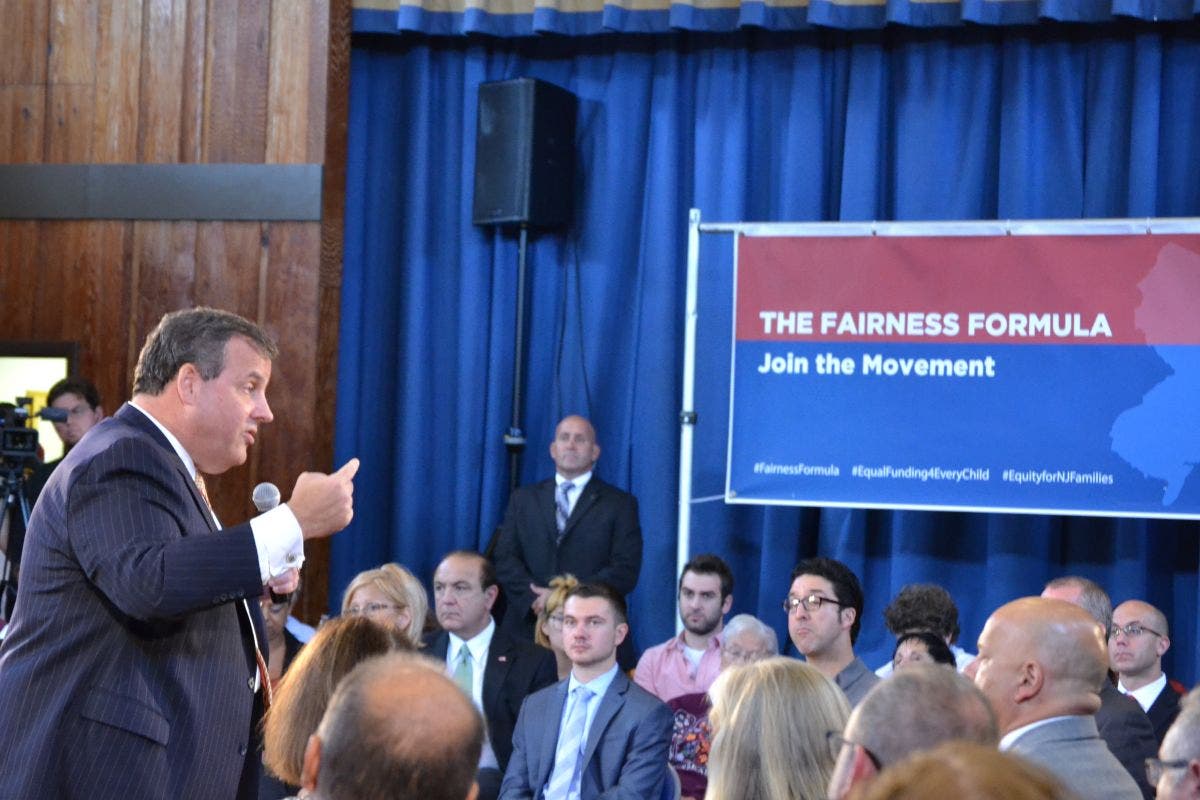
WAYNE, N.J. — Governor Christie pushed his controversial Fairness Formula to residents and pointed his finger at the New Jersey Education Association as being a large part of the financial problem plaguing state's public education system.
The plan is designed to reduce the state's ever-increasing property taxes and improve failing urban school districts like Paterson and Newark. The plan would require all public school districts to receive the same amount — $6,599 — per pupil in tax dollars.
"I'm calling out a bad system," Christie said at a clubhouse overlooking Packanack Lake. "It's time to fight. This is what's driving the property tax problem. If don't fix this, we won't fix the property tax problem. If we want to fix this problem, we have to fix it where the money is."
Find out what's happening in Waynefor free with the latest updates from Patch.
The plan would revamp a 30-year-old New Jersey Supreme Court decision that gave birth to the state's 31 Abbott districts — places like Paterson, Newark, and Asbury Park. These districts, Christie said, have received $98 billion in direct state aid since the decision. That compares to the $82 billion to the other 546 school districts have received in that same time.
Slightly more than $20,000 is spent on a Wayne student. Of that money, the state sends only a fraction in aid. Asbury Park spends about $33,000, $29,000 of which is paid for by the state.
Find out what's happening in Waynefor free with the latest updates from Patch.
Christie made the point that disproportionate amount of state aid to the Abbott districts, many of which have low graduation rates, like Asbury Park's, which is 66 percent. Wayne graduation rate is 96 percent.
"This a results problem, not a revenue problem," Christie said. "We have been, unlike most other state's in the union, been in a 30-year experiment. It's about saying 'This has not worked.'"
The average Wayne homeowner would save more than $2,100 in property taxes under the plan. According to the governor, 75 percent of school districts would get more state aid under the plan than they do today.
Christie attacked the New Jersey Education Association (NJEA) and the fact that its members only work a limited number of hours, for 36 weeks, and are limited, in some cases, by what they can do to help students, such as staying after school and offering extra help. The Obama administration called their health benefits package "platinum level" and members have co-pays of as little as $3 for prescription medications. The health insurance costs taxpayers $4 billion annually.
"Why not have the same benefits as the private sector does?" Christie said. "Money is not only being wasted on the school districts, it's being wasted on big, big benefits that are being demanded by this union. The union is the problem."
Christie also said teacher layoffs should be done on merit, not seniority.
Donna Persh, a retired teacher from the Morris Hills Public School District, said the NJEA is necessary. She said that, without it, many teachers would start out making just $15,000 and top out at $55,000 a year.
Christie wants to give local superintendents and the state Commissioner of Education David C. Hespe the ability to strike down line items in collective bargaining agreements that "don't contribute to education," the governor said.
Send local news tips, photos, and press releases to daniel.hubbard@patch.com. Get Patch breaking news alerts sent right to your phone with our new app. Download here.
Staff photo by Daniel Hubbard
Get more local news delivered straight to your inbox. Sign up for free Patch newsletters and alerts.