Community Corner
More NJ Teens Are Committing Suicide: Why It's Happening And What Can Be Done
A Patch special report: Why are an increasing number of New Jersey's young people killing themselves?


On the outside, T.J. Sefcik seemed to have it all. His family loved him. He was a two-sport athlete at Montville High School, playing hockey and lacrosse.
But inside, Sefcik was battling depression and mood swings. His behavior became erratic. He was in the care of a psychologist and a psychiatrist. Counselors, teachers, friends, coaches and his family were looking out for him.
In December of 2010, Sefcik stepped in front of a tractor-trailer on Route 287. He left a text on his phone, in which he said he was “giving up” and that he was “sorry for the all the trouble he caused.”
Find out what's happening in Waynefor free with the latest updates from Patch.
He was 16 years old.
Sefcik isn't alone. More children and teenagers in New Jersey are committing suicide, a phenomenon that's ringing alarm bells for mental health professionals. After unintentional injury and illness, suicide is now the third leading cause of death for New Jersey's young people ages 10-24.
Find out what's happening in Waynefor free with the latest updates from Patch.
The number of suicides among children and young adults has increased 40 percent since 2002, according to the New Jersey Youth Suicide Report. The report was compiled by the New Jersey Department of Children and Families and uses data up to 2015, the most recent year for which it is available. It was at an all-time low 15 years ago, in 2002, at 3.2 suicides out of every 100,000 children. Now it's at 5.5 suicides per every 100,000 children.
And it’s not just New Jersey. Teenage suicide is climbing across the United States, peaking at a rate of 8.5 out of 100,000 children and teens nationally.
But the question is, why is this happening? And what can be done?
Psychologists point to an array of factors, such as the rise of social media and online bullying, transgender and sexuality issues, increased academic and social pressure and increased access to drugs and alcohol.
"This is definitely something that needs attention,” said Maureen Brogan, the statewide Traumatic Loss Coalition coordinator at Rutgers University. Brogan, a licensed professional counselor and a New Jersey-certified Disaster Response Crisis Counselor, sits on the Governor’s Youth Suicide Prevention Council.
Watch: How You Can Prevent Your Children From Becoming Victims Of Bullying
Her group is the one called into schools to talk to students and staff after there is a suicide. “When we’re talking about something that is the third leading cause of death for young people — that needs attention.”
Suicide on the rise among pre-teens, too
Sadly, there is an even more alarming trend occurring: While suicide rates are declining for older teens, those ages 19-24, they are increasing for younger teens and pre-teens, ages 10-18. Since 2007, suicide rates among children between the ages of 10 and 14 has doubled, according to the Centers for Disease Control.
“We are starting to see deaths by suicide at younger ages, such as in 9- and 10-year-olds,” Brogan said. “It’s still few enough that they don't become statistically significant. But it's still an increase.”
Part of that may be because their deaths are more accurately classified than in the past, she said; they used to be labeled as accidents. But more research is badly needed about why pre-teens are increasingly taking their own lives, she said.

Chart from the New Jersey Youth Suicide Report
“Mental health struggles are the number one cause of suicide among children,” said Dr. Tamar Kahane, an adolescent psychologist and founder of the Kahane Center for Developmental and Psychological Well Being in Englewood. “A young child does not have the capacity yet to have foresight and plan the way adults can. They can be more impulsive. That puts them at a higher risk of doing something dangerous, not just committing suicide.”
Teen suicides often come in clusters, and school officials say they must react swiftly to make sure students aren't overwhelmed with grief — and to prevent copycat issues. A student who is in distress or on the edge may be pushed into action by seeing a friend or classmate choose to end their life, suicide experts say.
Without intervention, it can lead to a series of events that leaves deep scars in a community.
Manasquan experienced this unfortunate scenario between 2008 and 2012. The Manasquan "cluster," which claimed at least 10 lives from 2008 to 2013, is widely regarded as one of the worst suicide clusters in the country. All of those who killed themselves were either teens or young adults.
It began with Tim Schenke, an 18-year-old honors student at Manasquan High School. He was hit by a train on the evening of April 26, 2008, in Spring Lake; his death was later ruled a suicide. Connor Cameron, 15, a competitive bodyboarder and well-liked, popular student at the high school, was the 10th and final death; he died in Feb. 15, 2012. He was also hit and killed by a train.
Schenke's mother, Lisa, said her son battled depression for years.
“The adolescent mind is very different from our mind,” said Phyllis Alongi, clinical director at the Society for the Prevention of Teen Suicide, based in Freehold. “Their judgment is so cloudy with desperation and emotional pain, and the emotional pain is so intense that it's difficult for an adolescent to decipher, 'Am I always going to feel this way? Where can I go for help? Is someone going to be able to get me out of this?' They're stuck.”
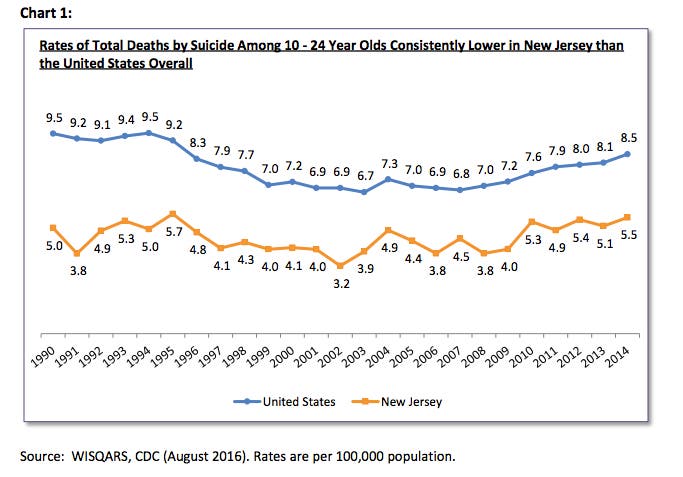
Chart from the New Jersey Youth Suicide Report
Is bullying the root of the suicide increase in children and teens?
There have been many high-profile cases to support this position, including the death of Tyler Clementi. Mallory Grossman, a 12-year-old girl in Rockaway, Morris County, just died suddenly last week; her mother said she was bullied before her death.
Some counselors and parents say it’s more often an underlying, undiagnosed mental health or emotional issue that can torment a child, and not bullying.
“A lot of kids are bullied and go through breakups, and they don’t kill themselves,” said Wendy Sefcik, T.J.'s mother, in Montville. “The bullying isn’t OK, but that’s not the reason behind the suicide. There is something else there: depression. There is a difference between someone who is struggling due to a life event and someone who has a true mental health condition like depression.”
Brogan, the Rutgers counselor, agrees. Online bullying gets a lot of media attention nowadays, but it’s not always the culprit behind youth suicide that people think it is, she said.
“What’s really interesting about social media, which has been around for 15 years now, is that it can be both negative and positive in terms of teen suicide,” Brogan said. “Yes, we’ve all heard of the cyber bullying. But what we’re actually starting to see now is young people using the internet to connect, such as the ‘It Gets Better’ campaign for LGBTQ youth."
Another big culprit is stress. Today’s teens face extremely high expectations to excel.
“There is a lot of internal pressure young people put on themselves to be the best — you can’t just have good grades, you have to have straight As,” Brogan said. “You can’t just be a good athlete, you have to be an elite athlete. Somehow, as a society, we’ve made ‘average’ bad. Do you ever hear a parent say, ‘I’m just so grateful my kid is average?’”
Who is most at risk for suicide?
Teen boys are much more likely to die by suicide than teen girls, the 2015 New Jersey study found. That’s in part because boys choose more lethal methods. Teen boys are overwhelmingly more likely than girls to use firearms: 21 percent of boys ended their life with a gun versus 8 percent of girls. Yet teen girls are more likely to use poison, the study found.
“There is absolutely a gender difference. Males take their own lives at four times the rate of females,” said Alongi. “Young women who attempt suicide tend to use more non-violent means, whereas young men use firearms, which are more likely to result in death.”
Mental illness and emotional issues manifest differently among boys and girls, experts say.
“We know that impulsivity can play a large role as a risk factor, so any diagnosis in which that is a side effect or a symptom, or any clinical diagnosis that increases impulsivity, is at an increased risk (of suicide),” Alongi said. “Research tells us that more males than females are diagnosed with ADHD and ADD, which includes being impulsive.”
Teen girls are more likely to suffer from other psychological problems, such as depression and anxiety. Early onset puberty can also lead to suicidal thoughts or preoccupation in teen girls, Alongi said.
Suicide rates also vary widely in different geographical regions in New Jersey. For example, teen suicide is markedly higher in rural areas of New Jersey.
According to the report, New Jersey’s Skylands region, which includes counties like Sussex, Morris, Hunterdon and Warren, has the highest rate of youth suicide in people ages 10-24, at 7.4 per 100,000.
New Jersey’s most urban zones, areas like Newark, Paterson and Jersey City, have the lowest rates of suicides.
Part of that is access to guns, Brogan said, which is higher in rural communities. There also are not enough mental health resources in rural areas, and teens may have to drive miles to get to a counseling center, she said. They don't see signs about mental health resources while walking to school or getting on the bus, which they might in more urban areas, she said.
But there are some positive changes being made: Gun shops in rural parts of the country are now partnering with suicide-prevention groups to educate customers about suicide and prevent them from getting guns.
The three counties with the highest rates of youth suicide are Morris with 6.8, Monmouth with 5.5 and Bergen with 5 out of 100,000 children and teens. The Jersey Shore region was next, including Monmouth, Ocean and Atlantic counties.
Bergen County had the highest number of teen suicides in 2015, with 26. Salem County had the least with four.
Asian-American teens were the most likely demographic to commit suicide, and their numbers have risen in the past few years, the study shows. White teens and African-American teens have nearly the same suicide rate. Hispanic teens were least likely to commit suicide.
What can be done?
Many places in New Jersey are making an effort to alleviate stress among teens and young people.
Some school districts have opted to bring yoga and mindfulness into the classroom. Stafford Township and Shore Regional High School in West Long Branch both invited yoga teachers into the schools to teach gym teachers, sports teams and students.
Other districts, such as West Windsor-Plainsboro, are giving less homework and have done away with midterms to give kids a break.
Schools have a critical role not just in the aftermath of a suicide but also in prevention and intervention, said Michael Blatt of the Ocean County Health Department.
Blatt, who is the coordinator of the county’s Commission for Individuals with Disabilities, also oversees the Ocean County Emergency Response Committee, which assists school districts faced with the death of a student or staff member.
When a student dies, the district's crisis team reaches out to students who may have known the child — classmates, friends or even other family members within the district. When there are signals a student is struggling as a result of the tragedy, counselors address it, even getting the student emergency treatment outside the school if it is warranted, David Healy, the Toms River Regional superintendent, and Thomas Gialanella, the Brick Township interim superintendent, said.
It's also important for parents and teachers to recognize potential warning signs, which include:
- Talking about wanting to die
- Looking for a way to kill oneself
- Talking about feeling hopeless or having no purpose
- Talking about feeling trapped or in unbearable pain
- Talking about being a burden to others
- Increasing the use of alcohol or drugs
- Acting anxious, agitated or recklessly
- Sleeping too little or too much
- Withdrawing or feeling isolated
- Showing rage or talking about seeking revenge
- Displaying extreme mood swings
(The more of these signs a person shows, the greater the risk, according to experts.)
If you are worried someone you know is considering suicide, do not leave them alone. Be sure to remove any firearms, alcohol, drugs or sharp objects that could be used in a suicide attempt. Call the National Suicide Prevention Lifeline at 800-273-TALK (8255), take the person to an emergency room or seek help from a medical or mental health professional.
Additional resources:
- Tlc4teens.org: A website created by the Traumatic Loss Coalitions for Youth, which includes organizations, hotlines and relevant articles that have been vetted by TLC. The site contains links to state and national resources for issues such as suicide prevention, grief, mental health, depression, substance abuse, dating, bullying, anxiety, self-care, underage drinking, sexuality and gender identity.
- Call or text 2NDFLOOR — a confidential and anonymous helpline for New Jersey youth and young adults, ages 10 to 24, at 888-222-2228. It is staffed 24 hours a day.
- NJ Hopeline: 855-NJ-HOPELINE at 855-654-6735
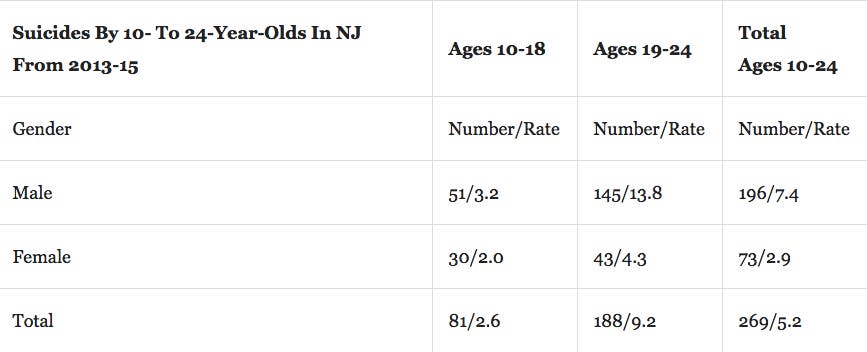
Here is a breakdown of suicides by 10- to 24-year-olds in New Jersey from 2013-15:

Map from the New Jersey Youth Suicide Report
Want to learn more? Read the entire 2015 New Jersey Youth Suicide Report.
By Carly Baldwin and Daniel Hubbard, Patch Staff Writers
Staff writers Katie Kausch and Karen Wall contributed to this report.
Image via Pixabay
Get more local news delivered straight to your inbox. Sign up for free Patch newsletters and alerts.