Health & Fitness
South Jersey Mega-Site Delivers 100,000th COVID Vaccine Dose
A Pitman woman received the 100,000th COVID-19 vaccination at the state's "mega-site" in Gloucester County on Sunday.


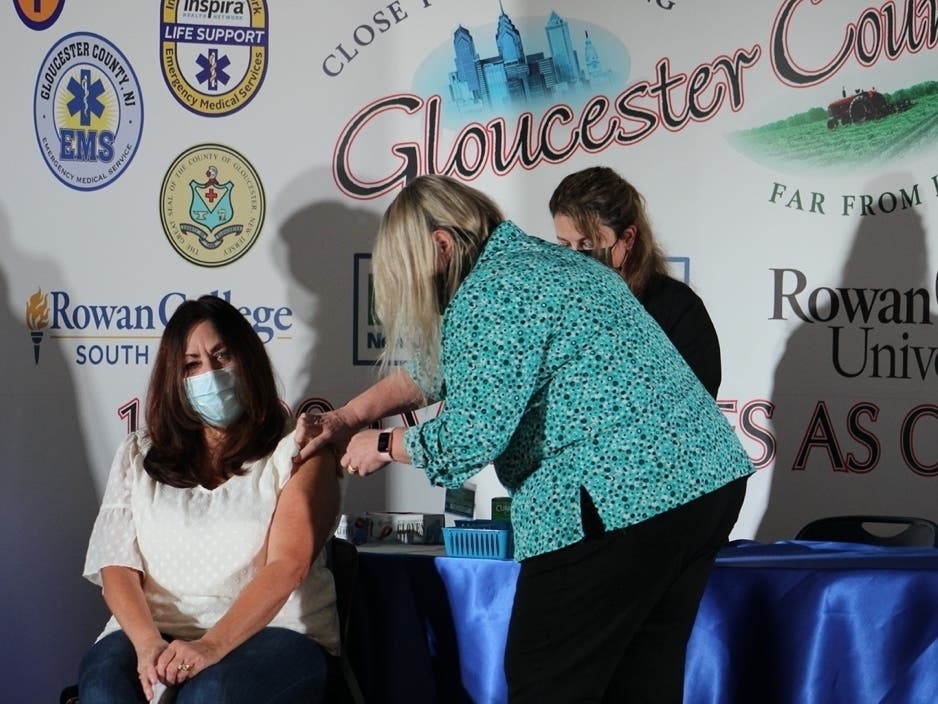
DEPTFORD, NJ — A Pitman woman received the 100,000th COVID-19 vaccination at the state’s “mega-site” in Gloucester County on Sunday, county officials announced.
Susan Malinoski received the dose at the Rowan College of South Jersey site at 1400 Tanyard Road, officials said Monday afternoon. The site serves residents from all over the state.
“The Gloucester County Mega Site has been working so diligently to provide vaccines to our residents and others beyond County lines,” Gloucester County Commissioner Director Robert M. Damminger said. “Every day we’re serving our Country proudly, and we are very proud to hit the 100,000-vaccine landmark.”
Find out what's happening in West Deptfordfor free with the latest updates from Patch.
Video of the vaccination can be seen below. The set for the video was provided by Prof Productions, Inc. Officials also thanked local donors including LaScala’s Fire Glassboro, Chic Fil A Mantua, Home Depot Mantua, Edelman Fossil Park, Bearington Collection and Bogey’s Club and Café.
Find out what's happening in West Deptfordfor free with the latest updates from Patch.
New Jersey Coronavirus Updates: Don't miss local and statewide announcements about novel coronavirus precautions. Sign up for Patch alerts and daily newsletters.
The “mega-site” - which is supported by the County of Gloucester, Gloucester County Health Department, Gloucester County Office of Emergency Management, Gloucester County EMS, Happy Healthy You Family Medicine, the New Jersey State Health Department, National Guard 44th Infantry Brigade, Rowan College of South Jersey and Rowan University - opened in January. Read more here: NJ’s COVID-19 Vaccine Mega-Site Opens In South Jersey
At that time, the Pfizer vaccine was available, and the Moderna vaccine became available shortly thereafter. The Johnson & Johnson one-shot vaccine was recently approved, and Gov. Phil Murphy has said he expects it to become available for New Jersey residents this week. Read more here: NJ Expects COVID-19 Vaccine Doses By Next Week
“Our nurses, volunteers, National Guard, Gloucester County employees and staff are all working tirelessly to get the New Jersey population vaccinated, and we can’t wait to hit our next milestone,” Gloucester County Commissioner Jim Jefferson said.
Even if you're not eligible to receive a COVID-19 yet, New Jerseyans can pre-register online. Walk-ins are not accepted. On Monday, Murphy announced that teachers and others would soon be added to the list. Read more here: More NJ COVID Vaccine Expansion: Clergy, Food Workers, Day Care
The state set a goal to vaccinate 70 percent of its adult population – or 4.7 million adults – within six months.
Who is eligible for vaccination at this time?
Currently, vaccines are available to the following groups:
Healthcare Personnel (Phase 1A)
Paid and unpaid persons serving in health care settings who have the potential for direct or indirect exposure to patients or infectious materials, including, but not limited to:
- Licensed healthcare professionals like doctors, nurses, pharmacists, and dentists
- Staff like receptionists, janitors, mortuary services, laboratory technicians
- Consultants, per diem, and contractors who are not directly employed by the facility
- Unpaid workers like health professional students, trainees, volunteers, and essential caregivers
- Community health workers, doulas, and public health professionals like Medical Reserve Corps
- Personnel with variable venues like EMS, paramedics, funeral staff, and autopsy workers
- All workers in acute, pediatric, and behavioral health hospitals and ambulatory surgical centers
- All workers in health facilities like psychiatric facilities, Federally Qualified Health Centers, and rehabs
- All workers in clinic-based settings like urgent care clinics, dialysis centers, and family planning sites
- All workers in long-term care settings like nursing homes, assisted living facilities, group homes, and others
- All workers in occupational-based healthcare settings like health clinics within workplaces, shelters, jails, colleges and universities, and K-12 schools
- All workers in community-based healthcare settings like PACE and Adult Living Community Nursing
- All workers in home-based settings like hospice, home care, and visiting nurse services
- All workers in office-based healthcare settings like physician and dental offices
- All workers in public health settings like local health departments, LINCS agencies, harm reduction centers, and medicinal marijuana programs
- All workers in retail, independent, and institutional pharmacies
- Other paid or unpaid people who work in a healthcare setting, who may have direct or indirect contact with infectious persons or materials, and who cannot work from home.
Long-Term Care Residents and Staff (Phase 1A)
All residents and staff of long-term and congregate care facilities, including:
- Skilled nursing facilities
- Veterans homesGroup homes like residential care homes, adult family homes, adult foster homes, and intellectual and developmental disabilities group homes
- HUD 202 Supportive Housing for the Elderly Program residences
- Institutional settings like psychiatric hospitals, correctional institutions, county jails, and juvenile detention facilities (for eligible minors, e.g. 16+ years of age may be eligible for Pfizer vaccine under the emergency use authorization)
- Other vulnerable, congregate, long-term settings
First Responders (Phase 1B)
Sworn law enforcement, firefighters, and other first responders, including:
- New Jersey State Police troopers
- Municipal and county police officers
- Campus police officers
- Detectives in prosecutors' offices and state agencies
- State agency/authority law enforcement officers (e.g. State Park Police and Conservation Officers, Palisades Interstate Parkway Officers, Human Services police, and NJTransit police)
- Investigator, Parole and Secured Facilities Officers
- Aeronautical Operations Specialists
- Sworn Federal Law Enforcement Officers and Special Agents
- Bi-State law enforcement officers (e.g. Port Authority)
- Court Security Officers
- Paid and unpaid members of firefighting services (structural and wildland)
- Paid and unpaid members of Search and Rescue Units including technical rescue units and HAZMAT teams
- Paid and unpaid firefighters who provide emergency medical services
- Paid and unpaid members of Industrial units that perform Fire, Rescue and HAZMAT services
- Members of State Fire Marshal's Offices
- Bi-State Fire Service Personnel (e.g. Port Authority)
Individuals at High Risk (Phase 1B)
Individuals aged 65 and older, and individuals ages 16-64 with medical conditions, as defined by the Centers for Disease Control and Prevention, that increase the risk of severe illness from the virus. These conditions include:
- Cancer
- Chronic kidney disease
- COPD (chronic obstructive pulmonary disease)
- Down Syndrome
- Heart conditions, such as heart failure, coronary artery disease, or cardiomyopathies
- Obesity (body mass index [BMI] of 30 kg/m2 or higher but < 40 kg/m2)
- Severe Obesity (BMI ≥ 40 kg/m2)
- Sickle cell disease
- Smoking
- Type 2 diabetes mellitus
Individuals who are pregnant and those in an immunocompromised state (weakened immune system) from solid organ transplant are also eligible but should follow CDC guidance and first discuss vaccination with their medical provider before receiving the vaccine.If you are currently eligible, click here for more information on where to get vaccinated.
Beginning March 15, the following groups will be eligible for the COVID-19 vaccine:
- Educators, including support staff, in pre-K through 12th grade settings
- Childcare workers in licensed and registered settings
- Public and local transportation workers, including bus, taxi, rideshare, and airport employees; NJ TRANSIT workers; and Motor Vehicle Commission staff
- Public safety workers who are not sworn law enforcement or fire professionals, including probation officers and fire safety inspectors
- Migrant farm workers
- Members of tribal communities
- Individuals experiencing homelessness and those living in shelters, including domestic violence shelters
"Two weeks from today, these groups which I just mentioned will be able to make their appointments and start getting vaccinated," Murphy said. "We expect this to be a total of several hundred thousand workers and residents. What is being constructed between now and the 15th … the exact how and where, and in some cases when, is going to be worked out."
Beginning March 29, front-line essential workers in the following categories will also be eligible for vaccination:
- Food production, agriculture and food distribution (including grocery store and restaurant workers)
- Eldercare and support
- Warehousing and logistics
- Social services support staff
- Elections personnel
- Hospitality
- Medical supply chain
- Postal and shipping services
- Clergy
- Judicial system
After these phases are complete, then the general public will be eligible for vaccination. The timing of the progression among the groups depends on the supply of vaccine to the state balanced by the demand in various phases, officials said.
Other things to know about the vaccine:
- The state has changed the immunization system from an opt-in to an opt-out program for any resident who chooses to receive a COVID-19 vaccination. People who wish to be vaccinated against COVID-19 do not have to first opt-in to the system to make sure that their two-dose regimen is properly tracked and managed.
- Thirty days after the current public health emergency ends, people who enrolled due to the COVID-19 vaccine will be afforded the opportunity to withdraw from the system. The Executive Order does not force anyone to receive the vaccine.
- The state will securely store the vaccine recipient's name, address, date of birth, race, ethnicity, and gender. These are standard data elements that have been used across vaccines administered in New Jersey.
- New Jerseyans can also expect to provide additional demographic and occupational data to ensure equitable and efficient scheduling of vaccinations.
- Medical screening questions will be asked to assess eligibility. All data collected can only be used for public health purposes, like ensuring that the same person returns for a second dose of the same COVID-19 vaccine at the right time interval.
- Data cannot be used for civil or criminal enforcement and cannot be used for immigration enforcement.
Get more local news delivered straight to your inbox. Sign up for free Patch newsletters and alerts.