Politics & Government
West Deptford Zoning Board Tanks T-Mobile Tower
The board rejected the company's application after a hearing Tuesday night.


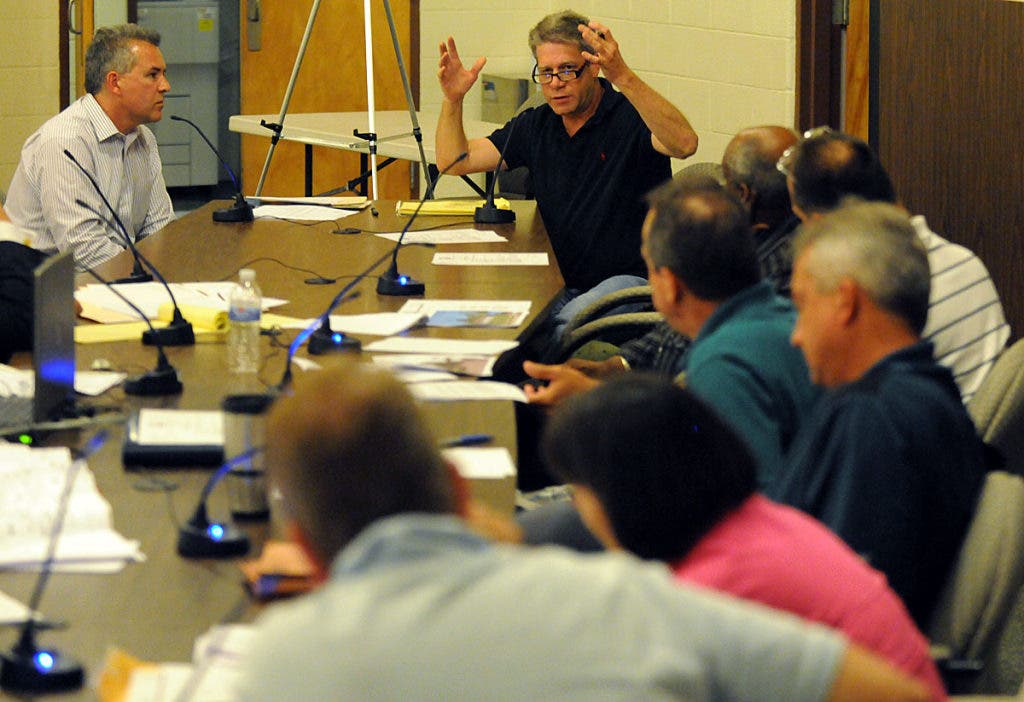


Goliaths don't come much taller than a 156-foot monopole cell phone tower.
They don't fall much harder, either, as the West Deptford zoning board Tuesday night roundly rejected, in an unopposed vote with just one abstention, an application by T-Mobile to erect their tower in a residential zone between Pennfield and Sherwood Estates off Jessup Road.
“The zoning board did the right thing,” said Jeff Hansen, a Fernwood Drive resident and one of the unofficial spokespeople, along with Dave Sileo, of the dozens of other Pennfield and Sherwood Estates residents who turned out for the meeting.
Find out what's happening in West Deptfordfor free with the latest updates from Patch.
It was a little more complicated than just a simple site plan application, though–the board had the matter remanded to them by a court challenge to the tower's original approval last year, and had to specifically hear arguments on whether the tower's placement in a residential zone had a detrimental effect on the township's zoning plan.
That led to a nuanced dance of experts from T-Mobile's side, as they showed photo simulations of the tower, testified on the potential for home values to take a hit and what–if anything–the township's master plan and zoning plan have to say about what can and cannot go in a residential zone.
Find out what's happening in West Deptfordfor free with the latest updates from Patch.
One of the major points raised by T-Mobile's experts is the lack of any specifics on cell phone towers in residential areas–though there are allowances for the towers in heavy industrial zones–in either West Deptford's master plan or zoning plan. James Miller, T-Mobile's planner, said they have to make inferences, since the residential zone definitions don't ban the towers outright.
He also pointed out that, under the federal Telecommunications Act of 1996, requires that wireless providers have seamless coverage–and to get the seamless coverage in West Deptford, that means putting a cell tower in a residential area.
“In some instances, there's no alternative,” Miller said.
And while perhaps not ideal, T-Mobile's bevy of experts said placing a tower in a residential zone is something that's been done elsewhere without affecting the surrounding homes.
Mark Tinder, an appraiser who spoke on behalf of T-Mobile, said he's never seen home values go down because of the presence of cell phone or other towers–an assertion that was met repeatedly with jeers approaching Jerry Springer levels from the audience–and eventually produced a study he'd done on a home in Randolph Township, in Morris County, that showed only a 1-percent difference in the selling price of a home near a pair of communications towers and other homes in the area.
“There's no reasonable potential value impact that's associated with this proposed use,” he said. “The marketplace itself is not reacting in any measurable way to these installations.”
Residents of the affected neighborhoods seized on Tinder's comments during the public portion of the meeting, slamming his claims over and over.
Randy Knowles, a real estate agent who lives on Fernwood Drive, said his experience is that home buyers see the towers as a negative.
“I haven't gotten a call from someone saying, 'Get me a house next to a cell tower,' " he said, a sentiment that was reiterated by several residents who spoke on the evening.
It wasn't just about home values, though. Beth Rodack, a Pennfield Drive resident, said putting the tower in the residential area would wreck the value of her home, not to mention her view.
“Unless we get some redwood trees, it will not be hidden,” she said.
And though there was more than an hour of emotional testimony from residents, the issue essentially boiled down to the final 45 minutes of the night, after the board's planner, Jay Petrongolo, said he believed the tower would create a substantial negative affect on the both the township's zoning plan and master plan.
“This use is contrary to those [plans'] objectives,” he said.
Petrongolo also said the tower, being visible from everywhere around it, would have a definite negative effect on residents, calling it a “visual detriment.”
He pointed out that the tower would be allowed in a heavy industrial zone, and could even be a fit in one of the township's light industrial zones, where it would have less of an effect.
That prompted a lengthy last-ditch effort by T-Mobile's team, which hauled out photos of the PSE&G tower across Jessup Road from Pennfield and had Tinder bring out one of his full reports–the one on the homes in Randolph Township–in an effort to shore up their argument.
That effort proved for naught, as zoning board chair Joseph Jarrett moved to reject the application and the board voted in short order to do just that, a move met with a wave of applause.
It was all hugs and handshakes afterward among the residents who survived the war of attrition that was the four-hour meeting. As his friends and neighbors chatted outside the municipal building, Hansen said he's not completely relieved about the board's decision to reject the plan, since there could still be a legal challenge from T-Mobile on the rejection.
“It's certainly a step in the right direction,” Hansen said.
Gary Forshner, the attorney representing T-Mobile, said it would be premature to say the company will move next to challenge the decision in court, but that option is available to them.
Get more local news delivered straight to your inbox. Sign up for free Patch newsletters and alerts.