Community Corner
Russ's Ravings: Your Life Flashes Before Your Eyes For 45 Minutes
An MRI of the tumor in my brain and the aftermath of sharing my experience changed my outlook this week.


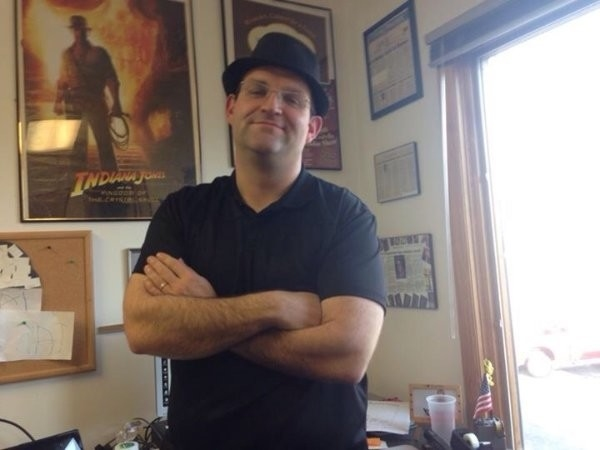
Editor's note: The following is Patch Field Editor Russ Crespolini's, hopefully, weekly column. It is reflective of his opinion alone.
It is the noise that is most surprising. They warn you, before they send you into the futuristic stargate for the MRI of your head. For those of you who don't read this column regularly (and why wouldn't you) last week I wrote about the MRI the doctor ordered to get a look at the tumor growing on my pituitary gland.
But I digress...
Find out what's happening in Westfieldfor free with the latest updates from Patch.
The noise is surprising not just because it is loud, but because it is varied, and jarring. Long, high pitched beeps and short staccato bursts that seem like mortar shells being set of at various distances.
To begin the prep they pack you onto a cushioned slab and strap your head into a collar. The collar has a face piece that presses against your chin, not hard, but enough to notice. They pack your ears with plugs and with small pillows to help insulate you from the noise.
Find out what's happening in Westfieldfor free with the latest updates from Patch.
Soon, you are being loaded like a torpedo into a tube being prepared for firing. All that is missing, once you get locked in place, is water flooding the tube before launch. You try to banish the thoughts of coffins and crematoriums from your mind. Before heading in, you are hooked up to an IV and the saline for some reason you can taste when it hits your bloodstream. As you head into the tunnel, the technicians pat your legs, letting you know they are there and you are going to be ok.
It is surprisingly comforting.
At this point I made the mistake of opening my eyes. I swear my eyelashes scraped the top of the tube when I opened and closed them.
From there, it is an alternating series of noises and squeals interspersed with the voice of the technician keeping you apprised of how the test is going and how long each sequence lasts. At some point, they introduce dye into your IV in order to contrast the images. As the dye creeps in you fight the thoughts of what lethal injections must be like.
But essentially, during this process, you are alone with your own thoughts. Alone with no distractions, alone with no phone and no connection to the outside world. This is the perfect time for your brain to go through a greatest-hits reel of every mistake you ever made, every fear you ever had and every possible permutation of the test and its outcomes.
By the way, I really wish I hadn't let the gym teacher weigh me in front of a room full of people in the seventh grade. And I also am rethinking the homemade Valentine's Day card I gave a girl in the eighth grade. And I definitely would NOT have instituted a dress code and phone answering policy when I took over my first newsroom.
When the test is over, the waiting period begins. For me, it meant waiting until next week to consult with the doctor. I left the test with a mild reaction to the dye and a feeling like the Sword of Damocles hanging over me.
I didn't know how I was going to get through an entire week without putting some plan in motion for recovery. Sure, I knew the odds were against whatever was growing inside me being malignant, but I also knew that my bloodwork and the way I was feeling showed it was already impacting me.
I had no idea how I was going to tamp down my anxiety and muscle through another week.
And then my first column on my diagnosis hit and everything changed.
The response was simply overwhelming.
Comments on social media, comments on the post itself and an unbelievable number of emails. Oh so many emails. People from current and former coworkers to politicians I've covered over the years to strangers in our communities I have never met.
Many of the emails were encouraging thoughts and hopes and prayers for my wellness. And many were people sharing their struggles, or a loved ones struggling with illness. It was a sobering, humbling, transformational experience for me.
The kindness I was shown, and the insight into the human condition and that so many people are struggling with illness that doesn't have obvious symptoms shook me. And woke me up and made me realize how fragile we all are.
And at the same time, from the emails I read, indescribably strong.
And this is one of the benefits of the Patch network. Everyday my colleagues and I strive to cover our communities, the heart of our communities, the best we can. We know we don't always get there and we know we miss the mark sometimes but we are constantly trying to improve and grow and connect with our readers. We are trying to make that connection I experienced this week available to everyone. Through our stories, through our Neighbor Posts, through our social media.
And this was real, tangible proof that it works. So as I sit here now, writing this, I am scheduled to consult with my doctors in the morning to discuss what treatment options are best for my case and go over my results in great detail. And under normal circumstances I think I might have a hard time sleeping.
But I think about the readers who shared their victory over steeper odds, and the politicians who shared their prayers and good vibes and I think of my incredible team at Patch that nationwide said they would be there for me no matter what.
And I think I will sleep just fine.
There is an unspoken rule in journalism, that you never want to make yourself the focus of the story. In fact, there is a former colleague of mine who finds a way to make every story, every social media post and comment about himself and his career. He is infamous for this and often prompts collective eyerolls from so many of us when we see it. I didn't want to be "that guy."
But in this case, I am glad I was.
Thank you to everyone who is taking this journey with me. I still don't know what is going to happen next, but with so many of you on my side, I am not nearly as afraid.
Russ Crespolini is a Field Editor for Patch Media, adjunct professor and college newspaper advisor. His columns have won awards from the National Newspaper Association and the New Jersey Press Association.
He writes them in hopes of connecting with readers and engaging with them. And because it is cheaper than therapy. He can be reached at russ.crespolini@patch.com
Get more local news delivered straight to your inbox. Sign up for free Patch newsletters and alerts.