Home & Garden
1st Flower Grown In Space: NJ Astronaut Shares Photos
NASA astronauts share the story behind the first flower ever grown in space, and how it may help humanity reach Mars one day.


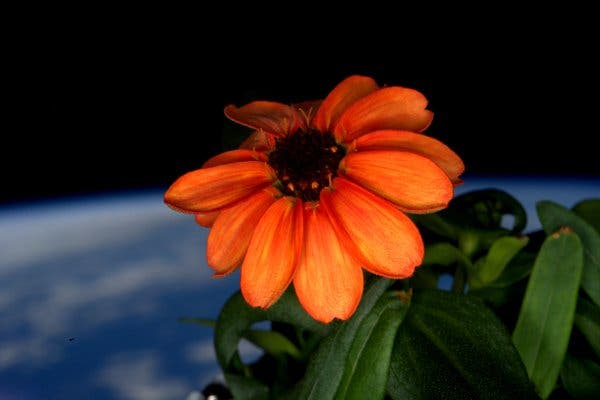
From the humble blossoming of a zinnia flower, humanity may one day reach Mars.
In a real-life scene from out of the blockbuster movie, The Martian, NASA astronauts aboard the International Space Station recently shared progress on their ambitious experiment to grow a zinnia flower in microgravity.
NASA astronaut Scott Kelly – a native of Essex County, New Jersey – shared the news via a social media post on Saturday.
Find out what's happening in West Orangefor free with the latest updates from Patch.
The zinnia is not the first plant life to take root at the well-known orbiting space station. In 2014, astronauts produced a crop of red romaine lettuce which they were able to safely eat.
Find out what's happening in West Orangefor free with the latest updates from Patch.
But the zinnia – the first flower ever grown in space, according to Kelly – represents an endeavor more complex than farming a leafy green.
“The zinnia plant is very different from lettuce, said Trent Smith, NASA Veggie project manager. “It is more sensitive to environmental parameters and light characteristics. It has a longer growth duration between 60 and 80 days. Thus, it is a more difficult plant to grow, and allowing it to flower, along with the longer growth duration, makes it a good precursor to a tomato plant.
The project wasn’t without its difficulties, NASA scientists reported.
Early problems included water seepage, guttation and epinasty… all anomalies which pointed to “inhibited air flow in the plant growth facility,” according to scientists.
These problems, coupled with high humidity and wet surfaces, culminated in a mold problem shortly before Christmas, NASA reported.
But a little bit of mold has never stopped a good scientist.
“Contrary to seeming like a dead end for the crop, the issues faced by the zinnias offered a multitude of learning opportunities for scientists back on Earth,” NASA scientists stated in a recent blog. “What may seem like a failure in systems is actually an exceptional opportunity for scientists back on Earth to better understand how plants grow in microgravity, and for astronauts to practice doing what they’ll be tasked with on a deep space mission: autonomous gardening.”
After volunteering to act as de facto garden guardian, Kelly – assisted by NASA’s earthbound Veggie team – managed to turn the project around. And on Jan. 12, the first peeks of petals began to sprout on a few of the space buds.
“While the plants haven’t grown perfectly, I think we have gained a lot from this, and we are learning both more about plants and fluids and also how better to operate between ground and station,” said Gioia Massa, NASA science team lead for Veggie. “Regardless of the final flowering outcome, we will have gained a lot.”
“Plants can indeed enhance long duration missions in isolated, confined and extreme environments – environments that are artificial and deprived of nature,” said Alexandra Whitmire, deputy element scientist for the Behavioral Health and Performance element in the NASA Human Research Program.
Whitmire said efforts like the recent zinnia experiment will yield important information in preparation for a Mars mission.
“In future missions, the importance of plants will likely increase given the crews’ limited connection to Earth,” Whitmire said.
- See related article: WATCH: NJ Astronaut Breaks Record For Days In Space
Photos by NASA
Get more local news delivered straight to your inbox. Sign up for free Patch newsletters and alerts.