Neighbor News
A Tale of Two Protests
The Transformation from 1968's Search for Harmony to Today's Hostility

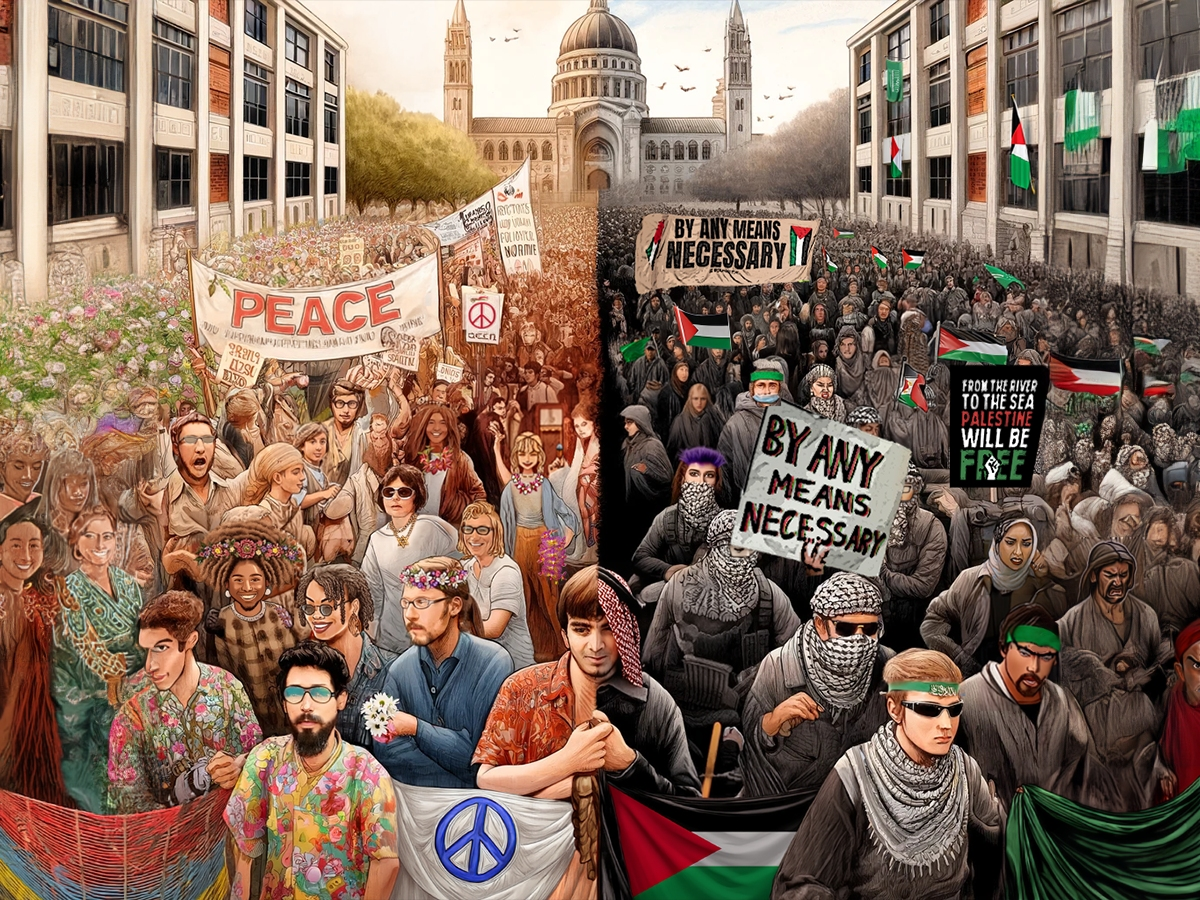
The stark contrast between the iconic civil rights and free speech protests of 1968 in America and France and today's pro-Palestinian student protests is both stark and disheartening. The 1960s movements, epitomized by demonstrations at Berkeley and the Sorbonne, championed ideals of peace, love, and intellectual pursuit of freedom. These activists marched with a vision to expand rights and foster dialogue, rooted in non-violence and inclusivity.
Contrastingly, today’s campus protests, under the banner of advocating for Palestinian rights, have adopted a tone and method alarmingly divergent from those noble principles. Parts of these protests have not only condoned but have also romanticized the violence of Hamas, a designated terrorist organization. The chilling implications of chants like "from the river to the sea, Palestine will be free" suggest a call for the eradication of Israel rather than peace or coexistence.
More troubling is the targeting of Jewish students on campuses, which mirrors the darkest chapters of history, such as the systematic exclusion of Jews from academic and public life in Nazi Germany. There have been reports of Jewish students being barred from university activities, and there are growing calls for violence against Jewish students—a horrifying echo of 20th-century atrocities. This behavior, antithetical to the essence of academic engagement, betrays a fundamental misunderstanding of the rights these protesters claim to defend.
Find out what's happening in West Orangefor free with the latest updates from Patch.
Moreover, surveys suggesting that over 50% of the protesters are "outside agitators" indicate that these movements might not be the organic, student-led crusades they claim to be, but rather influenced by external groups. This undermines the authenticity and grassroots nature of the movements, contrasting sharply with the genuine student activism of the 1960s.
The inconsistency extends to the global scope of human rights advocacy. The same fervor seen in pro-Palestinian protests is conspicuously absent when it comes to other dire human rights crises. Genocides in Sudan and Darfur, the Jihadist genocide of Christians in Nigeria, the Syrian civil war with over 600,000 dead, and the genocide against one million Uighurs in China all occur with little outcry from these activists. The brutal invasion of Ukraine by Russia, a conflict with profound humanitarian consequences, similarly fails to elicit comparable campus activism.
Find out what's happening in West Orangefor free with the latest updates from Patch.
This selective outrage raises serious questions about the consistency and integrity of the activist agenda. The prioritization of one single conflict over all others suggests that political narratives, rather than the severity of human rights violations, are the main influence on the activism. This selective advocacy undermines the credibility of the movement, suggesting a swayed commitment to human rights based on factors other than the injustice itself.
To truly advocate for human rights and justice, a more consistent and comprehensive approach is essential. Silence on these global crises diminishes the moral authority of those who stand on principles of universal human rights. History will not kindly remember a movement that, in its zeal to champion one cause, tramples on the rights and safety of others, nor will it respect an activism that ignores large-scale atrocities that do not fit a particular political narrative. We must demand better of our institutions and ourselves to uphold the true spirit of advocacy and justice.