Business & Tech
Transco Gas Pipeline Will Bring Jobs To Middlesex County, Study Says
The expansion of a natural gas pipeline right under your feet will bring jobs and tax dollars, Rutgers says. Critics say it's 'Trumpian.'


OLD BRIDGE, NJ — If the federal government approves the extension of the Transco pipeline through Middlesex County and underneath Raritan Bay, it will bring both jobs and tax dollars into the area, a new study from Rutgers University found.
However, Transco's critics point out that Rutgers was paid by the pipeline company to do the study, which they say dims its integrity.
"I've never seen a more shameful report put out with a university's name on it," said Jeff Tittel, director of the New Jersey Sierra Club, which is against the pipeline expansion. "This is Trumpian. This report is a fraud and a sell-out by Rutgers."
Find out what's happening in Woodbridgefor free with the latest updates from Patch.
The Williams Companies, one of the nation's largest suppliers of natural gas, wants to expand the Transco pipeline through the eastern part of Middlesex County. Miles of natural gas pipelines already exist underneath central New Jersey, and they've been there for decades. These pipelines are the main arteries to carry gas into New York City. However, those lines are at 100 percent capacity, the company says.
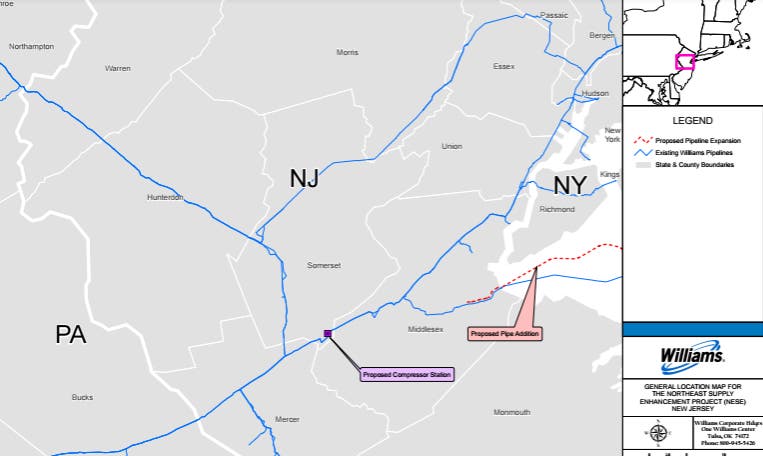
As you can see in the map, Williams wants to now build additional gas pipelines just north of Cheesequake State Park and then extend them out into the Raritan Bay. There will be three miles of pipeline underground in Middlesex County, and then 26 miles of pipeline stretching under the Raritan Bay, extending to its final destination in Rockaway Beach, Queens. The expansion project also includes a new natural gas compressor station built on the South Brunswick/Franklin Township border in Somerset County.
Find out what's happening in Woodbridgefor free with the latest updates from Patch.
Williams must get the federal government's approval. They filed their application with the Federal Energy Regulatory Commission (FERC) in March, and it takes FERC about a year to decide. If approved, the project will directly and indirectly generate 3,186 jobs during the one-year construction period, researchers at the Rutgers' Edward J. Bloustein School of Planning and Public Policy found. Professor Michael L. Lahr and researcher Will Irving were hired by Williams to do the study. According to their work, in New Jersey alone, building the pipeline will generate $239.9 million in additional economic activity (GDP), including 2,411 direct and indirect jobs during construction, $171.9 million in labor income and $16.4 million in local and state taxes.
"Most people don't realize that we pay what's called ‘ad valorum’ property tax on our pipeline. In many counties we are the highest paying property tax payers," explained company spokesman Chris Stockton. "Last year in Middlesex we paid $1.4 million in taxes. As a result of this project, it will increase by about $1 million. In Somerset County we paid more than $1 million last year, and as a result of this project, it will increase about $25,000 annually."
The tax dollars go to support local school districts, he said.
However, Tittel said that all the estimates on tax dollars and job creation were supplied by Williams to Rutgers.
"Where is the independent peer-reviewed data? All the data comes from Williams; there is no verification that it's true," he said. "Also, how many of these jobs are coming from out of state? When I visited another pipeline project recently, all the workers' license plates in the parking lot were from Texas, Oklahoma and Ohio. These are highly-specialized jobs brought in from places in the U.S. where they have experience building pipelines. What percentage of those jobs are coming from New Jersey?"
"Approximately 60 percent of construction labor is estimated to be drawn from within the region," Stockton said. "Some of these jobs are highly specialized, but more than half will come from local union labor."

Rutgers maintains that they derived their estimates based on average construction wages from annual industry labor earnings reported to the U.S. Department of Labor and the IRS.
"Mr. Tittel was not involved in this process, so it’s not surprising that his assumptions are so far off base," Stockton shot back. "The Bloustein School is one of the nation’s leading centers for the theory and practice of planning and public policy scholarship and analysis, so it is disappointing – yet not surprising – that Mr. Tittle would question the institution’s credibility."
Tittel also predicted property values will drop for homes in Old Bridge Township near the pipeline expansion.
"That why the New Jersey Realtor Association opposes a lot of these pipelines," he said. "Property values go down when a pipeline is put in next door and compressor stations pump chromium and other chemicals into the air."
As part of Rutgers' Economic Advisory Service, it is not uncommon for Rutgers researchers to perform studies such as this for fees. Research clients have included ExxonMobil, Public Service Electric & Gas, BP, Lockheed Martin and Goldman Sachs, as well as state agencies.
Williams refused to disclose how much they paid Rutgers to do the study.
You can read the full Rutgers report here yourself.
On land, the pipeline is only required by law to be three feet under the earth, but Williams said they plan to place it at seven feet. At its deepest point, the pipeline will be 85 feet under the bottom of the Raritan Bay. If they are approved, Williams plans to use offshore horizontal direction drilling along the coastline and across the Port Ambrose Channel.
Get more local news delivered straight to your inbox. Sign up for free Patch newsletters and alerts.