Politics & Government
Lawrence Lessig, Academic and Political Activist, Speaks at Ramapo High School
Lessig: "My favorite statistic so far, .000015 percent of America, … that's 47 Americans, had given 42 percent of the money that's been spent in this election cycle."
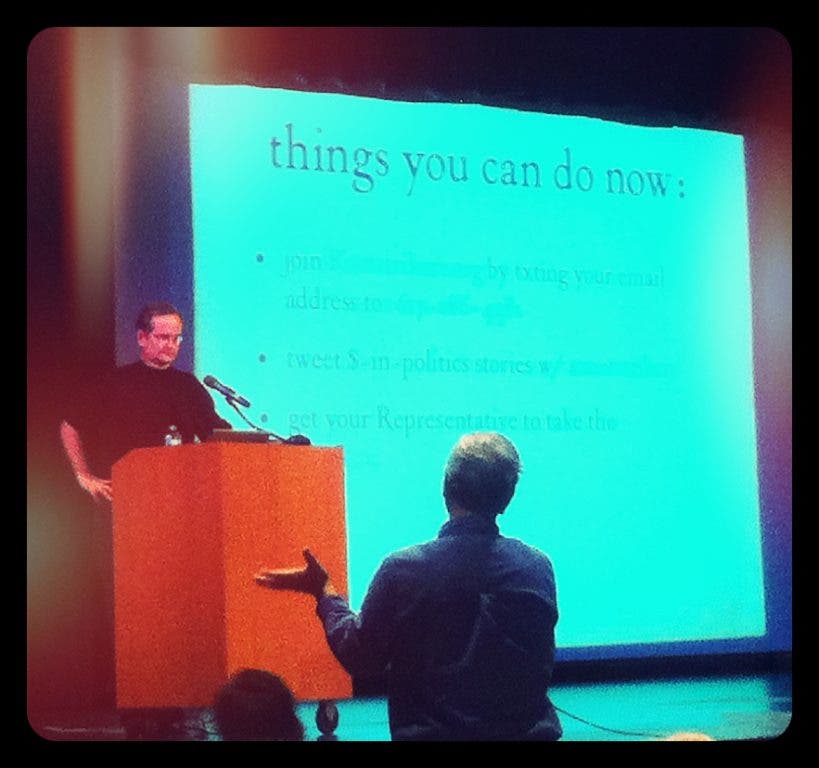
Lawrence Lessig, director of the Edmond J. Safra Foundation Center for Ethics at Harvard University and professor at Harvard Law School, spoke at Ramapo High School on Wednesday night. The program was co-sponsored by North Jersey Public Policy Network and the Ramapo High School Public Policy Group.
A crowd of about 100 audience members, including Ramapo High School students and faculty, turned out for the event.
Lessig's focus was on his view of the corruption that money has caused in United States politics.
Find out what's happening in Wyckofffor free with the latest updates from Patch.
He began by illustrating a metaphor.
A powerpoint presentation showed a map of the USA titled, “Lesterland.” Lessig said that in Lesterland, .05 percent of the people are named Lester.
Find out what's happening in Wyckofffor free with the latest updates from Patch.
The “Lesters,” as he referred to them, were a metaphor for United States “funders,” or the small percentage of people who fund political campaigns with large quantities of money.
Lessig explained, “In Lesterland, the people have the ultimate influence over the elected officials, because after all, there is a general election. But that ultimate influence is exercised only after the Lesters have had their way with the candidates who want to prevail in that general election.”
“This dependence upon the Lesters produces a subtle and understated, let’s say, camouflaged, bending to keep the Lesters happy," Lessig said. "Reform that angers the Lesters is, let’s say, unlikely.”
Lessig paused to let his metaphor sink in.
“The United States is Lesterland. So the United States also has two elections," he said. "One election is the general election, the second election we should call the money election.”
The microphone then cut out and Lessig wittily joked, “There’s no conspiracy, I’m sure.” The audience laughed, the microphone came back and he went on.
“There are just as few relevant funders in America as there are Lesters in Lesterland. Now, you say, really? .05 percent? In 2010, .26 percent of America contributed more than $200 in a congressional election. One quarter of 1 percent. 05 percent gave the maximum amount to any congressional candidate. .01 percent or 1 percent of the 1 percent had given $10,000 or more in the election. And my favorite statistic so far, .000015 percent of America, … that’s 47 Americans, had given 42 percent of the money that’s been spent in this election cycle so far.”
Lessig spoke of the amount of time that candidates spend raising money to give back to congress. “As they engage in that practice they develop a sixth sense, a constant awareness, about how what they do might affect their ability to raise money. They become, in the words of the X-Files, shape-shifters.”
Lessig called for reform and change, often separating his ideas into three points or using repetition to drive his point home. He explained the need for citizen funded campaigns, where a lot of people give small amounts of money instead of few people giving large quantities of money.
He also pointed out that the money corruption severely affects the way Americans view an election. “Rock the Vote, which organizes and turns out young voters … found in 2010 a significant number of their young voters were just not going to show up to vote. So they polled them to ask them why.
“The number one reason by far was: no matter who wins, corporate interests will still have too much power and prevent real change," Lessig said. "And it’s not just kids. The vast majority of Americans who could have voted in 2010 did not vote in part, at least, because of this belief. That’s the corruption. That’s the problem that we as a republic need to address.”
Lessig went on to say that instead of focusing on the divide between the left and the right, we should focus on the disparity between those who are in the inner circle of Washington D.C. and the rest of the country. He referenced the book, “Men Are From Mars, Women Are From Venus,” cleverly changing the title to, “D.C. Is From Mars, We Are From Earth."
Lessig explored the violent tactics used by Malcolm X in comparison to the pacifistic methods of Martin Luther King, Jr., saying that the latter method is what Americans need to use to tackle the corruption. “The question is, are we disciplined enough to do that and could we be disciplined enough to do that?”
Have a question or news tip? Contact editor Joseph M. Gerace at Joseph.Gerace@patch.com, or find us on Facebook and Twitter. For news straight to your inbox every morning, sign up for our daily newsletter.