Community Corner
GPS Tracking Offers Insights Into The Secret Lives Of NY Moose
The second year of the Department of Environmental Conservation Adirondack Moose Research Project has revealed a few surprises.


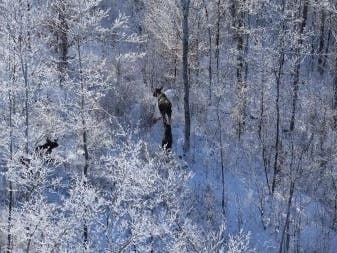
NEW YORK — Moose can't answer census questions and they live in some the most remote areas of the state, but environmentalists have a toolbox of other means to track the elusive beasts.
The New York State Department of Environmental Conservation (NYSDEC) announced the preliminary results of the second year of a moose research project in the Adirondack region. This year, 19 moose were fitted with GPS collars as part of a project assessing moose health and population.
The NYSDEC partnered with researchers at the New York Cooperative Fish and Wildlife Research Unit and the College of Veterinary Medicine at Cornell University, the State University of New York College of Environmental Science and Forestry (SUNY ESF), and Native Range Capture Services to safely capture, collar and collect biometric data on the 19 sample moose.
Find out what's happening in Bedford-Katonahfor free with the latest updates from Patch.
"Each year of this valuable research increases our understanding of New York's moose population and its vital role in our State's biodiversity," NYSDEC Commissioner Basil Seggos said in a statement announcing the second year of the project."The data collected through DEC's research partnership with Cornell, SUNY ESF, and Native Range Capture Services helps us understand the health of our moose and allows us to make evidence-based management decisions to support this treasured species in the future."
SEE ALSO: Have You Caught A Glimpse Of The Hudson Valley Moose On The Loose?
Find out what's happening in Bedford-Katonahfor free with the latest updates from Patch.
NYSDEC officials said the GPS collars will continue to provide location data and information on moose activity, patterns, movements and mortality. Data collected as part of this research effort will contribute directly to the continued management of moose in New York.
The agency said previous moose research in the Adirondacks has helped researchers better understand adult moose survival and reproduction, but little is known about calf survival and dispersal in New York. By collaring calves and monitoring their survival to adulthood, biologists will be able to investigate factors limiting moose population growth, such as the effects of parasites on juvenile moose survival. These parasites, including winter ticks, brain worm, giant liver fluke and associated diseases, have increasingly become a management concern in the Northeast and elsewhere.
"There are multiple stressors in New York that might be limiting moose population growth," Cornell University Professor and U.S. Geological Survey New York Cooperative Fish and Wildlife Research Unit Leader Angela Fuller explained. "Our research team includes wildlife and disease ecologists and wildlife managers, working closely to better understand the role that parasites might be playing in limiting moose populations. The recent moose collaring effort will allow us to estimate calf survival and better understand moose health."
The cooperative research project is funded by a Federal Aid in Wildlife Restoration grant through the U.S. Fish and Wildlife Service. These funds are collected through federal excise taxes on firearms, ammunition and archery equipment, and then apportioned to states for wildlife conservation.
This year's research also included sampling white-tailed deer pellets and water sources to detect and better understand the prevalence and distribution of brain worm and giant liver fluke across the landscape. Larvae from these parasites are found in deer scat, where they are picked up by snails and then incidentally consumed by moose as they forage on plants, the NYSDEC said.
Trail cameras were deployed by environmental officials in the fall of 2021 to determine range overlap between deer and moose and to monitor hair loss on moose infested with winter ticks.
"The opportunity to capture and sample live moose provides us with a ton of valuable information about moose health," Wildlife Disease Ecologist and Director of the Cornell Wildlife Health Lab Krysten Schuler said. "Unfortunately, we are seeing more evidence of parasites, like winter ticks and liver flukes, on the young moose, but this study allows us to identify management options for these problems."
For additional information about moose biology, current research, or to report moose sightings, visit NYSDEC's website.
Get more local news delivered straight to your inbox. Sign up for free Patch newsletters and alerts.