Politics & Government
Splash Car Wash, Rippowam Wait (Again) Till Next Month
Bedford zoning board hears land-use proposals (again) but delays formal action until December.
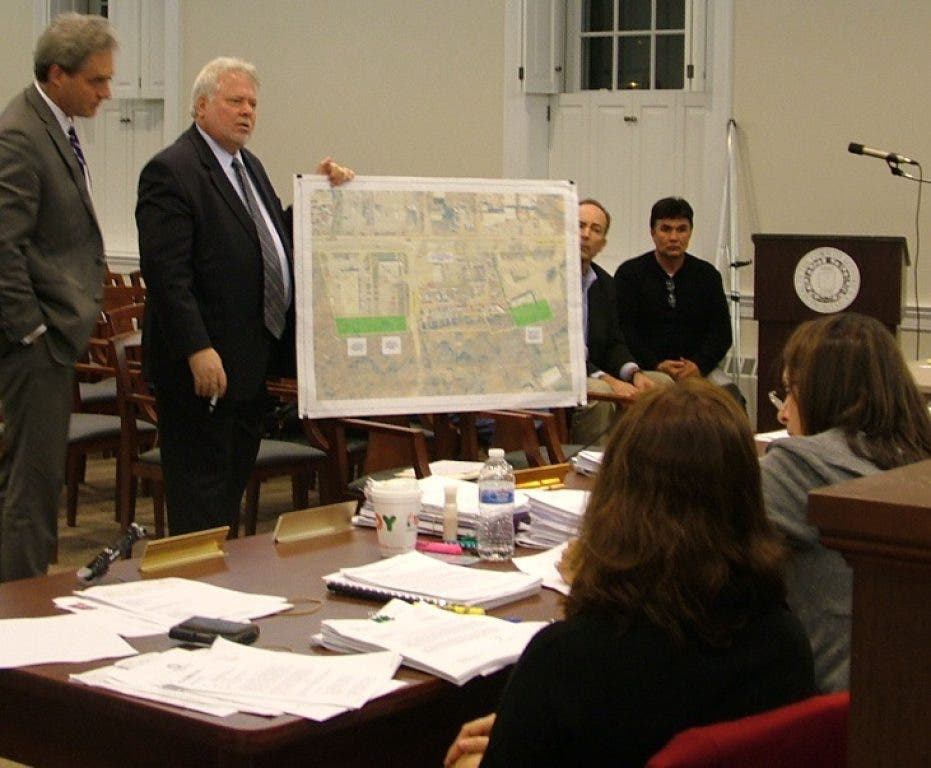


Tantalyzingly, closure appeared within reach Wednesday night for a pair of long-running Bedford land-use issues. But after hours of sometimes testy exchanges, both the Rippowam Cisqua School and Splash Car Wash wound up ticketed instead for separate return appearances next month before the zoning board of appeals.
By that time, well past midnight, Rippowam had at least won informal, conditional approval of its quest to modify the special-use permit allowing the exclusive private school to carve out additional space for athletics off Clinton Road.
But Splash, now in its third year before Bedford regulatory panels, not only failed to gain four expected variances but also raised new issues, with roots in zoning statutes going back a half-century or more.
Find out what's happening in Bedford-Katonahfor free with the latest updates from Patch.
Rippowam Cisqua School
Rippowam representatives, led by Mount Kisco land-use lawyer John Marwell, will come back Dec. 5, when the zoning board is next scheduled to meet. By then, Town Attorney Joel Sachs is expected to have in place a final resolution spelling out the conditions under which the board will vote on the school’s special-use permit.
Find out what's happening in Bedford-Katonahfor free with the latest updates from Patch.
Unlike this summer’s marathon Rippowam public hearing, when neighbors’ concerns that irrigating the fields with dozens of pop-up sprinkler heads could impact nearby water wells, Wednesday’s discussion centered on just how many youngsters now play at the athletic complex.
Marwell and ZBA member Meredith Black, herself a land-use lawyer with the White Plains firm Zarin & Steinmetz, locked up in protracted debate over what each described as the fields’ “intensity of use.”
“This board is looking to establish a baseline [of current use],” Black said. Such a number was meant not to restrict the number of players permitted to play today, she said, but only to measure their growth in number in the future. “I don’t believe that that penalizes the applicant in any way,” Black insisted.
Marwell, for his part, questioned not only the board’s authority to establish a baseline but also its ability to accurately measure the fields’ current use, either by students or outside groups desperate for field space.
“Some would say the entire community needs more play fields,” Marwell told the board.
Splash Car Wash
Despite almost 2½ years of regulatory oversight, the Splash application, was in deep water almost immediately, and that was just over fundamental qualifications for a variance. Separate requests sought 1) a special-use permit, allowing a car wash on the site, and 2) three variances permitting the car wash to skirt zoning restrictions on parking and an acoustic barrier fence.
While board members Wednesday wrestled with a number of variance issues, one of them—the use permit—highlighted the especially tricky terrain land-use codes must navigate.
In granting variances, municipalities officially turn a blind eye to a zoning violation to avoid unduly penalizing the property’s owner.
For example, the proposed Splash site, onetime home of the Bedford Hills Carvel stand, contains a 50-foot strip of land separating commercially zoned property along Route 117 from the homes farther up Valerio Court. Zoned, however, for residential use, the buffer strip is virtually worthless unless the ZBA gives permission for its commercial use.
Splash’s bid for a so-called “use” variance, allowing the commercial car wash on residential property, was widely seen as a slam dunk. But a hardship, Bedford’s code makes clear, cannot be “self-imposed”: Somebody who knowingly acquires a piece of economically valueless land cannot then assert that fact to justify a variance.
When Town Attorney Sachs pointed out this requirement—and the board’s explicit duty to deny a use variance if it finds that’s the case here—he set off a scramble to learn a) when did the current owners acquire the property and b) what was its zoning at that time.
As it turns out, the proposed Splash site—570 Bedford Road, where it meets Valerio Court—has been in the Martabano family since the 1950s, with pieces of the land handed down over the years to multiple family members. And in the seeming serendipity of small towns, Splash’s lawyer is Charles Valerio Martabano, a Mount Kisco attorney for more than three decades.
“Valerio Court is named after my grandfather,” he told the board as the long evening’s proceedings slid toward a post-midnight dénouement.
Shortly thereafter, Board Chairman David A. Menken adjourned the meeting, which had started ay 7:30, to a special day, Dec. 3, when Splash will be the sole topic on the ZBA agenda. By then, town officials plan to pin down, in Sachs’ words, “the first Martabano entity to acquire the property, and in what year,” and the zoning in existence at the time.
Related stories:
Letter to the Editor: New Car Wash Site Presents Dangers
ZBA Postpones Action on Car Wash Variances