Politics & Government
Town Tackling Two New Ways to Toss Things Out
Single-stream recycling and competitively bid garbage contracts would mark major shift in pickups.
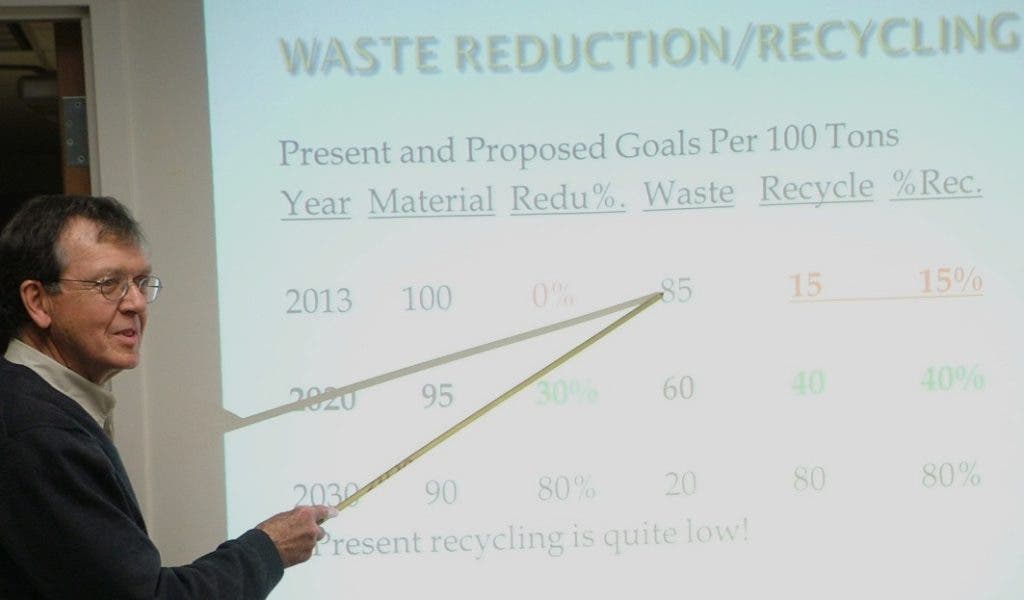
Bedford lawmakers are looking to improve how the town throws things away, at home and in business.
Chief among the changes being considered are simplified recycling and town-controlled—perhaps less costly—garbage-pickup routes. Nothing has been decided and the town board is continuing its discussions, Supervisor Lee V.A. Roberts emphasizes.
Still, as a work session last week made clear, officials are considering two moves that could markedly change the way homeowners and shopkeepers recycle and put out their trash for collection.
Find out what's happening in Bedford-Katonahfor free with the latest updates from Patch.
The first initiative, single-stream recycling, would end the need to separate, say, one type of plastic from another, or glass from paper. “Everything would be dumped in together and pulled apart at the transfer station,” Roberts said.
In the second major move, contract carting, homeowners and others would no longer have to arrange individually with pivate carters for garbage pickup. Instead, officials would map collection routes throughout the town, then open them to competitive bidding by the carting firms. Though the town would bill for the collections on the property owners' real-estate-tax bill, the charge would appear as a separate fee, not a tax.
Find out what's happening in Bedford-Katonahfor free with the latest updates from Patch.
Mergers and acquisitions in the sharply competitive carting business are seen as helping to clear the way for change. “In Bedford, the smaller mom-and-pop carting firms have been swallowed up by two major outfits,” Roberts pointed out. The two, County Waste Management Inc. in Harrison and City Carting Inc. of Stamford, now do most of the pickups in Bedford. “In the past, people were attached to their [small] private carters,” Roberts said. “Now, we’re thinking that’s no longer an issue—because there aren’t any.”
By subjecting the garbage pickups to competitive bidding, Roberts said, “we . . . think that we could save people money.” The supervisor views such savings as a potential selling point for the program. “If we can cut your bill in half,” she said, “it might be attractive.”
In a bidding scenario, the town could also stipulate “other amenities that we might want to require from the successful bidder,” she said, citing bulk-trash pickups as an example.
Another potential money-saver might be found in a “pay-as-you-throw” option that varies a homeowner’s weekly charge on a sliding scale, based on the amount of trash being collected.
On the second front, pickup is free for recyclable materials, which generate a modest (Roberts puts the figure at $1,100 per month) revenue stream for the town. Nevertheless, compliance with recycling requirements—no, they’re not voluntary—could be better, officials acknowledge. Single-stream recycling is seen as a way to achieve that.
“With one big container, you don’t have to worry about your glass and aluminum, your papers. They’d all go in one [container], and only the garbage part would be separate,” Roberts said. “You wouldn’t have much excuse for not recycling.”
Calling single-stream “the wave of the future,” she said, “It’s done all over; we’re really behind.”
Eventually, Roberts predicted, “we will all go to single-stream recycling.”