Politics & Government
What Brooklyn Democrats’ Power Fight Could Mean
A guide to how Brooklyn's Democratic Party works, who controls it and what could change next.


BROOKLYN— For much of the 20th century, powerful Democratic organizations controlled much of Brooklyn politics. They helped candidates win elections, brought voters to the polls and helped people get political jobs.
The system could work well for the people inside it.
A strong organization could find candidates, organize voters and help elected officials work together.
Find out what's happening in Brooklynfor free with the latest updates from Patch.
But the system also created a problem for some. The people who controlled the organization could have a lot of influence over who received political opportunities.
Reform groups then entered the June primary with a goal: win enough district leader seats to control the party’s 42-member executive committee.
Find out what's happening in Brooklynfor free with the latest updates from Patch.
Eight of nine reform-backed candidates won contested races, while 14 more reform-aligned leaders kept their seats without opposition.
The results gave reformers what appeared to be a majority.
“We’ve seen for many, many years under different party leadership, the same culture of corruption, the same pay to play and a party that has just not been effective," Tony Melone, president of New Kings Democrats, told NY1.
So when Brooklyn voters chose district leaders in June, they did more than pick local party representatives. They also helped decide who would vote on the next leader of the Brooklyn Democratic Party.
But, current party leader Assembly Member Rodneyse Bichotte Hermelyn challenged the reformers’ vote count during her NY1 interview.
“I am not convinced that the opposition or the so-called reformers have 22 votes,” Bichotte Hermelyn, who represents parts of Flatbush, Little Haiti, and South Midwood, said in a NY1 interview.
She wants to expand the group of people who will vote for the next party leader.
Right now, 42 people can vote on the executive committee.
Bichotte Hermelyn wants to raise the number to more than 68.
She has led the Brooklyn Democratic Party for six years.
“We're looking to open the political structure because many members across Brooklyn have asked to have more voices, more representation, more ideas, and I have listened to that,” Bichotte Hermelyn said.
What Is The Brooklyn Democratic Party?
The Brooklyn Democratic Party does not mean all the Democratic politicians who represent Brooklyn.
The official organization has the name Kings County Democratic County Committee.
New York law requires political parties to have county committees.
The county committee includes Democrats elected from small areas called election districts. Some districts cover only a few blocks.
On paper, this setup gives regular voters a way to take part in the party.
Brooklyn has about 1.2 million registered Democrats, according to the Brooklyn Democratic Party. The county committee has thousands of possible seats, although many seats have stayed empty.
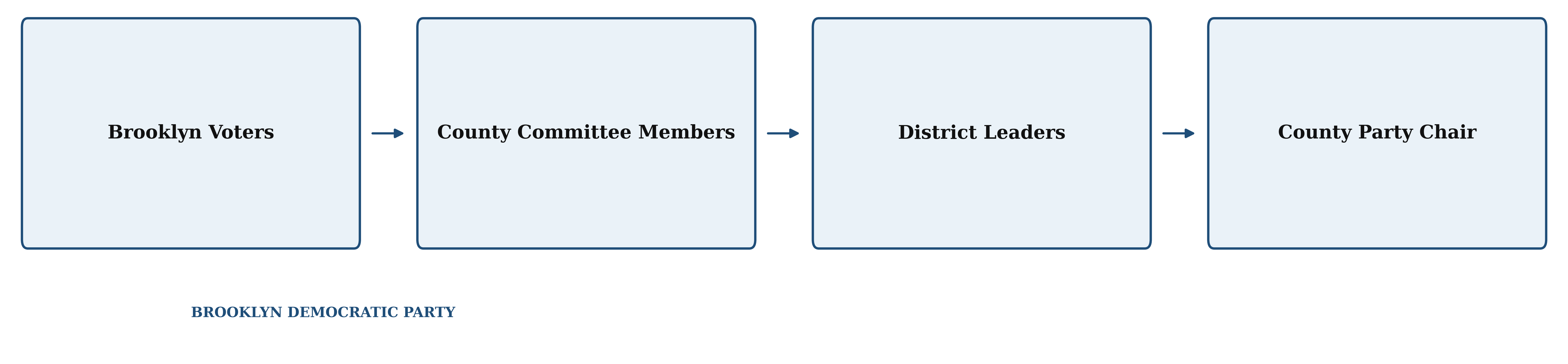
The basic structure looks like this:
- Brooklyn voters
- County committee members
- District leaders
- County party chair
So What Does A District Leader Do?
A district leader serves as an elected, unpaid party official.
Brooklyn has 21 Assembly districts. Each Assembly district has two district leader positions. When every seat has someone in it, Brooklyn has 42 district leaders.
District leaders also serve on the New York State Democratic Committee. Voters may see their names on the ballot under the title “State Committee Member.”
District leaders can help organize Democrats in their neighborhoods: recruit volunteers, organize local meetings, reach out to voters and connect neighborhood Democrats with candidates and party officials.
They can take part in choosing judicial candidates and help shape party rules.
Most important for the current fight, they help choose the county party chair.
The Brooklyn Democratic Party describes district leaders as members of the county party’s executive committee.
Why Does The County Chair Matter?
People often call the county chair the “Brooklyn Democratic Party boss.”
The title can make the job sound more powerful than it really is. Still, the chair sits at the center of Brooklyn's Democratic organization.
The county party can influence candidate selection, party endorsements, judicial nominations and party rules. It also helps organize Democrats across Brooklyn.
Brooklyn ranks among the strongest Democratic areas in the country.
Brooklyn's Democratic Party can help candidates win elections by endorsing them, connecting them with volunteers and local party activists, supporting their campaigns and sometimes helping determine who gets the Democratic nomination.
The borough also serves as a political base for some of New York City and New York State’s most powerful Democrats.
The party’s influence has changed over time, but one part of the system has stayed in place: a relatively small group of district leaders plays a major role in choosing the party chair.
Julio Peña III, one of Bichotte Hermelyn’s opponents, said he had gathered enough support to replace her.
If all 22 people stayed together, they could elect a new chair.
But political votes rarely work so simply.
District leaders can negotiate. They can change their minds. They can back different candidates. They can make agreements about the party’s future.
Bichotte Hermelyn argued that the final vote would not happen until the organizational meeting. Members could change their positions before then.
“In this party, people reserve their votes until the very last day, which is the election day,” she said.
Then Bichotte Hermelyn Proposed A Much Bigger Committee
Her proposal would give 26 county committee executive officers voting rights. She also wants to expand Assembly district committees and add delegates chosen by members in those districts.
The plan could create an executive committee with more than 68 voting members.
Bichotte Hermelyn argued that Brooklyn has too many Democrats to let only 42 people make major party decisions.
“We only have 42 district leaders who are making decisions for 1.2 million Democrats,” she said during the NY1 interview.
She compared Brooklyn with other counties whose executive committees include more members compared with their populations.
She argued that her plan would give more county committee members and neighborhood representatives a voice.
Why Are Reformers Angry About The Expansion?
The timing creates the biggest dispute.
Reformers just won enough district leader races to appear capable of taking control of the existing 42-member executive committee.
Now the committee could grow by more than two dozen voting members before the group chooses the next county chair.
The change does not automatically mean Bichotte Hermelyn will win.
But it changes the math.
"Obviously we have a majority of a coalition, but we want this to be a much broader coalition of folks and really ensure we are turning the page and building a new Democratic Party,” Peña said.
What Happens Next?
The next major step will come during the party’s organizational process, expected in late September or early October.
Until then, reformers must keep their coalition together and agree on a candidate for county chair.
Bichotte Hermelyn has not said whether she will seek another term, while the party must decide who gets voting rights on the expanded executive committee.
Get more local news delivered straight to your inbox. Sign up for free Patch newsletters and alerts.