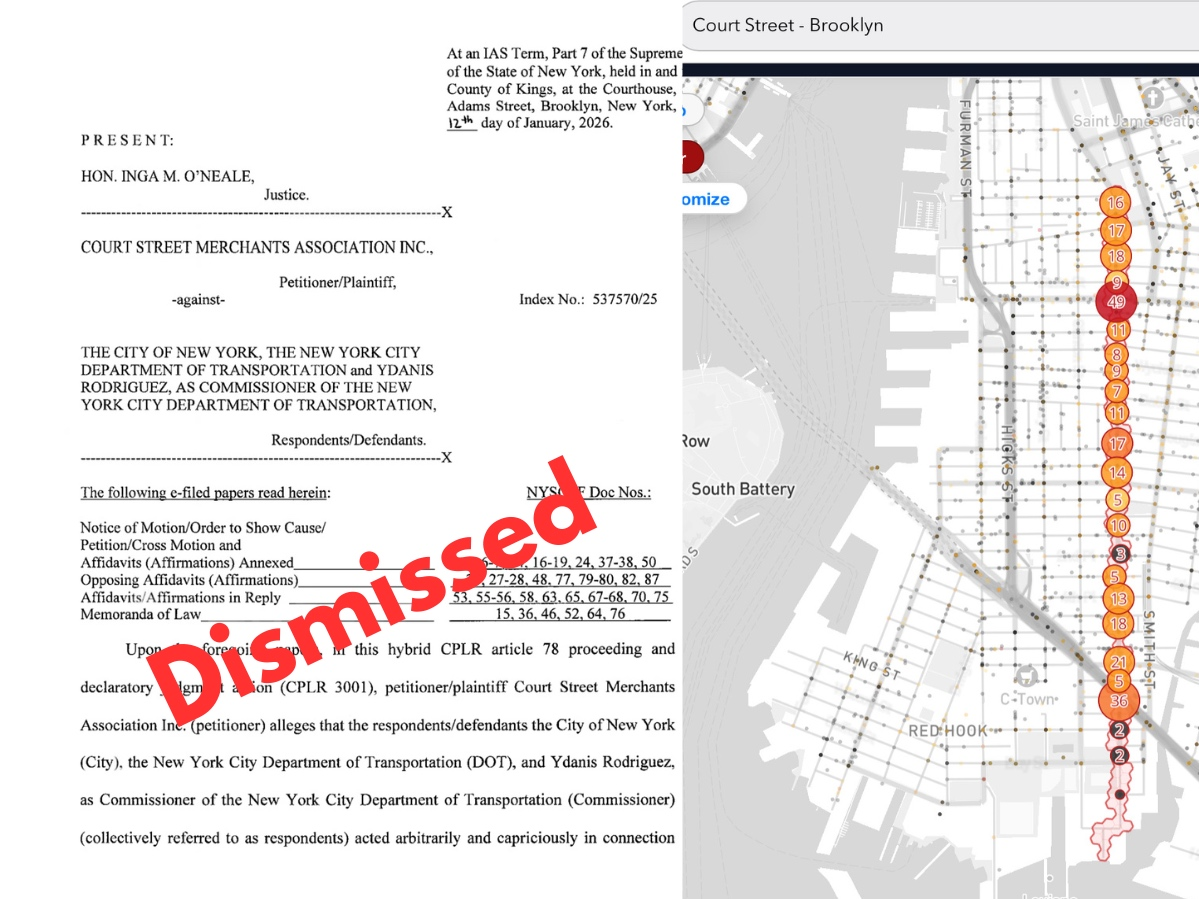
Last week, a Brooklyn Supreme Court judge, Inga O ‘ Neale, ruled that the New York City Department of Transportation acted on a rational basis, in pursuit of safety, under state law, and dismissed the lawsuit seeking to block the Court Street bike lane. She made clear that decisions about how city streets are used are policy questions for elected and accountable officials, not the courts. If opponents want different outcomes, the remedy is not litigation; it is electoral change.
The Court Street bike lane has drawn significant attention in my district over the past few months, leading some to describe it as a “controversy.” That framing gives volume more credit than it deserves. What has actually occurred is a sustained discussion, not a divided outcome. Despite the noise, and even with higher-than-usual attendance at our meetings, Brooklyn Community Board 6 approved the bike lane unanimously last year.
The judge dismissed opponents’ concerns as anecdotal, lacking data or context. Policy decisions like this are implemented because they, to a certain degree, reflect election results. Decisions about shared infrastructure belong to those accountable to the public, whether directly through elections or by appointment by those elected, not to whoever can dominate a meeting room or a courtroom.
Find out what's happening in Brooklynfor free with the latest updates from Patch.
Safe streets are not a luxury or a preference. They are a public safety imperative, and the data support the construction of protected bike lanes to achieve that goal. If you want to see where additional safety measures,such as protected bike lanes, are needed, visit crashcountnyc.com.
As opposition to the Court Street bike lane grew louder, supporters of the bike lane were often described as out of touch with the district, even though the facts suggest otherwise. The election results tell a different story. Roughly 75 percent of the district voted for the most pro-bike-lane mayoral candidate in the city’s history. Calling that outcome “out of touch” is less an argument than a misunderstanding of where you are, like going to Fenway Park and insisting that people rooting for the Red Sox are out of step with the crowd.
Find out what's happening in Brooklynfor free with the latest updates from Patch.
New York City has over 8 million people. Brooklyn Community Board 6 has over 120,000 residents. Even if 200 people pack a meeting room, that represents a decimal point, not a majority. Of course, it’s easy to get confused when local media is famous for “blaming bikes”.
With the Court Street bike lane now vindicated in court, the question is no longer whether it should exist, but how well it is enforced.
Enforcement works best when responsibility aligns with expertise. For that reason, the Mamdani administration should seriously consider returning traffic enforcement to the Department of Transportation, where it lived until 1996, rather than leaving it solely with the NYPD. Streets are public infrastructure, and managing them safely requires policy, data, and design, not just punishment. That means speed cameras, expanded daylighting, and more.
The debate over the bike lane’s existence is over. What comes next is making sure that, no matter how or when we got there, we end up with a safer Court Street for everyone.