Politics & Government
Election, Engagement, Community
My experience at the community level is why I support the Office of Mass Engagement.


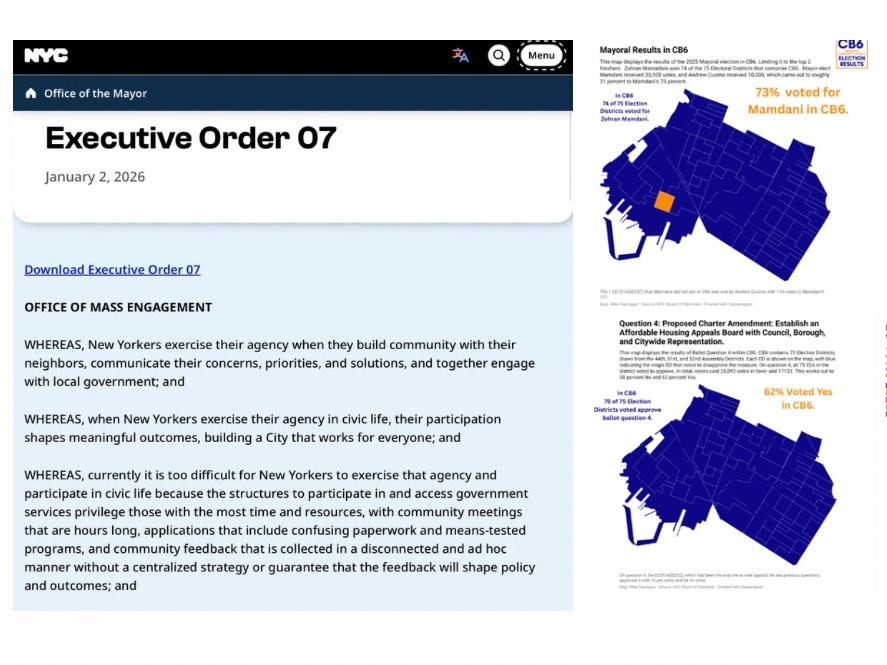
On his second day in office, Mayor Mamdani signed an executive order establishing an Office of Mass Engagement. It’s a policy shift that my experience tells me is the right move.
The order names a problem that anyone who has spent time in civic life recognizes: too often, “community” is defined by the small number of people who repeatedly show up. That is not because they care more, but because they have the time, flexibility, and familiarity with civic processes that many New Yorkers don’t. When those voices are treated as synonymous with an entire district, our understanding of the public will become distorted.
The last few months at Brooklyn Community Board 6 have illustrated this dynamic with unusual clarity.
Find out what's happening in Brooklynfor free with the latest updates from Patch.
As is often the case after elections, attendance at CB6 meetings has increased. The most consistent and unifying theme among many of the new attendees has been opposition to the Court Street bike lane. Alongside that opposition has come a recurring claim: that CB6 does not represent the district, and that “the people” oppose bike lanes, new housing, and the broader policy direction reflected in the last election.
Showing up matters. But it doesn’t confer ownership over the word “community.” As Roger Ebert famously reminded movie critics inclined to universalize their reactions, “you saw this movie!”. The same applies here. Attendance and volume reflect a point of view and a style, not a consensus.
Find out what's happening in Brooklynfor free with the latest updates from Patch.
In an election-district-level analysis I completed last November, I examined how CB6 residents actually voted. If instead the district is defined as the tens of thousands of residents who participated in the 2025 election, a very different picture emerges. In that election, Zohran Mamdani carried 74 of CB6’s 75 election districts, and the pro-housing charter amendments passed in 74 of those same 75 districts. For the most contested housing measure, support was neither narrow nor confined to a few areas. It was district-wide.
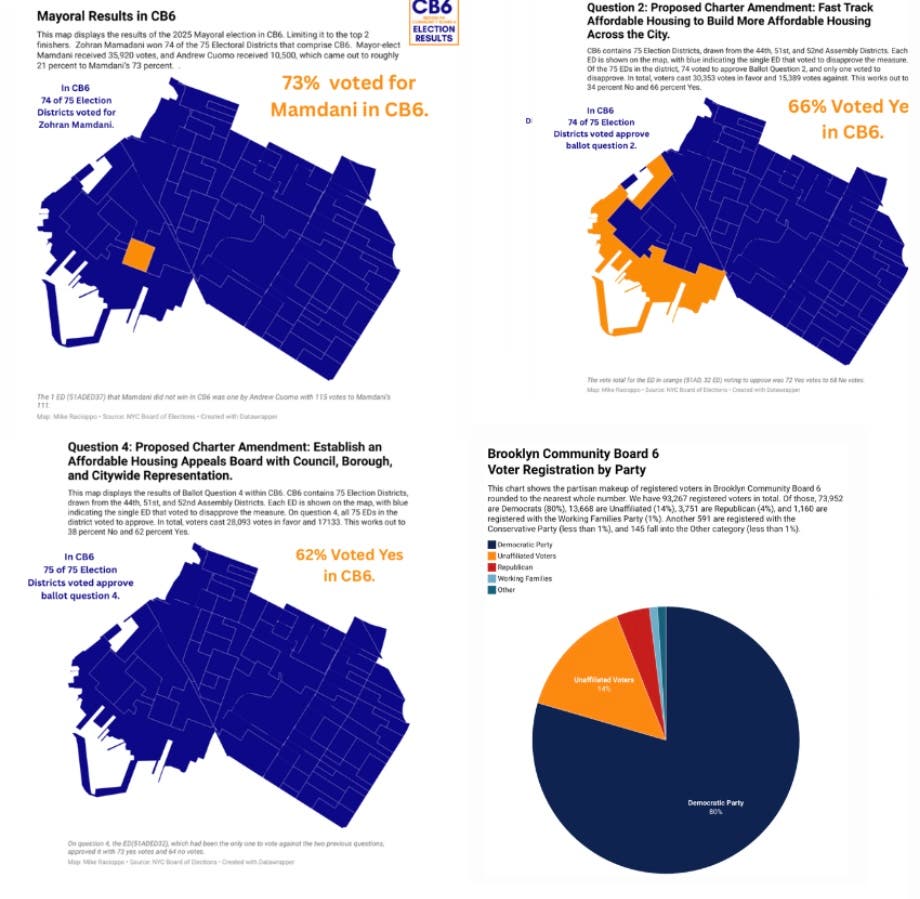
That reality stands in sharp contrast to what is often asserted at community meetings. When someone says “the people opposed this,” the data suggests a more accurate statement would often be, “I opposed this.”
This disconnect is not abstract to me. In my position, as is clear in the executive order itself, I regularly work with the offices it creates, consolidates, and oversees. The challenges it describes are the same ones I encounter in practice: fragmented engagement, feedback that is passionate but not representative, and systems that reward persistence and availability rather than broad participation.
The executive order acknowledges that our current civic structures privilege those with the most time and resources, and that engagement is too often disconnected and ad hoc. It also recognizes an essential truth: participation only builds trust when people can see how their involvement shapes outcomes. When election results are ignored or minimized in favor of whoever shows up most often, that trust erodes.
None of this is an argument against community board meetings or public testimony. Those forums matter. They surface concerns, refine policy, and provide accountability. But they are not, on their own, a representative sample of a community, especially when ballot-box turnout exceeds meeting attendance by several orders of magnitude.
What the last few months at CB6 have shown is how easily the loudest or most organized voices can come to be treated as the neighborhood’s definitive voice, even when the data tells a different story. That dynamic frustrates residents who feel unheard in meetings and alienates voters whose preferences seem to disappear once the election is over.
This is precisely why the Office of Mass Engagement matters. By centering broader, more accessible forms of participation and tying engagement to real outcomes, the city has an opportunity to align civic conversation with civic reality. Engagement should not be a test of endurance. It should reflect the full range of people living in a community, including those whose primary form of participation is voting.
Combined with the announcement of Rental Ripoff hearings in every borough, tools to protect tenants, and a call for residents to share their experiences with abusive landlords, this is exactly the kind of mass engagement the executive order envisions. It meets people where they are, focuses on real outcomes, and recognizes that engagement has to extend beyond formal meetings to be meaningful.
Taken together, the creation of the Office of Mass Engagement, the administration’s housing executive actions, and the Mayor’s willingness to show up directly, including standing in an apartment building with tenants facing real pressure, point in the same direction. They reflect a belief that governing is not just about who speaks the loudest or longest, but about meeting people where they are and acting on what the broad public has already made clear. From where I sit, that combination of mass engagement, housing action, street safety, and direct presence is not just encouraging; it could be truly transformative. It is exactly what this moment calls for.