Crime & Safety
NYC To Spray Parts Of Manhattan For West Nile Virus
Central Park, Upper West Side, Morningside Heights, Upper East Side, Harlem and Washington Heights will be sprayed with pesticide.


MANHATTAN, NY — Parts of Manhattan will be sprayed with pesticide this week as city health officials work to curb mosquitoes carrying West Nile virus as local cases tick up.
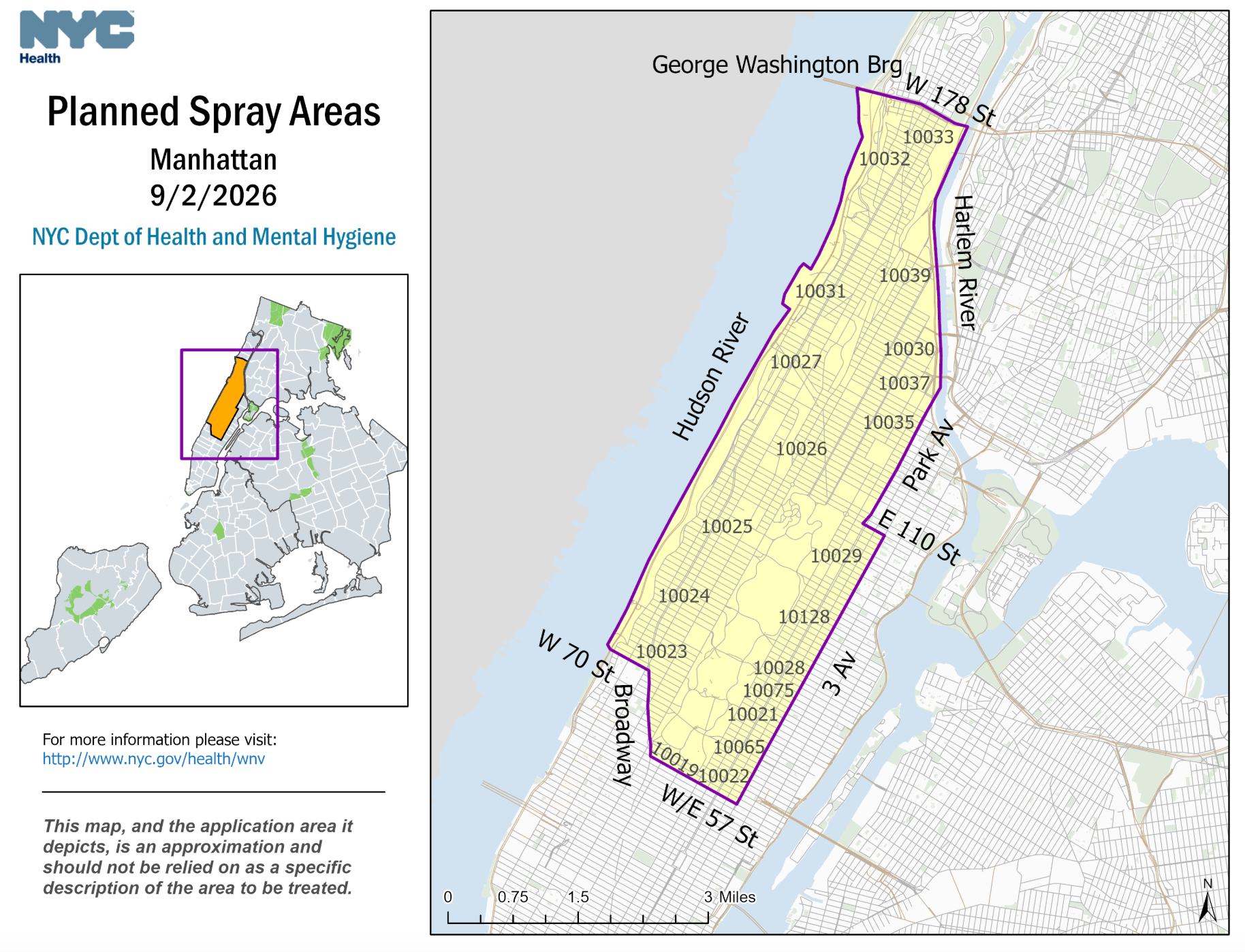
New York City Health Department officials say five people have tested positive for the virus this past month. The department's trucks will spray targeted areas of Manhattan early Wednesday morning, Sept. 2, according to the agency.
Central Park, the Upper West Side, Morningside Heights, the Upper East Side, Harlem and Washington Heights will be sprayed.
Find out what's happening in Central Parkfor free with the latest updates from Patch.
Treatment in Manhattan will begin after midnight Tuesday and continue into Wednesday morning, with spraying expected to wrap up by 6 a.m., weather permitting.
If weather prevents the spraying, the city will move the treatment to the same hours the following day.
Find out what's happening in Central Parkfor free with the latest updates from Patch.
The spraying comes after the Health Department's mosquito surveillance detected West Nile virus activity and elevated adult mosquito populations in parts of the city.
“Our surveillance gives us a neighborhood level picture of West Nile virus activity and helps us act where intervention can make a difference,” NYC Health Commissioner Dr. Alister F. Martin said.
The city will use Duet, an EPA-registered pesticide applied from truck-mounted equipment. Health officials said the risks to people and pets are low, though people who are particularly sensitive to the spray's ingredients could experience temporary eye or throat irritation or a mild rash.
People with respiratory conditions may want to stay indoors during the spraying, officials said. Air conditioners can remain on, though residents can close vents or set units to recirculate as an added precaution.
Health officials are urging New Yorkers to protect themselves from mosquito bites by using EPA-registered insect repellent, wearing long sleeves and pants in areas with high mosquito activity and making sure windows and doors have properly fitted screens.
Residents should also dump standing water from flowerpots, buckets, birdbaths, gutters and other containers where mosquitoes can breed, officials said. Standing water can be reported to 311.
For questions, email Miranda.Levingston@Patch.com.
Get more local news delivered straight to your inbox. Sign up for free Patch newsletters and alerts.