Arts & Entertainment
Hair Sanctuary at Socrates Sculpture Park
A space for conversation by Jenna Boldebuck, Kelly Li, and Yvonne Shortt
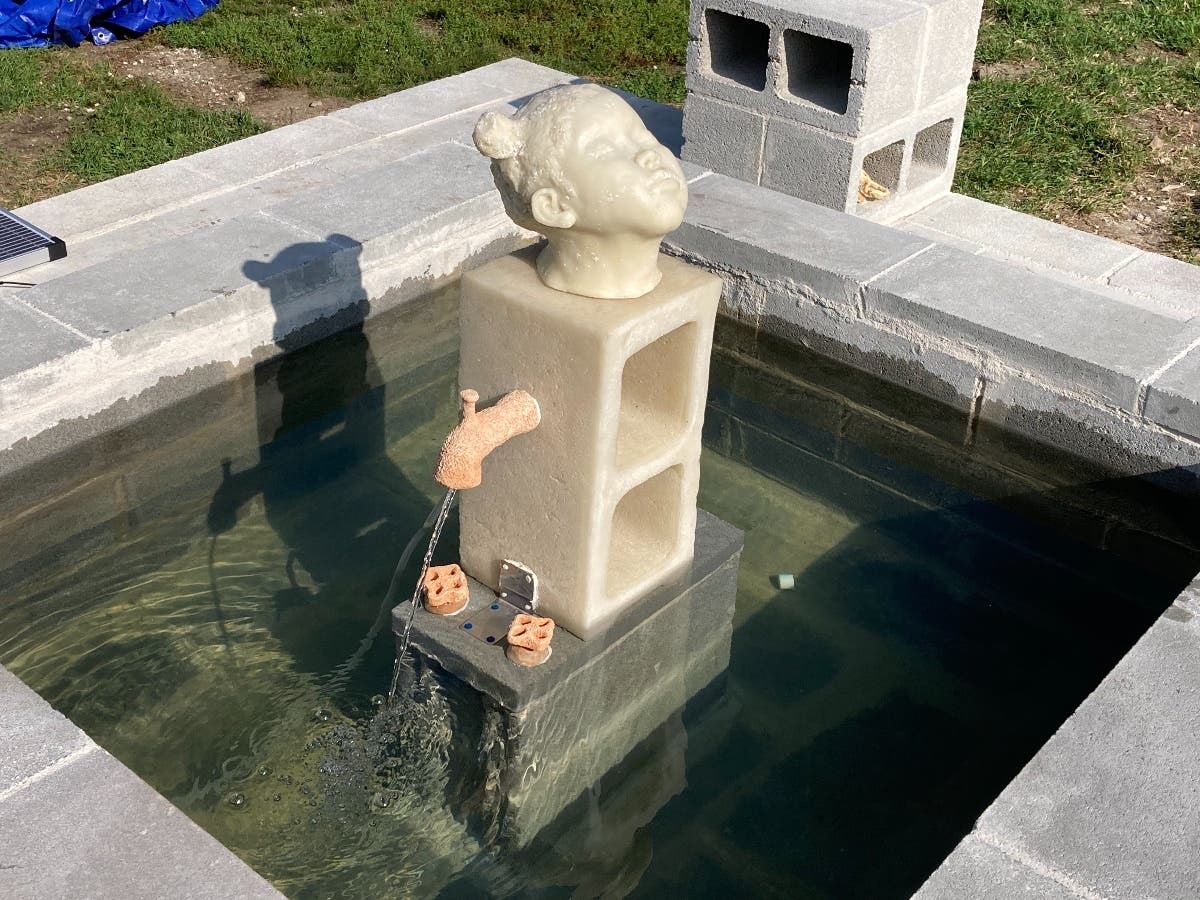


Over the last two weeks, Jenna Boldebuck, Kelly Li, and Yvonne Shortt have been busy installing a new art piece at Socrates Sculpture Park. The piece consists of three afro picks, a structure, water, audio track, and smaller sculptures. The title of the piece is African American Marbleization: An Act of Civil Disobedience; Hair Sanctuary.
As one approaches the installation, there are three six foot afro picks. Each pick has a handle made of a porcelain & wood, and pick teeth welded in metal. According to Ms. Shortt, the picks were inspired by picks originating centuries ago. The picks form a half circle around a structure. The structure has a head and cinder block cast in resin and marble dust in the center with seating plus a water element. The structure is created using cinder blocks to represent everyday materials. Inside the cinder blocks are objects ranging from a slipper to braids. Sitting on the structure are other porcelain sculptures including a mask, protective braid, and hair products.
On the side of the structure surrounding the picks is a QR code to listen to stories recorded by many in the community about hair. "I recorded a story because I wanted people to hear from me that hair is a matter of life and death," said one person who recorded a story but preferred to stay anonymous. At first, one might not scan the QR code, instead deciding to take in the piece and interpret it for themselves. "That is great, but not to listen to the stories is a mistake," said Ms. Shortt. "I want you to hear these stories and record your own." The stories discuss everything from hair loss to freedom.
Find out what's happening in Forest Hillsfor free with the latest updates from Patch.
This fall Ms. Shortt will be a visiting artist at Marymount Manhattan College where she will discuss the piece and work with students and professors to create more work for the installation. Ms. Shortt will also lead a class in the spring where she will create public art with the students to go on campus. Ms. Shortt currently has two pieces on Marymount Manhattan Campus. and six afro picks on Queens College Campus.
On Queens College Campus, Ms. Shortt is also trying to create a framework to work with students. "I'm hopeful we can figure out a framework at Queens College because it's important that next year the handle I created comes down and a new handle created in collaboration with the students goes up on the pick teeth," said Ms. Shortt. She believes public art should be about community narratives. Ms. Shortt also believes that ideas change and so should public art.
Find out what's happening in Forest Hillsfor free with the latest updates from Patch.
The shape of Ms. Shortt's afro picks are not the shape of those one sees for purchase in most stores in the United States. According to research, afro picks originated over 5500 years ago in Egypt, and were documented as coming to the U.S. during the 1950's and 1960's. It was at this time that the wood carved and stone chiseled pieces underwent change. First, the teeth were fabricated in metal for strength. Then, the wood and stone sculptures on the teeth were fabricated in plastic during the Black Power Movement. Personal narratives were substituted for an iconic Black Power narrative.
Ms. Shortt, Li, and Boldebuck are using picks as a way to bring personal narratives back to communities. They are also using architecture to reimagine urban spaces and to shape how conversations take place in communities.