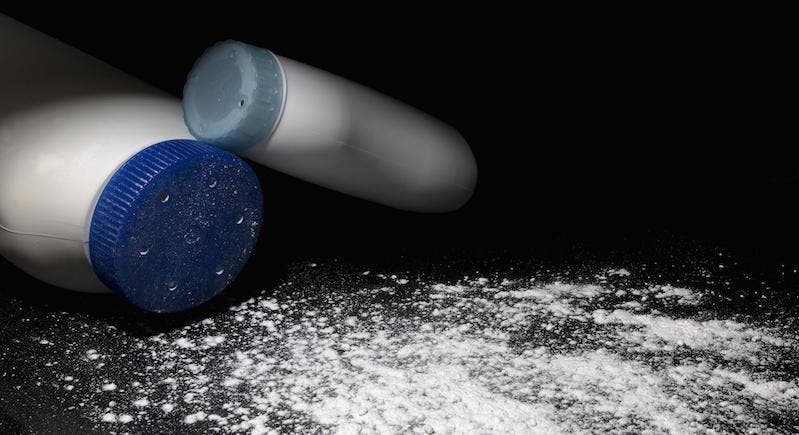
When choosing a baby powder to use on themselves – and on their infants – women should play it safe and avoid talcum.
That’s what two Northwell Health physicians – one a gynecological oncologist, the other a longtime population health expert – are saying in wake of a $72 million verdict against Johnson & Johnson in a case that linked talcum powder to ovarian cancer.
“The prudent thing to do is not to use talcum powder in the perineal region,” said Jacqueline Moline¸ MD, vice president and Chair, Occupational Medicine, Epidemiology and Prevention, Northwell Health.
Find out what's happening in Great Neckfor free with the latest updates from Patch.
“One of the tenets of occupational and environmental medicine is that if there’s a safer product, you substitute it because that eliminates the risk. In this case, the substitute is cornstarch,” Dr. Moline added.
Jill Whyte, a gynecologic oncologist at North Shore University Hospital, said she remains unconvinced that talc is linked to ovarian cancer. But she noted that considering cornstarch is such a safe alternative, baby powder users should avoid talc.
Find out what's happening in Great Neckfor free with the latest updates from Patch.
“When you put it in perspective with other known risk factors – including family history, infertility and obesity – talc’s potential to cause ovarian cancer is mild in comparison,” Dr. Whyte said. “But when my patients ask me, I tell them I don’t really see any need for women to use talcum powder and that it’s an easy enough substance to avoid. We do know that a very safe alternative is cornstarch-based powder.”
One of the tenets of occupational and environmental medicine is that if there’s a safer product, you substitute it because that eliminates the risk. In this case, the substitute is cornstarch. - Dr. Jacquline Moline.
In last week’s verdict against Johnson & Johnson, a Missouri jury concluded that the ovarian cancer that led to an 62-year-old Alabama woman’s death in October 2015 was the result of her decades-long use of the company’s talcum powder product. It became the first such case among more than 1,000 across the country where a jury ruled for a monetary award.
Dr. Moline said that there is some evidence that talc particles may enter the body through the genital tract and travel through the uterus and fallopian tubes, ultimately reaching and causing inflammation in the ovaries.
“The take home message is don’t use talcum powder, if you can avoid it,” she said. “Make sure the powder you’re using doesn’t have talc in it -- just to be safe.”
“These are long latency diseases,” Dr. Moline continued. “You don’t use the product now and develop the problem a month from now. You develop it three or four decades later.”